This is the third edition of our monthly snapshot (previous versions here and here). This is our June version of the same report, analyzing consumer activity across more than 1.5MM online product pages from more than 1,200 retail/brand sites.

This time, we focused on a three-month period (starting February 24 2020 and ending May 24 2020). Each report, we specifically analyse review submission levels, review length and sentiment, overall conversions/sales and review consumption.

We are seeing stabilization in most of the data we capture, as the market seemingly adapts to a new “normal”. Ecommerce sales volumes are still at around three times pre-pandemic levels, although there was a small increase in web traffic since our last snapshot report. The biggest change we saw was an increase in reviews submitted, which more than doubled in May alone. 

Key ecommerce market trends

01

Digital sales increase 206% between February and May, stabilizing at new high levels after climbing through April

02

Review submission levels up 2.3x from April to May, while overall consumer sentiment remains steady

03

Review content continues to be critical to converting browsers to buyers

Order transaction volumes stabilize at new high level but page visits climb

In last month’s snapshot, we reported two months of continuous and significant growth in digital consumer transactions. It was unsurprising that these surged given broader social and political conditions driven by the pandemic. But the extent of the growth (up 212% in less than two months) really underlined the huge shift that occurred.

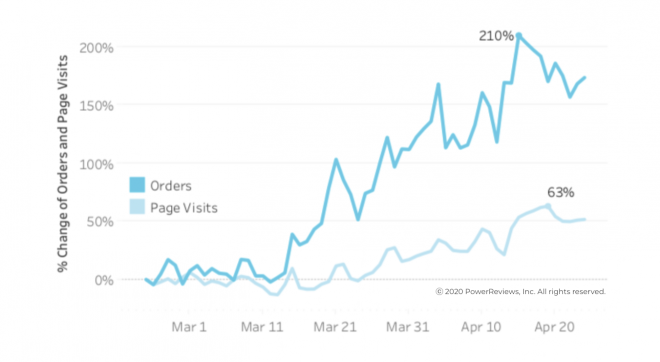
Based on what we’ve seen throughout the month of May, it seems that ecommerce is now operating in a “new normal” environment. Our data peaks towards the end of our analysis period (up 206% on May 22 in comparison to the end of February) highlighting no let-up in demand.

However, we did see a slight climb in traffic. Baselining our data at the end of February, page visits hit a peak increase of 63% in late April. This same number rose to a 79% increase on May 17. We had noted that consumers were buying rather than shopping before. This change indicates that they are becoming slightly less decisive as the pandemic continues.

We talked about channel shifting last time as consumers used to shopping in-store were forced to transition online. This slight increase in page traffic is also potentially part of this shift to a “new normal” as shoppers become more familiar with browsing online. Uncertainty around job security and income is also most likely playing a role in consumers becoming less decisive.

Traffic up, while order volumes hit a “new normal”?
Page-visits-climb-slightly-orders-remain-at-same-high-level.png

Review submission levels more than double, while review content and sentiment remains consistent

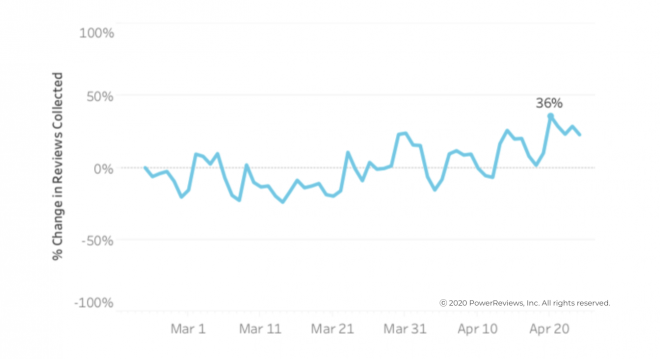
The big story when it comes to review content is that review volumes have risen significantly, up 2.3x from April to May. At the beginning of the month, review submission volumes were 81% higher than they were at the end of February. In late April, the same comparative figure was 36% – which was the peak we saw in that month.

This is to be expected to a certain extent: review submission volumes always lag behind purchases for obvious reasons (typically, consumers like to try the product a little before reviewing it). It is perhaps also a reflection of consumers not used to shopping online becoming more accustomed to doing so and adopting more typical ecommerce-driven behaviors.

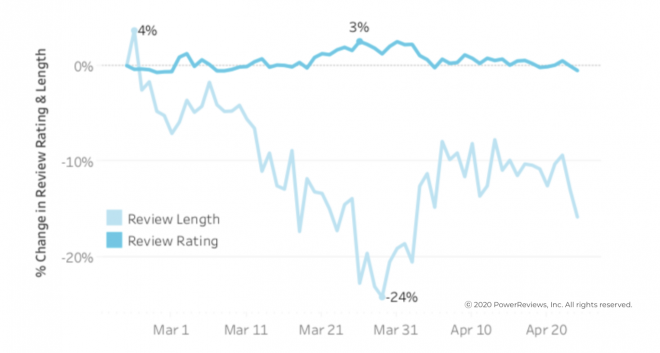
In terms of the actual content of reviews, there were not any huge shifts. Sentiment – in the form of average rating – remains flat, which makes sense given the products themselves are unlikely to have changed significantly in this period. Review length is down slightly on pre-pandemic levels but, given the average review length is 154 characters, a decrease of 10-20% is not particularly significant or meaningful.

Review volumes up 2.3x in May
Review-submission-volumes-rise-significantly-after-starting-to-climb-in-April.png
Review length stabilizes, ratings unchanged
Review-length-still-down-very-slightly-on-pre-pandemic-levels.png

Review content continues to be critical to driving purchase decisions

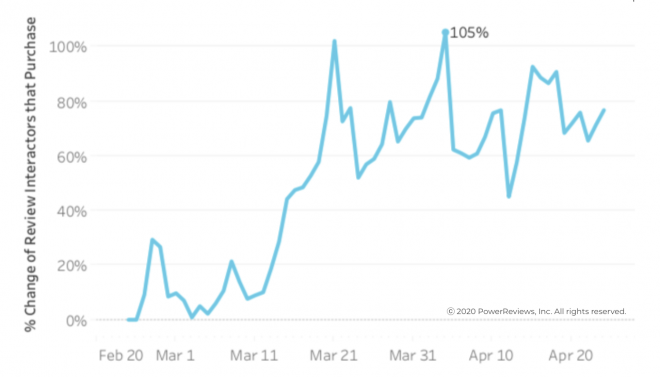
As we reported previously, reviews have become even more important in the COVID-19 era. Consumers that convert were engaging with review content (sorting, filtering etc) at as much as double the rate they were before the epidemic fully hit the U.S in April.

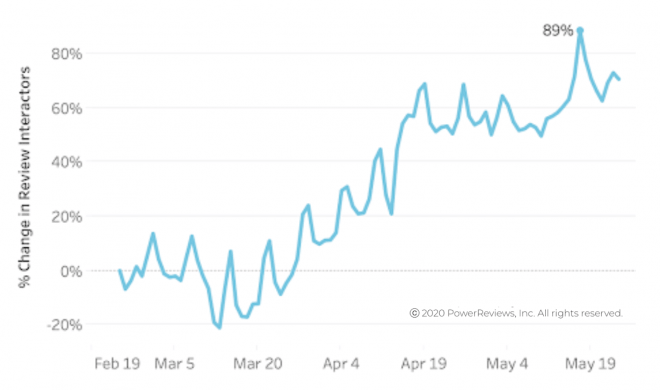
Mirroring how sales volumes have leveled off over the past month, typical review engagement was consistently 70%+ up on “typical” levels. Shoppers are still heavily relying on review content to assess product quality and make purchase decisions, as evidenced in total review interaction levels – which have increased steadily since we started capturing this data at the end of February. In May, this hit a high of 89% above end of February levels.

As we theorized last month, we believe this is most likely because low inventory levels are forcing consumers to buy products they hadn’t previously before.

Review content continues to have big impact
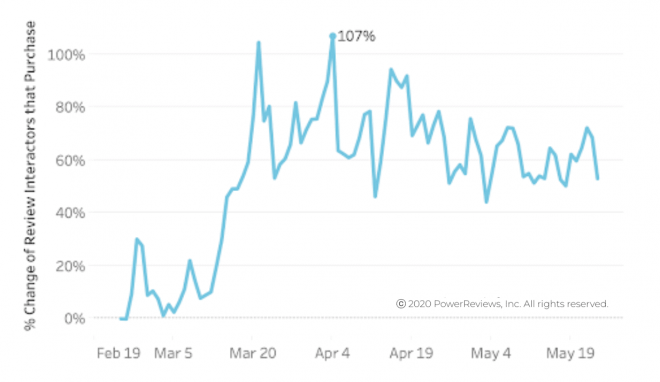
Consumers-still-relying-on-reviews-to-make-purchase-sessions-at-higher-rate-than-before-pandemic.png
Review engagement increases
Consumer-interactions-with-online-reviews-almost-doubles-compared-to-pre-pandemic-levels.png

Summary

Review submission volumes increased significantly in May, which was the biggest change in all the metrics we analyze. We actually predicted this in last month’s snapshot because we know review submissions lag behind the time of purchase. With sales levels showing no signs of declining, we would expect this figure to either climb further still or at the very least remain at its currently high level. With this being the case, this period represents an excellent opportunity to generate deep and impactful review content from your customers.

Speaking of sales volumes, they continue to consistently be at around three times pre-pandemic levels. They did not significantly decrease or increase since last month’s snapshot report. This implies normalization in the market. It’ll be very interesting to see how much of this holds once stores reopen.

Consumers continue to rely on ratings and review content to justify purchase decisions, providing the validation and social proof necessary to drive sales. Review engagement among purchasers is now at around 70% higher than more typical times and total review engagement has steadily increased in the last three months.
For a deep dive into these findings, register for our webinar on June 11.

The Perfect Review:
At a Glance

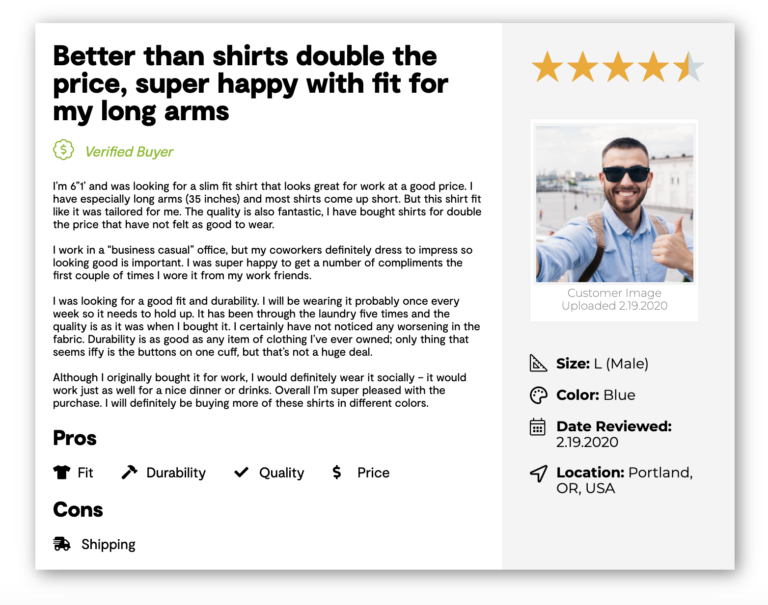
When thinking about the concept of “the perfect review,” always remember the purpose of any customer-generated content. Reviews are simply a vehicle for building trust with customers by delivering an authentic depiction of your products.

But what exactly makes a “perfect review?“

See the perfect review below, or

Informative Title
Titles need to grab shopper attention quickly.
Rating
Five star reviews are ideal but consumers value authenticity above all.
An artificially-inflated rating will only lead to distrust of your brand.
Verified Buyer
Ensures content is 100% reliable, and more valued by consumers.
Relatable Stories
Real-life accounts of use cases add value and color that is critical to the buying decision.
Length
Reviews longer than 500 characters are proven to generate a greater number of conversions.
Contextual Media
Authentic imagery and video “out in the wild” adds unrivaled credibility.
Profile Info
Specific demographic detail to make content relatable and relevant.

Get more insights in the latest PowerReviews guide:

The Ultimate Guide to the Perfect Review
and how to cultivate more of them

Impact of Reviews on Conversions

Reviews convert browsers into buyers. Learn how to leverage the best ones, and see why you’re leaving dollars on the table with inadequate reviews.

The Anatomy of a perfect review

A perfect review has a number of elements. Understand exactly what these are (including the data that proves it) by downloading this Guide.

6 Strategies to collect better reviews

Learn six strategies you can start leveraging right now to generate the best-quality reviews for any product or campaign.

Get all these insights and more...

Paige Thulin

Last month, we released our first monthly snapshot (summary here). This is our May edition of the same report, analyzing consumer activity across more than 1.5MM online product pages from more than 1,200 retail/brand sites.

This time, we focused on a two-month period (starting February 24 2020 and ending April 24 2020). We specifically looked at review submission levels, review length and sentiment, overall conversions/sales and review consumption.

Given this has been quite possibly the biggest disruption to retail and ecommerce since people started shopping online, the results continue to be extremely revealing.

The surge in online traffic and sales volumes have been well documented but the data is still breathtaking.

Key ecommerce market trends

01

Digital sales increase 210% between February and April

02

Review submission levels and length rise in April, while overall consumer sentiment remains steady

03

Review engagement up 105% between February and April

Order transactions surge as online traffic also rises

Unsurprisingly and as reported widely elsewhere, our data reveals that digital consumer transactions have surged during these times of self-quarantine and “stay at home” orders. However, the numbers are still staggering. Online sales volumes leapt 210% between February 24 and April 15. This continued the trend we saw in last month’s snapshot, when we reported an increase of 101%. That seemed a massive increase but proved to be a sign of what has subsequently followed.

While product page traffic had been relatively stable in March, this also began to climb in April. However, these increases have not been at the same rate as order volumes – meaning shoppers are becoming even more decisive as conversion rates have also continued to increase. We again attribute these trends to consumers buying lower consideration products so spending less time browsing and comparing products.

Online shopping volumes continue to climb
Traffic also begins to rise in April after staying steady through March

Review submission levels and review length increase in April, while average rating steady

After initially staying relatively steady in March, review submission levels actually rebounded in April topping out at 36% higher on April 20 than they were at the end of February. Given the huge growth in online shopping volumes, this actually is a decline in real terms. This is possibly because much of the growth in order volumes is likely coming from consumers who typically shop offline.

In the same way, review length did increase in April from what we saw in March, but overall reviews submitted remain shorter than before the impact of COVID-19 hit fully. However, a higher volume of reviews are still being submitted right now than in more “normal” times, meaning this still represents a good opportunity for brands and retailers to generate increased CGC levels.

Sentiment – in the form of average rating – remains flat, which makes sense given the products themselves are unlikely to have changed significantly in this period.

Review volumes begin to rise steadily after initial fall
Review submission volumes rise, peaking at 36% higher on April 20 than at end of February
Review length begins to rebound after initial fall
Review length up around 10% since low at end of March but accompanying rating stable

Engagement with consumer reviews surges

Reviews become even more important in the COVID-19 era. Consumers that convert are still engaging with review content (sorting, filtering etc) at as much as double the rate they were before the epidemic fully hit the U.S.

Given our data is based on review engagement as a proportion of consumers who buy (and, as we see above, this has jumped significantly), total review engagement is way up on “normal” levels and has climbed in line with increased sales volumes.

Shoppers are heavily relying on review content to make purchase decisions, perhaps because low inventory levels are forcing them to buy products they hadn’t previously before.

Review engagement remains skyhigh
Consumer interactions with online reviews more than doubles in COVID-19 period

Summary

The big story is the sheer increase in online sales volumes over the past two months, having more than tripled in this period.

Consumers continue to rely on ratings and review content to justify purchase decisions, providing the validation and social proof necessary to drive sales. Review engagement continued to be at around double the level of more typical times and total review engagement has soared over the past two months.

Review volumes are also starting to increase, which is to be expected given review submissions lag behind time of purchase. With sales levels at such high levels, we would expect this figure to continue to climb over the next one to two months. With this being the case, this period represents an excellent opportunity to generate deep and impactful review content from your customers.

For a deep dive into these findings, including a specific look at ecommerce trends across health and beauty, view the recording of our webinar.

Stay up-to-date on the latest data and insights.

Over the last month, we’ve been analyzing consumer activity across more than 1.5MM online product pages from more than 1,200 retail/brand sites.

Between February 24 2020 and March 24 2020, we specifically looked at review submission levels, review length and sentiment, overall conversions/sales and review consumption.

Given this has been quite possibly the most disruptive retail and ecommerce month of all time, the results are – as you can imagine – very revealing.

The surge in online traffic and sales volumes have been well documented. But what impact has COVID-19 had on rating and review trends? And what do these say about broader market trends?

Consumer review behavior:
Key trends in COVID-19 era

01

Order volume up as conversions double

02

Review submission levels and sentiment stable but review length falls

03

Review engagement doubles

Order volume and conversions are up but traffic stable

Unsurprisingly and as reported widely elsewhere, our data reveals that online purchase levels are way up on normal during these times of social distancing.

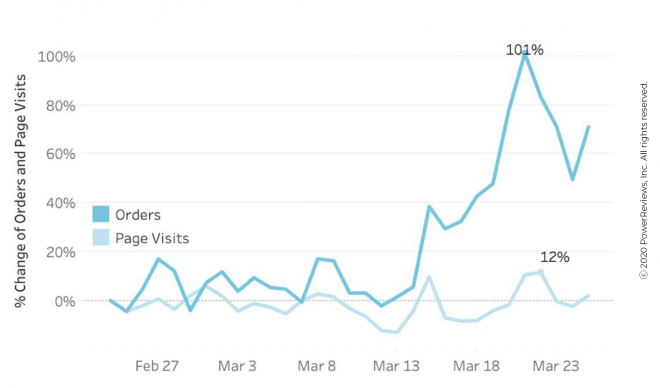
However, product page traffic has been steady – noteworthy given the perception people have been living their lives online over the past few weeks. But shoppers are being way more decisive: conversion rates on March 21 were 101% the level they were less than a month earlier. We attribute these trends to consumers buying lower consideration products so spending less time browsing. This is a time when people are focusing on things they need vs things they want (e.g toothpaste instead of a sofa upgrade).

Traffic steady but conversions skyrocket
traffic-steady-conversions-skyrocket copy
Conversion levels peak on March 21 after doubling within a month.

Review submission levels and sentiment stable but review length shortens

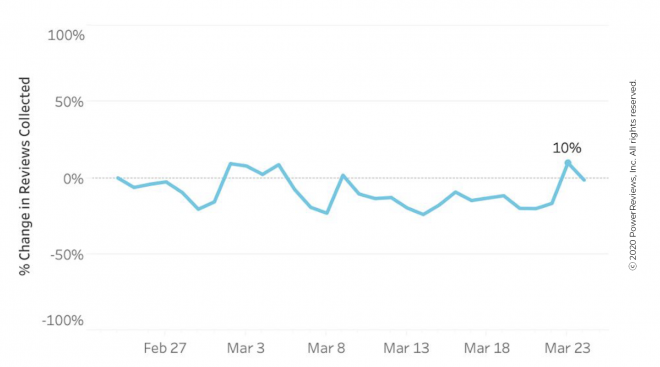
The COVID-19 pandemic has had little impact on consumer motivation to provide reviews, nor the underlying sentiment when doing so. We are not able to attribute any variation in either submission levels or overall ratings accompanying each review.

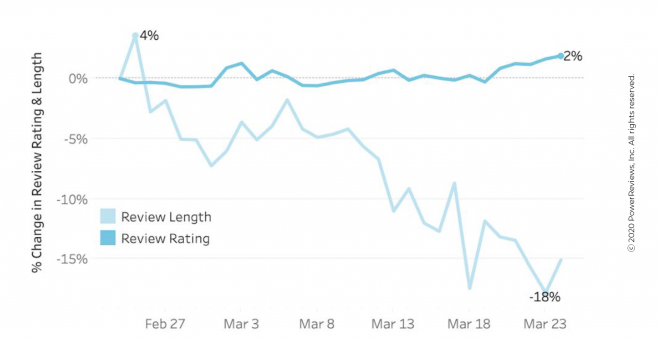
However, we did notice a significant difference in review length – with a 22% fall between February 24 and March 22. We believe this is either because consumers do not have the time time due to increased stress and/or greater need to multitask  throughout this period.

Review volume stable
review-volume-stable copy
Shift in consumer behavior driven by COVID-19 has minimal impact on review submission levels.
Review length falls significantly but sentiment stable
review-length-falls copy
Review length down by 22% but accompanying rating steady.

Review engagement surges

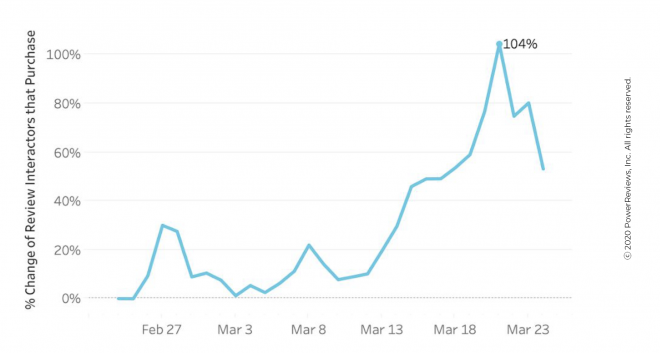
Reviews have become even more important in the COVID-19 era. Consumers are interacting with review content (sorting, filtering etc) before converting at as much as double the rate they were at the backend of February.

This is clear evidence that shoppers are now seeking significantly greater validation for their purchases, most likely because low inventory levels are forcing them to buy products they hadn’t previously before.

Review engagement increases significantly
engagement-increases copy
Consumer interactions with review content more than doubles during COVID-19 period.

Summary

Ratings and review content is having greater impact on consumer behavior in the COVID-19 era, providing the validation and social proof necessary to drive sales. According to our figures, conversions and review engagement peak within the same two day period (March 21st and 22nd 2020).

But it’s not just the fact that both these metrics increase that is significant, it’s the extent to which this is the case. Both conversions and review engagement more than doubled in less than a month.

However, review length is down in the same period. Given broader consumer trends of high conversion levels and the fact that review submission lags behind time of purchase, the next month represents an excellent opportunity to generate deep and impactful review content from your customers.


Download a copy of the research:
Stay up-to-date on the latest data and insights.

Turn every customer into an influencer

Social media influencing is at a critical inflection point: engagement rates are declining (down to 2.4% from 4% in 2016) and consumers are increasingly skeptical about content they see online.


Right now, authenticity is winning above all else, with 90% of millennials believing “authenticity” is the most important factor when choosing between brands – which is why brands are increasingly turning to “everyday influencers”. Find out why and how with our Guide.

Amazon’s Problem With Fake Reviews Doesn’t Just Hurt Them

It’s not secret–Amazon wins over ecommerce customers at nearly every step–from the initial product search to the repeat purchase. But even with it’s accolades, the ecommerce giant has its pitfalls. One area Amazon continues to feel pressure is with its rising number of fraudulent reviews.

Products flooded with fake reviews get pushed to the top of search, which has burner brands abusing consumer trust with flawless feedback. Unfortunately, Amazon’s fraudulent review content doesn’t just impact its own customers, but the entire ratings and reviews industry.

Download our eBook for insights into:

  • Amazon’s increasing number of fake reviews
  • The importance of trust and authentic customer feedback
  • How to spot fake reviews and moderate content
  • How PowerReviews moderates fake reviews and promotes authenticity

Detailed Insights from 2,000+ Shoppers

Getting shoppers to trust brands and retialers has always been a challenge for businesses. And this is especially true in the health and beauty industry where so many highly-personal products are applied to consumers’ skin or have an effect on their appearance.

What’s even more challenging is shoppers are more critical of brands – whether it’s about the ingredients, how the products are tested, or the overall quality. Consumers thoroughly investigate and research products with the help of ratings and reviews, but what else motivates them to buy, share with friends and family, or try something new?

PowerReviews conducted two online surveys of more then 2,000 U.S. health and beauty shoppers to better understand what makes these shoppers tick. In this study, you’ll learn:

  • How shoppers research, discover and make purchases  both in-store and online
  • What drives the decision to buy new or habitual products
  • How mass retailers actually beat Amazon at repeat purchases
  • The influence of visuals from friends, family and other shoppers

Win in all channels across the omnichannel journey

The health and beauty industry is quickly changing. What was once considered “good enough” doesn’t cut it anymore. This means shoppers’ demands are even more complex. 

What’s even more challenging is the growing skepticism of brands and their products. Consumers want health and beauty products to be personalized, match their skin types and advertised specifically to them.

So, how do you go up against ecommerce giants like Amazon and keep your customers happy? It all starts with trust. 

We surveyed more than 2,000 U.S. health and beauty shoppers to understand the changing behaviors of shoppers and how to increase buyer confidence in-store and online. In this report, learn:

  • How shoppers research, discover and make purchases  both in-store and online
  • What drives the decision to buy new or habitual products
  • How mass retailers actually beat Amazon at repeat purchases
  • The influence of visuals from friends, family and other shoppers

Consumer demands and expectations keep rising, which means brands have to be on their toes 24/7. And the stress builds up if chief marketing officers can’t make every customer touchpoint solid and effective. That’s why CMOs need a successful brand manager to spot trends, uncover product insights and align campaigns across every touchpoint.

This position is vital to the success of your company and while it’s a tough job, there are ways for good brand managers to become great. In this guide, we’ll provide the five qualities CMOs look for in a great brand manager.