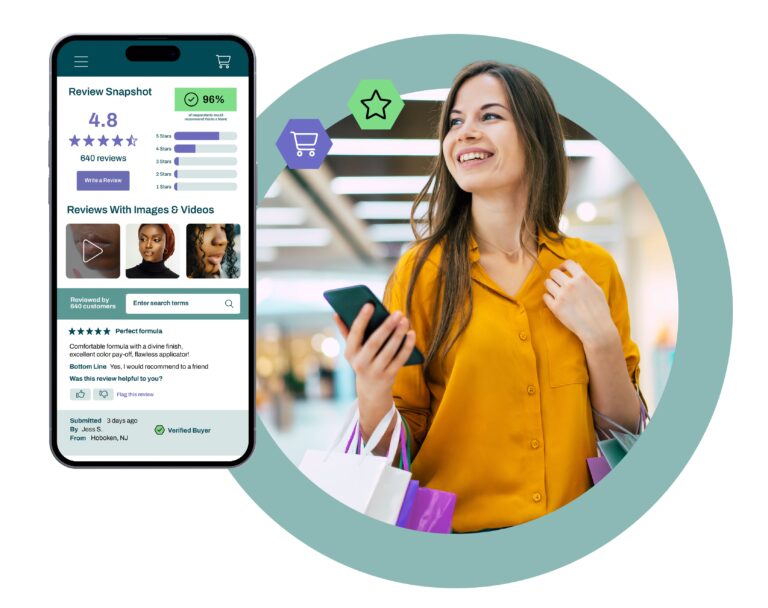




More than ⅔ of shoppers say the ability to read ratings and reviews prior to purchase decreases their likelihood to make a return.
Side Effects: Ratings & Reviews
Consult your Customer Success Team for tips to increase your daily dose of reviews.
Read the report to find out why ratings and reviews might be the cure to your return woes.

Paige Thulin

PowerReviews rounds out 1WorldSync’s product-content offerings, making it the only provider to help brands and retailers orchestrate all e-commerce product content 

CHICAGO, August 22, 2023 — 1WorldSync®, the Chicago-based technology company providing the world’s leading brands and retailers with critical product information to help consumers make purchasing decisions, has acquired PowerReviews, a leading SaaS provider of user-generated ratings, reviews, and other content. Terms of the transaction were not disclosed. 

PowerReviews, also based in Chicago, helps over 1,000 global brands and retailers collect and syndicate user-generated content and feedback—including ratings and reviews, Q&As, videos, and social-media content—giving shoppers the confidence to make purchases. Additionally, the solution delivers actionable insights to brands and retailers to drive more traffic, increase sales and improve products and services. 

1WorldSync is the leader in “product content orchestration,” technology that helps brands and retailers manage and standardize critical, behind-the-scenes and consumer-facing content, including product descriptions and data, to boost sales online and in brick-and-mortar stores. Customers include Albertsons, Kroger, Walmart, and Amazon, among others. 

“Adding PowerReviews to our suite of technology and solutions makes 1WorldSync the only provider that can help brands and retailers orchestrate all areas of the content you see on an online product detail page (PDP),” said Steve Sivitter, CEO of 1WorldSync. “User-generated content, whether ratings and reviews, Q&A, images or videos are critical to the e-commerce shopping and buying experience. Our ability to now offer these capabilities to our more than 17,000 customers is a key addition to our capability set.”

According to PowerReviews, consumers who interact with online ratings and reviews convert to purchase (buy a product) at 108% the rate of those who don’t. Those who interact with user-generated, Q&A content convert at more than 194% the rate of those who do not. 

Specifically, PowerReviews enables organizations, such as Post Consumer Brands, L’Oreal, Albertsons Companies, Target, and Walmart to generate better-quality customer product ratings and reviews in larger volumes and then analyze and benchmark the data to optimize their UGC programs for conversion, while improving product quality and customer experience. 

“The PowerReviews team is always proactive in helping us explore new ways to reach and connect with customers,” said Whitney Conner, Director of Customer Support, Mizuno USA. “With their ease of use, fantastic support, and valuable insights, PowerReviews has been critical in improving how we provide customers with the information they need to guide them through the purchasing journey.” 

The presence of ample, quality reviews is a significant driver of e-commerce and retail sales. The 2022 1WorldSync Product Content Benchmark report found that nearly half of online shoppers will leave a PDP if the product has poor or too few reviews. The same study also found that 46% of consumers read customer reviews on their smartphone while shopping in brick-and-mortar stores. 

“Brands and retailers must constantly ask themselves if they are providing consumers the most impactful content to guide their purchasing decisions,” said Randy Mercer, Chief Product Officer at 1WorldSync. “The addition of PowerReviews to our integrated suite of capabilities is yet another way we help our customers drive higher conversions and lower returns.” 

To learn more about 1WorldSync’s Product Content Orchestration solutions, or about PowerReviews, please visit www.1worldsync.com and www.powerreviews.com. 


About 1WorldSync 
1WorldSync® is the leader in Product Content Orchestration, enabling more than 17,000 companies in over 60 countries to simplify the creation and distribution of impactful content that’s accurate, consistent, and relevant everywhere commerce happens. Through its technology platform and expert services, 1WorldSync—backed by global investment firm Battery Ventures—solves revenue-impacting product content challenges faced by leading brands and retailers in the CPG/retail, DIY, consumer electronics, healthcare, and foodservice industries. 1WorldSync is one of the only product content providers and GDSN Data Pools to achieve ISO Certification 27001. 

About PowerReviews 
PowerReviews (PowerReviews.com) is the ratings and reviews specialist doing more with UGC to grow your business. We enable you to collect and share more and better user-generated content, display it for maximum conversion impact, and analyze it to benchmark and improve product experiences. 

Media Contact 
Ryan Hunt 
rhunt@1worldsync.com
Category Benchmarks

Wondering how your UGC program stacks up? Here are benchmarks for the Footwear category:

Avg. Review Coverage
0 %
Avg. Reviews/Product
0
Avg. Rating
0
Avg. Review Length
0
Avg. Media Coverage
0 %
Avg. Media/Product
0
Avg. Prod Question Coverage
0 %
Avg. Questions/Product
0

Methodology: Analysis of lifetime Ratings and Reviews submitted across 25.4MM+ online product pages on 3,600+ brand and retailer sites as of March 6, 2023

Best Practices

Not quite there yet? Check out some of our best practices to learn about how you can level up your UGC program.

Learn more about how PowerReviews can help you do more with UGC

What You Need to Know in Under 5 Mins

A major challenge for CPG brands is determining how to stand out among their competitors on the digital shelf. Understanding what it takes in your category is a critical element to success. 

With ratings and reviews being the single-most important factor impacting purchase decisions, user-generated content can be the key to unlocking ecommerce success — particularly in a crowded category like CPG.

Got 5 minutes? Perfect. Watch the video below or read on to learn what you need to know about ratings and reviews for the CPG category.

Review Benchmarks: CPG

The following benchmarks come from an analysis of product pages on PowerReviews client sites in the CPG category. We chose these benchmarks because they speak to both review quantity and quality – the two things brands should focus on to deliver a high impact UGC strategy. 

80.8%

Review Coverage

4.6

Average Star Rating

201

Average Review Length

235

Reviews per Product

30.3%

Average Media Coverage

Review Coverage = 80.8%

80.8% of the CPG products we analyzed have at least 1 review. This positions CPG brands ahead of many other verticals, but given the conversion lift of having just 1 review (see the next section), it is critical that brands strive to collect reviews for all the products on their site.

Average Star Rating = 4.6 stars

This is just below the sweet spot we recommend for the optimal conversion lift. Our research shows that products with ratings between 4.75 – 4.99 stars have the highest conversion rates.

Average Review Length = 201 characters

Longer reviews tend to have higher conversion rates, as they provide richer detail and more relevant information for shoppers. For the maximum uplift, we recommend a stretch goal of 500 characters per review (around the length of this and the previous bullet combined).

Reviews Per Product = 235

The average CPG product in our analysis has 235 reviews. This is wonderful, as nearly half (43%) of consumers want to see more than 100 reviews per product. Having said that, there is a linear relationship between review volume and conversion rates (again, see the next section), so more reviews is always better.

Average Media Coverage = 30.3%

30.3% of the CPG products we analyzed have at least one user-generated image or a video. Increasing this percentage can work wonders for your conversion rates, as visitors who interact with user-generated photos and videos are 103.9% more likely to convert.

These benchmarks are pretty high in comparison to what we typically see for other categories. But when you consider what makes the CPG category unique, it makes sense. The CPG category carries a lot of replenishment purchases. These are the products that people are buying again and over again, so it’s entirely possible that there’s a larger customer base from which to draw reviews. 

For brands with a solid UGC strategy, that can be an advantage: with more people to ask for reviews, the more reviews they can consistently generate to persuade others to purchase — leading to more online traffic and dollars. For brands without a UGC strategy, however, it only makes the category that much more competitive.

How Review Volume Impacts Conversion for CPG Brands

While the average CPG product in our analysis has 235 reviews, we hinted in the above section that more is always better. Here’s why.

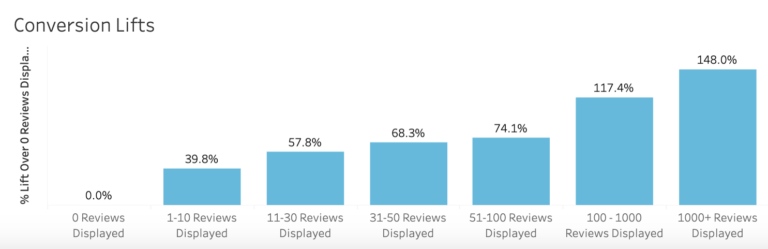
The chart below shows the lift in conversion when a customer sees a product page with a certain number of reviews displayed vs. a product page with 0 reviews. You can see there is a direct relationship between review volume and conversion lift.

Review Volume and Conversion Impact

As you can see, more is more when it comes to reviews. There is a significant uplift in conversion when a product goes from having fewer than 1,000 reviews to more than 1,000. At the same time, 1 review is better than none, so don’t be afraid to just get started!

What Makes a Great CPG Product Review?

It’s important to have a lot of reviews, but those reviews also need a certain depth to them in order to help buyers make buying decisions. When shoppers arrive on your product page, they’re right at the end of the purchase funnel. They are looking for information that is a bit deeper in level of detail to nudge them toward clicking that “Add to Cart” button. That’s where review quality comes in.

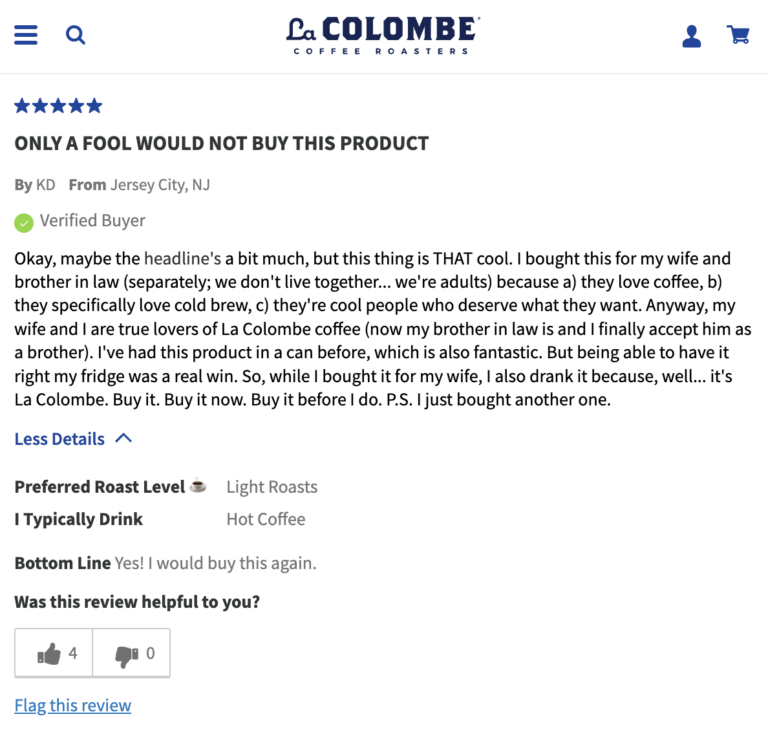
So, what makes a quality review for a CPG product? Let’s take a look at this example from La Colombe Coffee Roasters.

Not only does this review make a bold statement that is persuasive on its own (“Only a Fool Would Not Buy This Product”), but it contains a lot of personality and information about who bought this product and who is enjoying it. 

The review display also highlights a lot of key information outside of the block of text, such as the reviewer’s coffee preferences (e.g. “Preferred Roast Level”), a “Verified Buyer” badge to build trust, and the bottom line on whether they would purchase this product again (in this case, a resounding yes).

How to Collect CPG Reviews That Convert Browsers Into Buyers

To succeed at UGC, you need to capture reviews that are deep and rich in detail. How do you do that? It’s all about asking the right questions.

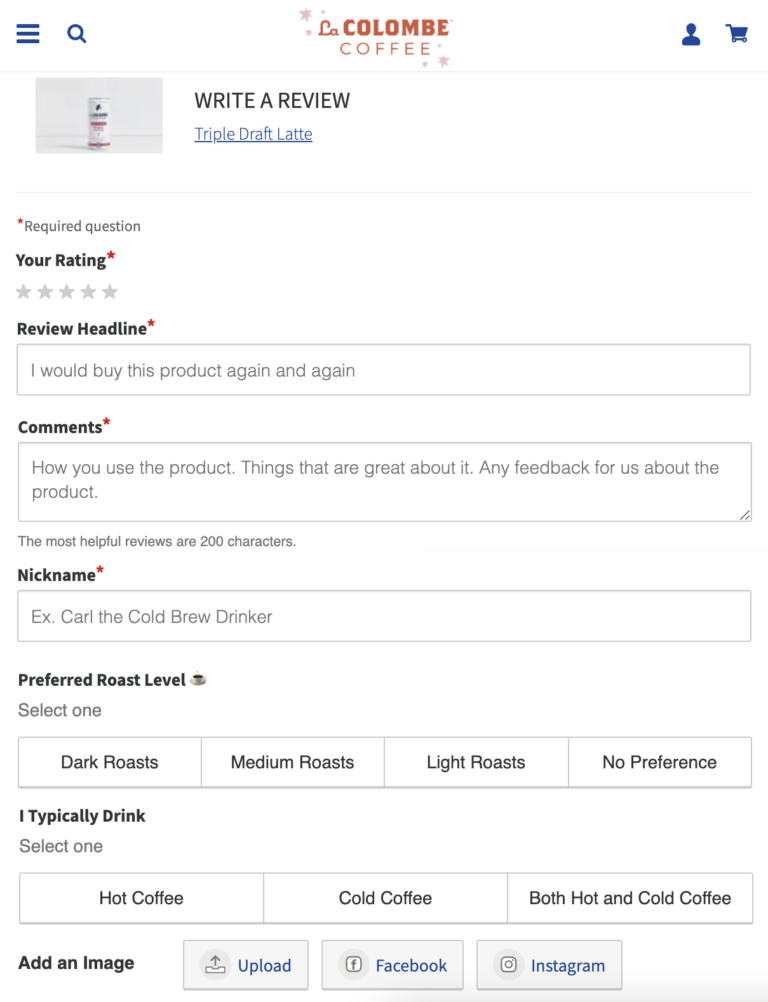
In addition to the standard review box, we recommend adding custom questions to your review forms to maximize the actionability of the information you collect. At PowerReviews, we call these Merchant Specific Questions, or MSQs. By adding MSQs, you can squeeze additional information out of reviewers that future shoppers will find useful, such as the best use case for a product, pros and cons, or taste preferences. Plus, by making these MSQs clickable options, as opposed to an open-text field, they are less burdensome on the reviewer to answer.

Avoid adding too many MSQs, though. We find that 8 questions is the sweet spot and once a form becomes much longer than that, we see a higher rate of abandonment. So, choose wisely, and be intentional about what kind of data you want to include on your product display pages to provide your customers with all of the information they need to make an informed purchase. 

For MSQ inspiration, take a look at this review form from La Colombe Coffee Roasters.

La Colombe obviously knows their customer, and they know the types of things their customers look for, so they’re looking to elevate that information in the data they capture and display on their product pages.

Once you have optimized your review form, it’s time to go out and collect those reviews! Try asking for reviews via your:

Bonus Step: Syndicate Your Reviews for Maximum Impact

Soon you’ll be collecting lots of detail-rich reviews on your website, and in high volumes, too. Congratulations! But the work’s not quite over just yet. To truly maximize the value of those reviews, you need to ensure that those reviews are showing up in all the same places your shoppers are. 

For CPG brands, that often includes retailers like Albertsons, Walmart, Target, and Amazon. Enter: UGC Syndication by PowerReviews. When you set up review syndication, your customers only have to write a review once. Then that review gets posted not only to your website, but to your biggest retail partners as well!

When setting up review syndication, the key is to focus on the biggest traffic websites that will have the biggest upside for you. You can find these using your sales data. You’ll likely ultimately get a bigger boost in revenue by maximizing your review footprint on one of these higher-traffic websites than a less-trafficked, lower-impact website. 

Ready to beat your competition and help more consumers discover your CPG products?

Contact PowerReviews to learn more about how UGC can grow your business.

What You Need to Know in Under 5 Mins

When you’re managing marketing for a toy brand, you need to know where you stand among the competition. Enter: ratings and reviews, a treasure trove of customer insights regarding your toys and those of your competitors. 

Reviews are also a powerful tool for driving more traffic to product pages and then converting that traffic at a higher rate — if you know how to use them to stand out from the competition. 

Got 5 minutes? Perfect. Watch the video below or read on to learn what you need to know about ratings and reviews for the toys category.

Review Benchmarks: Toys

The following benchmarks come from an analysis of Toy product pages.

71.6%

Review Coverage

4.7

Average Star Rating

112

Average Review Length

59

Reviews per Product

42.7%

Average Media Coverage

Monitoring the above metrics can help you ensure you’re generating both review quantity and review quality — the essential cornerstones of any high-impact UGC strategy.

Review Coverage = 71.6%

71.6% of the toy products we analyzed have at least 1 review. This is a great starting point, but given the conversion lift of having just 1 review (see the next section), it is critical that brands strive to collect reviews for all the products on their site.

Average Star Rating = 4.7 stars

This is just below the sweet spot we recommend for the optimal conversion lift. Our research shows that products with ratings between 4.75 – 4.99 stars have the highest conversion rates.

Average Review Length = 112 characters

Longer reviews tend to have higher conversion rates, as they provide richer detail and more relevant information for shoppers. We recommend a stretch goal of 500 characters for the maximum uplift.

Reviews Per Product = 59

The average toy in our analysis has 59 reviews. Consumers are split on the ideal number of reviews per product, with 57% being okay with a product having a review count in this range. But, 43% want to see more than 100 reviews per product. The bottom line? Consumers are always looking for more reviews.

Average Media Coverage = 42.7%

42.7% of the toys we analyzed have at least one user-generated product image or a video. It’s wonderful to see shoppers sharing their child playing with your toys! Increasing this percentage can work wonders for your conversion rates, as visitors who interact with user-generated photos and videos are 103.9% more likely to convert.

How Review Volume Impacts Conversion for Toy Brands

Brands always ask us, “How many reviews does a brand really need on all of their products?”

The short answer is, “As many as possible.” And it’s for one simple (but powerful reason): the more reviews a product has, the more likely it is to be purchased. 

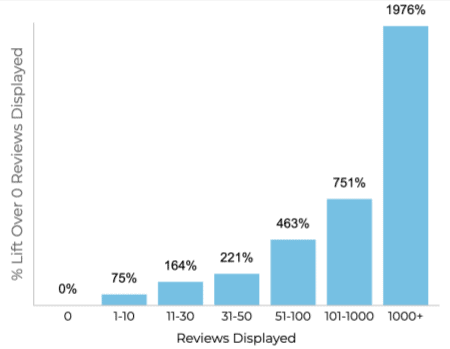
Take a look at this chart, which shows the lift in conversion when a customer sees a product page with a certain number of reviews displayed vs. a product page with 0 reviews.

Review Volume and Conversion Impact

As you can see, there is a direct relationship between review volume and conversion lift. 59 reviews per product is the benchmark for the Toy category and a great number to work towards. 

But, once you reach 59 reviews, you’ll want to keep on going. There’s a big lift once you pass 100 reviews. And once you pass 1,000 reviews, the conversion lift skyrockets. So, take a cue from Buzz Lightyear and shoot for infinity and beyond!

What Makes a Great Toy Product Review?

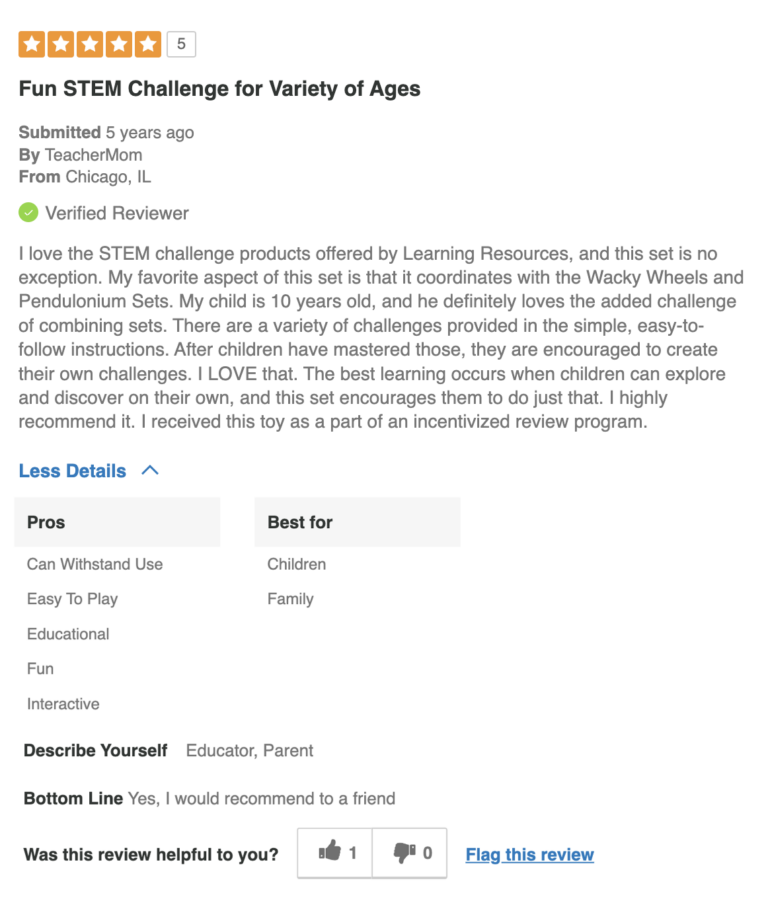
Review volume is important, but so is review quality. Let’s take a look at what makes a great review for a toy. 

This review answers a lot of questions potential customers may have, including:

  • What does this toy do?
  • What are the pros and cons of this toy?
  • Does it work with other toys? 
  • Who is the reviewer, and who did they purchase the product for?

That last question touches on one of the major trends we see in the toy category: gift buying. The toy category is unique in that, often, the reviewer is not the end user of the product. Many of the people who are purchasing your toys may not be at all familiar with your product, or even your brand, so they’re looking for guidance on what to buy. 

This is precisely why review quality is so important for the toy category. Reviews can educate your customers on how a toy works, what kinds of children will like playing with it, and more. The depth of a review — both in featured information like the “Pros” and “Best For” elements as well as the review itself — is hugely important for toy shoppers.

How to Collect Toy Reviews That Convert Browsers Into Buyers

Now that you know the kind of feature-rich reviews you want for your toys, the question is, how do you go about collecting them? 

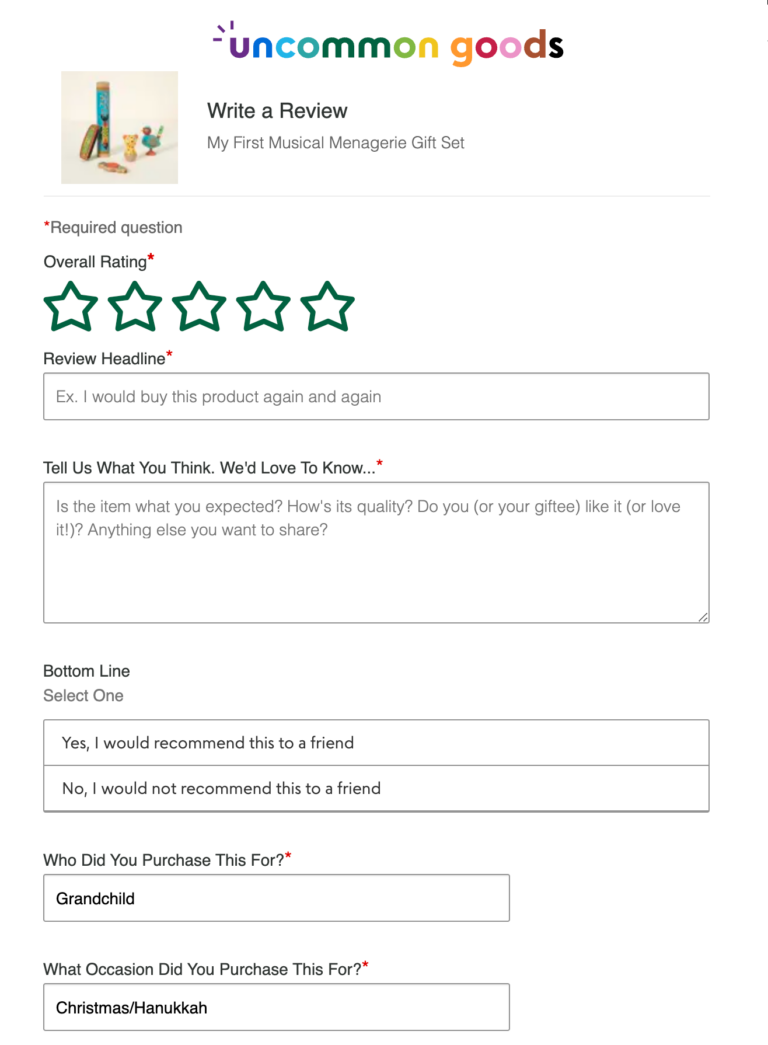
At PowerReviews, we recommend including custom questions on your review forms to maximize the actionability and relevancy of the type of information collected. We call these Merchant-Specific Questions, or MSQs. We’ve found that questions like “Who did you purchase this for?” and “What occasion did you purchase this for?” can be particularly helpful for the toy category and all the parents, grandparents, aunts, uncles, family friends, and more who are buying toys for the little ones in their lives.

When designing your review collection form, be thoughtful and intentional about what kind of data you want to include so your customers can access all of the information they need to make an informed purchase. Be careful not to make the forms too long, though. We find that 8 questions is the sweet spot. Once a form becomes much longer than that, we see a higher rate of abandonment. 

Next, think about how you can display this information to help shoppers who are reading the review. For example, you might elevate the pros/cons list higher up on your product page, in order to give people a quick glance and invite them to read more of your reviews. 

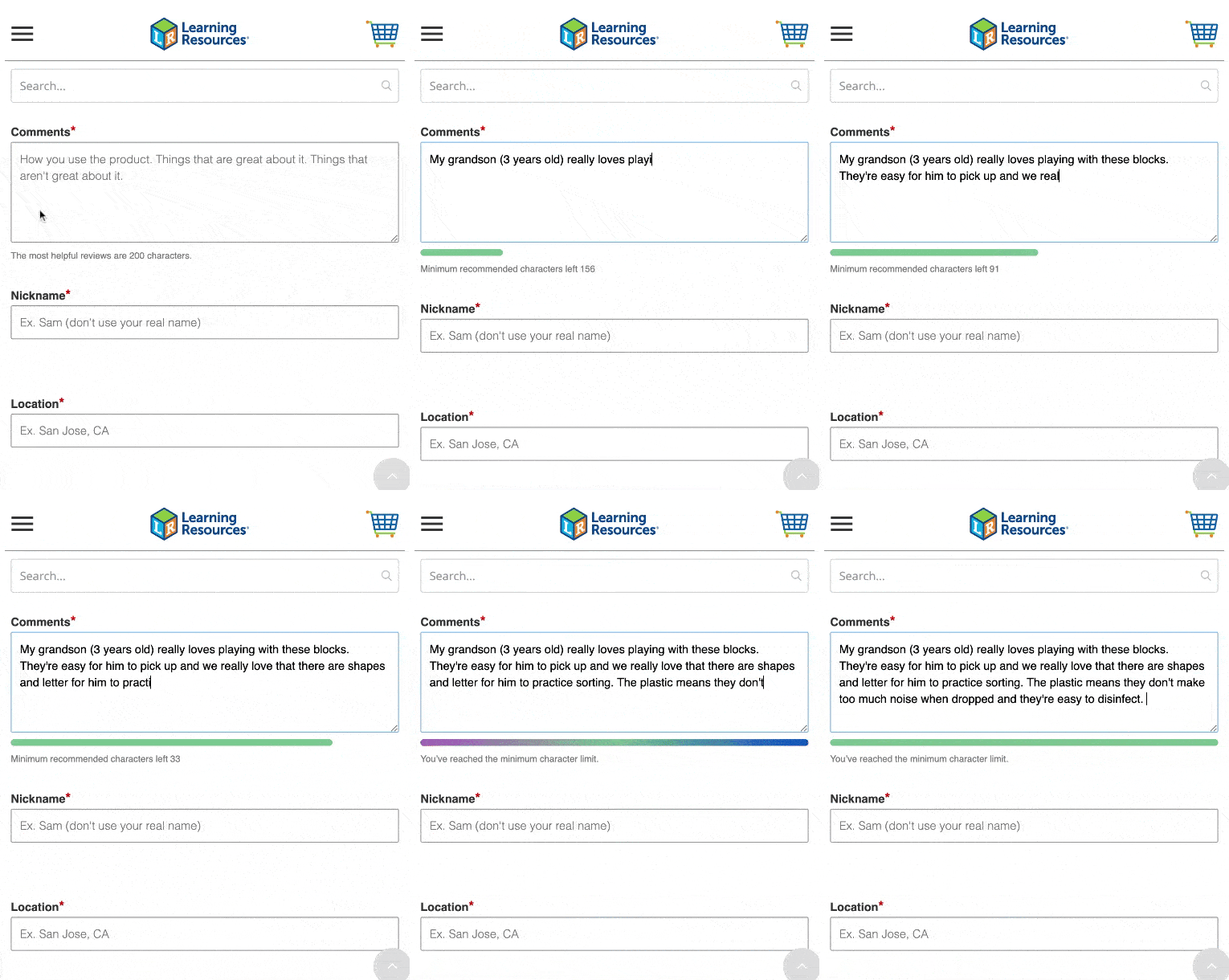
Don’t forget to add a character counter to cheer people on toward leaving longer, more detail-rich reviews!

Once you have your review form and display optimized for maximum impact, it’s time to go out and collect those reviews!

Try:

Bonus Step: Syndicate Your Reviews for Maximum Impact

Let’s say you’ve collected loads of great reviews, and they’re all on your website. That’s great if you’re a strictly D2C toy merchant. 

But, if you sell through more channels than just your website, then you need to make sure your reviews show up in all the places your customers are shopping, from Amazon to Target. 

This is where review syndication comes in. Your customers write a review once, and then — through the magic of UGC Syndication by PowerReviews — your review appears on multiple retail websites.

With syndication, one product review can easily turn into two, three, four, or more! When setting up review syndication, think about the retailers that are going to have the biggest impact for you — e.g. the highest traffic sites where you tend to make the most sales — as those are the ones where you’re going to enjoy the biggest returns.

Think about it this way: there is a huge amount of traffic on your biggest retailer sites – potentially many times more than your lower impact retailers. So it follows that you should focus on optimizing your presence there – both from a review volume and a review quality perspective – to ensure you stand out in an environment where competition is likely fierce.

Ready to have fun with reviews? Help consumers discover your toys with the power of ratings and reviews. Contact PowerReviews to learn more about how UGC can grow your business.