This is part two of a three-part series on best practices for retailers looking to drive more traffic and sales during the 2015 holiday season.
It’s no secret that the holiday season is a busy time for retailers. This year will be no exception, as eMarketer predicts holiday retail sales will be up 5.7% this year, the biggest jump since 2011.
Effectively leveraging reviews is one important way to drive even more traffic and sales during the last couple months of the year. After all, a study from Forrester found that ratings and reviews are the most influential type of product content. This is especially true during the holidays, when shoppers are on the hunt for the perfect gifts for their family and friends.
What’s the first step in effectively leveraging reviews? Generating lots of them. Read on to learn 4 best practices that can help you generate more reviews now in order to drive more traffic and sales during the holidays and beyond.
1. Consider Sampling for New Products A recent study we conducted with Northwestern University found that reviews are especially impactful when a customer is unfamiliar with a product or brand and thus is less likely to purchase. Why? Because there’s risk involved with buying an unfamiliar product. However, the presence of reviews help shoppers overcome that risk.
If your brand is releasing new products for the holidays, it’s important to have plenty of reviews to give shoppers the boost of confidence they need to make a purchase. How can you generate more reviews for new products? Consider product sampling. PowerReviews product sampling campaigns see an 85% conversion rate for reviews written for each sample sent. And the resulting reviews can help mitigate risk for future buyers, leading to more sales.
2. Implement a Post Purchase Email Program On average, 70% of consumer reviews come from post purchase emails. In fact, implementing an effective post purchase email program is the single most important step that brands and retailers can take to grow their review content.
Keep your post purchase emails short and simple, with a clear call to action. And avoid including other marketing or sales calls to action that may distract your customers.
3. Test Incentives and Rewards in Post Purchase Emails Nearly all shoppers use reviews when making purchase decisions. But far fewer actually write reviews.
How can you get more of your shoppers to leave reviews? Well, it seems a little motivation can go a long way. A PowerReviews survey found that more than half of consumers who aren’t writing reviews cited needing motivation to do so.
PowerReviews customers have found that promotions, sweepstakes and offer codes are a few effective ways to motivate shoppers to write reviews. Which will work best for your brand? Now’s the time to test different offers to see which will garner the biggest results. Also, consider running incentives now to generate more reviews in time for heavy shopping days like Black Friday and Cyber Monday.
4. Solicit Reviews from In-Store Shoppers Don’t make the mistake of only asking for reviews from customers who shop online. Stores are packed to the brim with shoppers in the weeks leading up to the holidays. If you’re not asking these in-store shoppers to write reviews, you’re missing out on a golden opportunity to generate more content.
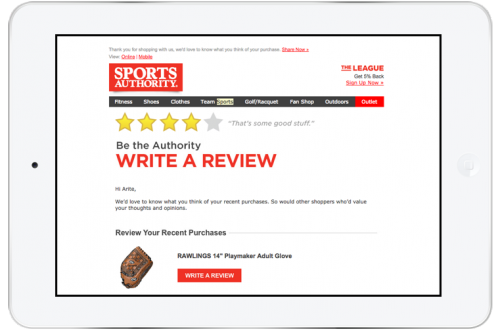
Sports Authority, a PowerReviews client, saw a 178% increase in month-over-month content submission once they began soliciting reviews from in-store customers. How did they do it? By capturing emails through their existing rewards program, then sending emails asking for reviews on items purchased by customers in-store.
This is part one of a three-part series on best practices for retailers looking to drive more traffic and sales during the 2015 holiday season.
If you’re like most retailers, you’re always on the hunt for ways to get ahead of the competition. This is especially true during the holidays, when consumers have nearly limitless shopping options. The good news is, effectively leveraging ratings and reviews can be instrumental in driving even more traffic and sales during the upcoming holiday season.
In this blog, I’ll focus on 3 ways you can make your reviews — and your review generation process — more mobile friendly, which is key as more and more consumers are expected to use their mobile devices to browse and buy this holiday season. By adopting these best practices, you can generate more reviews…which will help you drive more traffic and sales during the upcoming holiday season and beyond.
Make Your Reviews Mobile Friendly More and more shoppers are using their mobile devices to browse and purchase products. According to a survey from retail research agency Conlumino, nearly 45% of consumers plan to use a mobile device to shop for holiday gifts this year.
That’s why it’s key to make sure you have mobile-friendly reviews available on mobile apps and on your website. If you don’t, you risk losing shoppers…and not just those who are shopping online. Research from PowerReviews found that 70% of US shoppers want to be able to access product ratings and reviews while in store. Consider this situation: Kate is in a store shopping for a sweater for her son. She narrows her selection to two sweaters, but wants to see what other people have to say about them. So, she navigates to the retailer’s website on her mobile phone to find reviews for the two styles. She hunts around for a couple minutes, but then gives up. She leaves the store frustrated and decides to buy a sweater elsewhere.
Implement a Mobile-Friendly Post Purchase Email Up to 70% of reviews originate from post purchase emails. And more than half of emails are read on a mobile device. If you haven’t already, now is the time to implement a mobile-friendly post purchase email to maximize the number of reviews you generate — giving holiday shoppers that extra boost of confidence to make a purchase.
To ensure your post purchase emails look great on all devices and generates a high number of reviews , you’ll want to:
Keep the design of the email clean and simple, with the important elements in the upper portion of the email whenever possible
Make the call to action prominent and obvious
Avoid marketing content or other distractions that’ll cause readers to click away from the email
Use a single column layout so the email scales down nicely on mobile
Use a 16 or 18 point font size to make it easy to read on all devices
Keep content short and simple
Limit subject lines to 55 characters or less
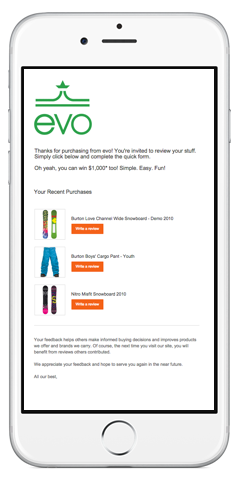
Simple changes can make a big difference. evo, an online outdoor and fashion apparel retailer, implemented a mobile-friendly post purchase email to solicit reviews and saw a 204% increase in reviews written on mobile.
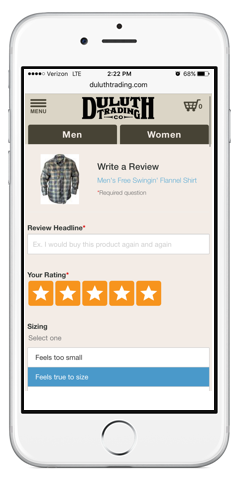
Use a Mobile-Friendly Write a Review Form Let’s say a customer receives your post purchase email on her phone, clicks to write a review, and is taken to a write a review form that requires her to pinch, scroll, and zoom in order to write a review. Chances are, she won’t do it. Shoppers expect a seamless shopping journey, regardless of the device they use. Make the review process as easy as possible for your shoppers by switching to a mobile-friendly write a review form.
Meet the Team is a recurring series on the PowerReviews blog, allowing you to get to know the people behind our success.
We recently sat down with Jessica Teji, Senior Client Services Director in our Chicago office, to learn more about her role, why she loves PowerReviews, and what she enjoys doing outside of work. Jessica’s only been with PowerReviews for six months, but she’s already made a tremendous impact helping our clients be successful with the PowerReviews platform.
What do you do at PowerReviews? As a Senior Client Success Director, my role is to help our Enterprise clients get the most use out of the PowerReviews platform. I work closely with Fortune 500 companies to help them increase User Generated Content (UGC) and utilize it across different channels.
I love helping our clients get a better understanding of their brand by observing the quantity and quality of UGC over time and identifying insights to continue to improve their products for consumers. For one of my clients, the engineering department’s performance is tied to the ratings on a new product launch. I’ve worked with this client to ensure that the moderation policies and right processes are in place to collect ratings and reviews and syndicate them to retailers as quickly as possible to increase conversion.
What’s your favorite thing about working at PowerReviews? The people and the environment make coming to work enjoyable. Plus, our culture and events are always a great way to reconnect with employees across different departments. My favorite event was hosting Built In Brews (a monthly happy hour hosted by a different, high growth tech company in Chicago) when we moved to our new office in the Loop. I enjoyed inviting family and friends to come visit our office and learn about what we do. The mayor even made a guest appearance!
What did you do before joining PowerReviews? I worked in finance at an asset manager, BlackRock, for six years in New York as a relationship manager for global insurance and financial institutions. After moving to Chicago, I worked for a five person startup and got exposure to SaaS, analytics and the entire lifecycle of a client.
What’s something people might not know about you? I love photography of all kinds and have done shoots on the side for charity events, engagement sessions, smaller parties and other events.
Earlier this week, there was a lot of media buzz after Amazon.com filed a lawsuit against more than 1,000 people for writing fake product reviews on their website. The fake reviewers were hired via Fiverr.com, a website where people perform odd jobs for $5 each. In at least one case, a fake reviewer went so far as to have an empty envelope delivered to him in order to trick Amazon into marking his review as verified.
Reviews are a powerful tool to help customers make informed business decisions and for brands and retailers to identify ways to better serve their customers. But fake reviews break down trust and have the potential to tarnish a brand’s image. This lawsuit is a good reminder to brands and retailers that it’s crucial to have measures in place to ensure review content is 100% authentic and fraud-free.
Don’t Be Scared of Negative Reviews
It’s no secret that positive reviews can be an extremely valuable tool to help drive sales. If I read about someone’s positive experience with a particular product, it increases my confidence in purchasing that product. However, negative reviews are equally powerful, a fact that was obviously not recognized by the sellers who solicited these fake, positive reviews. PowerReviews research found that 82% of shoppers specifically seek out negative reviews. And our recent research with Northwestern University found that a product is most likely to be purchased if its average star rating falls between 4.2-4.5 stars.
Perfect ratings are perceived as too good to be true. Allowing negative reviews to be displayed on your site builds trust with your shoppers and helps you identify ways to better serve your customers.
Keep Your Review Content Authentic
The authenticity of reviews is what makes them so powerful. That’s why it’s key to protect your brand from fake reviews. The first step is to ask your ratings and reviews provider what measures they have in place to ensure review content is authentic. For example, at PowerReviews, each and every piece of content passes through advanced fraud detection technology, and then is reviewed by our human moderation team to ensure it’s authentic and fraud free. What we don’t do, however, is edit the reviews. Reviews are displayed as they are written, allowing the true voice of the consumer to shine through.
Our review collection process also enables companies to collect reviews from verified purchasers and then badges those reviews as “verified buyers.” PowerReviews also allows brands and retailers to indicate whether a reviewer received a sample or if a review originated on another site.
Consumers trust reviews. And it’s the responsibility of brands and retailers to provide authentic content that consumers can trust. Aligning with the right reviews technology partner can help you not only drive traffic and sales, but also build and preserve trust with shoppers.
The book was full of great insights about making your business one that’s highly recommended, but one part of the book I found particularly insightful was a chapter about co-creation. Essentially, co-creation is asking your customers to share their ideas for new products and product improvements, with the understanding that your next big product idea could come from anywhere.
The Power of Co-Creation Asking customers to submit their ideas for new products and improvements to existing ones can be very powerful. Consumers love to share their ideas and will feel valued if you ask them to do so. Plus, with co-creation, your customers provide ideas you wouldn’t have access to otherwise. Customers are literally telling you what product offerings they would buy from you.
According to Rand, the main advantages of co-creation include:
Frequent customer engagement: Your employees may work from 9-5, but innovative ideas can hit at any time. With co-creation, consumers can submit their ideas 24/7.
Fresher Ideas: Co-creation can open the door to get new perspectives and creative ways to overcome challenges.
More Loyal Customers: Customers are loyal to brands they feel they’ve formed bonds with. Inviting customers to share their ideas and opinions helps brands build these relationships with consumers.
Greater WOM Momentum: If a customer provides an idea to a brand and the brand executes it, that customer will likely have a sense of pride — and be willing to recommend that brand to others. For example, the person who proposed the idea for a new Frappuccino flavor (especially one that Starbucks went on to develop) is likely to recommend Starbucks to others.
Different Co-Creation Initiatives Co-creation can take many forms. For example, Rand starts the chapter discussing CloroxConnects.com, an online community built by Clorox to solicit products ideas from consumers, suppliers and inventors. Starbucks developed My Starbucks Idea, a site that invites anyone to submit their ideas — large or small — for making Starbucks better. Frito-Lay held a contest called “Do Us a Flavor,” where they asked the public to submit their ideas for a new potato chip flavor.
These co-creation initiatives have all generated great ideas that the sponsoring companies have gone on to implement. Clorox got the idea for a bleach foam product. Starbucks has implemented (and continues to implement) ideas generated through My Starbucks Idea, including new coffee flavors, Frappuccino Happy Hour and splash sticks to prevent coffee from spilling on your clothes…just to name a few. And Frito Lay has gotten new ideas for new chip flavors, including Gyro and Southern Biscuits and Gravy.
Reviews as Co-Creation You don’t have to build an elaborate website or social media campaign in order to generate ideas and insights from customers. If you have ratings and reviews on your site, you already have a wealth of customer suggestions and ideas at your disposal that can be used to improve your products and services.
For example, let’s say you’re a brand that makes jeans. You notice that one style of jeans has 100 reviews, and an average star rating of 2.8. You dig into the reviews and see that several people note that while they love the style and quality of the denim, the zipper tends to stick. You can then take these insights to the manufacturer to change the zipper. Once the zipper has been changed, note the improvement on your website and watch the product rating increase.
Mining Reviews for Insights Gleaning these insights from reviews doesn’t have to be a time consuming process. With PowerReviews Analytics & Insights, you can easily identify insights about your products, enabling you to continuously improve your business.
Of course, all ideas suggested by consumers via your co-creation efforts won’t be good ones. But asking your customers for their ideas — and then using those ideas to improve your products — can be a great way to build relationships and better serve your customers.
Reviews are an important element in a shopper’s journey. In fact, PowerReviews research found that the presence of ratings and reviews ranked as the most important factor affecting purchase decisions — behind only the price of the product itself.
Reviews for Products in High Consideration Categories One element the Northwestern research team studied was the level of involvement or consideration from a consumer’s perspective when purchasing a product. For the purposes of this study, we defined high consideration categories as products that consumers think more about buying because of:
Price
Safety
New or unknown brand or product
For example, baby food is classified as a high consideration category because a baby’s health and safety is a big concern for parents. Obviously, parents don’t want to feed their children products that will harm them.
Take a look at the charts below which outline the findings for two high consideration categories — baby food and weight loss products. You’ll see that as the star rating for the cheaper product in each category increases, it has little impact on purchase probability. However, when the star rating for the more expensive product in the category increases, the purchase probability significantly increases. The takeaway here is that star ratings are most impactful for expensive products within high consideration categories.
Baby Food
Weight Loss
Reviews Mitigate Risk Why do star ratings have a bigger impact on products in high consideration categories? Purchasing a high consideration product requires careful consideration of economic investment, family safety or personal identity. For example, a consumer may not ordinarily seek out reviews for cereal or shampoo, but if it’s a new brand or is higher priced within its category (think organic), more information — in the form of reviews — can strengthen consumers’ confidence in a product, leading to a greater willingness to pay for it.
Consider Sampling for New Products Reviews are especially impactful when the likelihood of a consumer purchasing a product is inherently low. This is especially true when a brand or product is relatively unknown or completely new. But how can you generate more reviews for new products?
Product sampling is an effective way to generate reviews for new products. In fact, PowerReviews Product Sampling campaigns see an 85% review completion rate. The reviews you generate from sampling can help mitigate risk for future buyers, leading to more sales.
Shoppers are more likely to buy products that have higher average ratings. It seems obvious. But a recent study from PowerReviews and Northwestern University’s Spiegel Digital and Database Research Center found that the relationship between the average star rating of a product and its sales is not linear. Simply stated, the likelihood of a product being purchased doesn’t necessarily increase as its star rating increases.
The Northwestern research team analyzed ratings and reviews data in the consumer packaged goods industry and found that the number of stars has little effect on purchase probability when the rating is between 1 and about 3 stars. But when the average star rating surpasses 3, so does the likelihood of purchase. In other words, a customer is more likely to purchase a product with a 4 star rating that one with 3 stars.
Purchase likelihood then peaks when the average star rating of a product is between 4.2 and 4.5 stars. Once the average star rating surpasses this sweet spot, however, the purchase likelihood actually drops. Surprisingly, a shopper is more likely to purchase a product with an average of 4.2 stars than one with a 5 star rating.
Take a look at the graphs below and you’ll see that there’s some variation within categories. But the conclusion is the same: a perfect 5 star rating is NOT the most desirable.
Hair Color
Lightbulbs
Why a 5 Star Rating Isn’t the Best Why do purchases drop off once the average star rating surpasses 4.2-4.5? The Northwestern research team believes this is because consumers perceive ratings closer to a perfect 5.0 as “too good to be true.”
Consumers are smart and know that a product can’t be all things to all people. And they appreciate negative reviews as an important element in their decision-making process. In fact, previous PowerReviews research found that 82% of shopper specifically seek out negative reviews. Among shoppers under 45, this number jumps to 86%.
Embrace Negative Reviews Your knee jerk reaction may be to reject negative reviews. But the research from Northwestern proves that this isn’t the best course of action to drive sales. While you certainly don’t want to aim for negative reviews, allowing them on your site brings authenticity to your review content and helps you build trust with shoppers, especially the vast majority of consumers who are actively seeking out these negative reviews.
Study explores how specific features of ratings and reviews, such as length and sentiment, impact probability of purchase.
SEPTEMBER 22, 2015 – CHICAGO – An increasingly influential part of the consumer purchase process, ratings and reviews impact purchase decisions more than any other factor except price. Yet despite all of the research on the power of reviews, the circumstances that guide when and how ratings and reviews are most effective at driving sales is still a largely unexplored topic.
PowerReviews, a leading provider of ratings, reviews and question-and-answer technology to more than 1,000 brands and retailers, worked with Northwestern University’s Medill IMC Spiegel Digital & Database Research Center to release, “From Reviews to Revenue: How Star Ratings and Review Content Influence Purchase,” an analysis of how ratings and reviews influence purchase probability. Using PowerReviews data, Northwestern analyzed the impact of review length, sentiment and star ratings within the fast moving consumer goods (FMCG) category.
“We’re always seeking new information to help our customers – brands and retailers – understand the best ways to employ user-generated content to drive traffic and sales,” said Matt Moog, CEO of PowerReviews. “We’re excited to partner with Northwestern University and the Spiegel Research Center to deepen our understanding of the consumer purchase process through this third-party analysis.”
“While previous research has established that ratings and reviews are influential in purchase decisions, we set out to investigate the circumstances under which they are most influential,” said Tom Collinger, executive director of the Spiegel Research Center. “In our analysis, we found that not only are five star reviews not ideal for today’s skeptical shoppers, but that ratings and reviews carry more weight for items that require a higher level of consideration.”
Among the findings of the study, PowerReviews and Northwestern discovered three key insights:
Too Good To Be True: The Power of Negative Reviews Contrary to popular belief, the presence of some negative reviews can actually help boost sales. According to Northwestern’s findings, the likelihood of purchase peaks for products with an overall average star rating between 4.2 and 4.5. Products with five-star ratings are, in the eyes of the consumer, too good to be true.
Shoppers understand that every item can’t be the newest, fastest, cheapest and highest quality and often look at perfect five-star reviews with a level of skepticism. While brands and retailers should never aim for negative reviews, it is imperative that they embrace them. The presence of negative reviews builds trust with shoppers and makes overall product review data more credible.
Importance of Star Ratings for High Consideration Items Northwestern found that when consumers evaluate items that require a higher level of consideration, an item’s star rating has a much stronger impact. Higher consideration purchases are defined as those that pose some type of risk – whether due to expense, safety implication or unfamiliarity with the product or brand. Shoppers look to additional information – such as star ratings and reviews – to help mitigate that risk.
For example, a consumer may not ordinarily seek out reviews for everyday items such as cereal or shampoo, but if they’re considering a new brand or more expensive item within that category, it’s important that review and rating information is available. And if those products are highly rated, consumers are more likely to purchase than if they were not. As a result, reviews are an important resource to have when launching new products or brands.
When Reviews Are Shorter, More is Better Traditionally, brands and retailers have been concerned with volume of reviews with the mindset that the more reviews, the better. However, Northwestern’s analysis found that the ideal number of reviews depends on the length of the reviews themselves. When reviews are shorter, shoppers prefer to read more reviews, but when reviews are longer and more diagnostic, fewer reviews is acceptable.
About PowerReviews PowerReviews is the choice of more than 1,000 global brands and retailers to collect and display ratings and reviews on 5,000 websites. An essential resource for consumers as they search and shop online and in-store, ratings and reviews drive relevant traffic, increase sales, and create actionable insights to improve products and services. PowerReviews’ mobile-friendly rating and review and Q&A software is fast to implement and simple to customize, making it easy for brands and retailers to generate more authentic content that is seen by more consumers. The PowerReviews Open Network is the largest in the industry, more than 1 billion in-market shoppers every month, giving retailers and brands the power to reach shoppers wherever they are. For more information, visitwww.powerreviews.com.
About Northwestern University’s Medill IMC Spiegel Digital & Database Research Center The Medill IMC Spiegel Digital & Database Research Center is the first research center at the Medill School of Journalism, Media, Integrated Marketing Communications. It was founded in 2011 by a generous gift from the late Professor Emeritus Edward J. “Ted” Spiegel and his wife Audrey, and fortified by the support of corporations, alumni and friends. The center is part of Northwestern’s long tradition of applied research about advertising and marketing. The focus of the Spiegel Research Center is to do evidence-based, data driven analysis to prove the relationship between customer engagement and purchase behavior. The center’s research focuses on consumer behavior in social media and on mobile devices.
For additional information: Meghan Spork Walker Sands Communications 312-241-1474 Meghan.spork@walkersands.com
evo is a leading online retailer of outdoor gear and fashion apparel, headquartered in Seattle, WA. In 2006, evo chose PowerReviews to further connect with customers, enhance the online user experience and offer the most relevant, helpful information to buyers. Currently, over 23,000 products on evo’s website display user generated content.
The team at evo observed that 40-50% of their customers were opening their emails on mobile devices and saw this as an opportunity to improve the mobile user experience and increase the number of reviews written on mobile devices. In order to achieve this goal, evo partnered with PowerReviews to implement a new, fully responsive and mobile-friendly post purchase email.
The Results evo experienced impressive results after launching their new post purchase email template, including: