Reviews are an important part of a customer’s shopping experience. In fact, the presence of reviews ranks as the most important factor affecting purchase decisions — behind only the price of the product itself.
But here’s the thing: while nearly all shoppers (95%) use reviews, far fewer actually write reviews. PowerReviews research found that only 42% of consumers leave feedback for products they buy. This number dips to 32% for consumers aged 18 to 29.
What would it take to get more of your shoppers to write reviews? More than half of consumers who aren’t writing reviews cited needing motivation to do so. Offering some type of reward or recognition in your post purchase emails can help you generate even more product reviews.
Types of Incentives
Incentivizing your customers doesn’t have to be an expensive endeavor. Here are a few of the different types of incentives that have been successful for PowerReviews clients:
Sweepstakes: Sweepstakes are proven to improve review generation by up to 100%. The good news is, implementing a sweepstakes doesn’t have to be a lot of work for you. If you’re a PowerReviews customer, you can use the $1,000 PowerReviews Sweepstakes to incentivize customers.
Using an Existing Loyalty or Rewards Program: Do you already have an established loyalty or rewards program? Use it to encourage reviews. For example, if a customer in your loyalty program writes a review, she’ll get 10 loyalty points. Once she accrues a set number of points, she’ll receive some sort of promotion, like free shipping or a discount code.
Free Shipping or Discounts: Offer your shoppers a discount or free shipping to thank them for writing reviews. Not only will you generate more reviews, you’ll also give shoppers an excuse to shop with you again.
Remember: When developing incentives, it’s key to understand your audience. An incentive that works well for one audience may not resonate for another. Test different incentives to see what performs best for your brand.
Make the Offer Obvious
If you include a sweepstakes or other offer in your post purchase emails, make it prominent. If possible, include the incentive in the upper portion of the email so shoppers know what you’re offering, even if they don’t scroll through the entire email.
And don’t offer more than one promotion in the same email. If you include multiple offers, your audience will likely get distracted.
Learn More Best Practices for Post Purchase Emails
PowerReviews is growing rapidly. In just 12 short months, we’ve increased headcount by 200%. In fact, we’ve recently moved both our San Francisco and Chicago offices to accommodate growth, enable better collaboration, and provide our employees with a positive, energized, and all-around great work environment.
Earlier this month, tech professionals throughout the city had the opportunity to check out our brand new office space and see what life is like at PowerReviews when we hosted Built In Chicago’s Built In Brews, a monthly happy hour hosted by a different, high growth tech company in Chicago.
Built In Brews was a sold out event with more than 270 attendees, including a special guest, Chicago Mayor Rahm Emanuel. The mayor spoke to attendees about the growing tech scene in Chicago, and how graduates from around the country are choosing to move to Chicago because it’s a great place for folks to launch (and grow) their careers.
Matt Moog, CEO of PowerReviews and founder of Built In Chicago, also talked about the growth of PowerReviews and how Chicago has been an ideal, vibrant environment to foster this growth.
The theme of the event was “Star Wars: Ratings & Reviews,” tying together our fun culture with our fantastic software. As you can see, some folks took the theme pretty seriously.
Interested in joining the PowerReviews team? We’re hiring!
Interview with an Expert’ is a recurring series on the PowerReviews blog. We recently sat down with Kristal Akhavan, the manager of the moderation team here at PowerReviews, to get some insights on the process of moderation and its importance.
PowerReviews: What is the main goal or mission for the moderation team? Kristal Akhavan: The moderation team’s main focus is to ensure that all content displayed on our client sites is authentic and free from fraud, slander, foul language, competitor or price references, and offensive images and videos. Transparency and authenticity have been core focuses at PowerReviews and my team works to ensure that the content provided to consumers adhere to those standards.
PR: What does it mean to be authentic? KA: All of the content submitted through the PowerReviews platform (reviews, questions, answers) pass through an industry leading fraud prevention system and moderation process. All of our clients are expected to comply with these standards. Unlike others in our space, we don’t allow clients to implement policies that would purposely hide negative content. Our policies are 100% neutral and independent of a star rating, which allows for a truly authentic experience for shoppers.
PR: Could you take a minute and go through the steps of the moderation process? KA: First and foremost, each piece of content goes through a profanity filter, which looks for and identifies inappropriate words. After a review successfully passes through the profanity filter, my moderation team reviews each piece of content and our fraud detection technology checks to ensure all content is free from fraud. Finally, once the reviews are approved by the moderators and displayed on a client site, customers have the ability to flag a review if they believe it is inappropriate, offensive, etc.
PR: You mentioned that the moderation process begins with the profanity filter. Can you describe what that is? KA: Simply put, the profanity filter prevents inappropriate content from sneaking into reviews. Our profanity filter is synced with Urban Dictionary to ensure all iterations of foul language will be detected. Our clients also have the opportunity to add words to the profanity filter, if they choose.
Because the profanity filter step occurs before a review is submitted, customers have an opportunity to edit their reviews and re-submit, ensuring our clients capture more authentic and relevant content.
PR: You also noted that your team uses fraud detection software. How does it work? KA: Through industry leading fraud detection technology, we track devices’ digital fingerprints to ensure all of the content is fraud free and authentic. Fraud detection prevents spam, duplicate content for rewards, sabotage and promotional content from making it on to our clients’ sites. Since January of this year, we’ve removed more than 14,000 fraudulent reviews. Our engineering team is also developing additional technology to better identify and eliminate fraudulent reviews before my team even sees them.
PR: PowerReviews emphasizes the importance of human moderation. Why is moderation performed by a person better than a machine? KA: While the profanity filter can identify inappropriate language and we have software to detect fraud, computers aren’t equipped to notice instances of innuendo in a review. Others in the space use machine learning in place of moderators, but we’re focused on ensuring our content is relevant and appropriate for our clients and no phrases with innuendo or foul language make it on clients’ sites for consumers to view. 100% of our content is moderated by my team to ensure nothing slips through.
PR: How long will it take for a review to go through the moderation process and display on my site? KA: Our standard is to moderate all content in 72 business hours, but it’s usually quicker than that.
PR: There has been a lot of talk around fake reviews in the news recently. How does PowerReviews ensure reviews are authentic? KA: My moderation team has a set of guidelines they follow in order to ensure content is authentic. We never reject reviews simply because they’re negative. In fact, 86% of consumers seek out negative reviews while they shop, so businesses shouldn’t fear 1 or 2 star reviews on their site. The moderation team also never edits customer content and we reject any reviews which violate the moderation policies.
PR: Could you give some examples of violations to the moderation policy? KA: Content which includes items like clear advertisements, profane or obscene language and fraud are all examples of violations. There are a list of other violations, but the moderation policies were created to ensure our clients provide authentic, quality, and appropriate content to their consumers.
PR: What content does your team moderate? KA: In addition to review content, the team also moderates questions submitted by consumers, answers submitted by consumers, images and videos.
PR: Does the moderation team have the ability to properly moderate in industries where there are additional regulations, like Pharmaceuticals? KA: Definitely. We’ve added specialized moderators to our team who focus on specific industries, such as pharmaceuticals. We’ve also been able to efficiently set up processes to ensure that we can adhere to special rules in an industry, without slowing down the moderation process or compromising authenticity.
PR: A lot of the companies working with PowerReviews have international subsidiaries. Does the moderation team have the ability to moderate in languages other than English? KA: We currently moderate in 20 different languages including Spanish, Japanese, French, and Portuguese. We also have the ability to add needed languages for clients.
Do you have any other questions about moderation you’d like Kristal to answer? Do you have a moderation question regarding your specific industry? Leave your question in the comments!
Take a look around the room at your next networking event, and you’ll likely find a good number of people who are sporting some sort of wearable technology. Maybe you’re even one of them. If so, you’re certainly not alone. Research from PowerReviews found that almost 30% of U.S. consumers already own a wearable device — such as a smart watch, smart glasses or fitness tracker — or plan to buy one in the next 12 months.
The increased adoption of technologies such as wearable devices and beacons is making the path to purchase more complex, but these technologies also have the potential to open up opportunities for smart, forward-thinking retailers to connect with customers and drive sales. Read on to learn 4 keys to success for retailers looking to leverage the rapid shift toward mobile and wearable technology.
1. Provide shoppers with relevant information so they don’t leave your ecosystem. Imagine a customer is shopping in your store for a new TV. She’s deciding between two models and wants to see what other people have to say about each one before she makes a decision. She visits your website on her smartphone and searches for a few minutes, but doesn’t find any reviews for the two models she’s considering. So, she navigates to Amazon and quickly finds dozens of reviews for each — and also finds she can purchase one of the TVs for $20 less, with free shipping. She leaves the store empty handed.
This scenario points to the importance of providing customers with the information they want, when and where they want it. This means having mobile-friendly reviews available on mobile apps and on your website as well as using reviews in store, whether through digital displays or traditional print advertisements.
2. Use data to offer a better online and in-store customer experience. More than a third of consumers want a wearable device to make their lives easier. And 82% would like technology like smart watches to enhance their shopping experience. The key to providing these improved experiences? Data.
How can you get access to the data you need? Consumers are willing to share their data if there’s a real benefit for them. Smart retailers will use data to demonstrate value, in the form of rewards and offers. This granular view of customer behavior is invaluable and will in turn enable you to make communications more relevant, targeted and in sync with what customers really want.
3. Innovate and personalize information delivery. Gone are the days of one-size-fits-all marketing. Instead, shoppers have come to expect personalized information throughout their shopping experience.
Innovate within your ecosystem to provide customers with the information they need, when they need it so you don’t lose them to a competitor. Through demographics, transaction histories, social media engagement and reviews, retailers have the opportunity to be smart about how they reach out to shoppers. Beacons and other micro-location technology help them further target what content they serve and when and where they serve it. For example, if a retailer’s smartwatch app knows a consumer loves designer shoes, is in New York City on vacation, and just got a raise, it might suggest a highly-rated pair of shoes that’s on sale at a store two blocks away.
4. Don’t wait. Think wearable tech is a passing fad? Think again. Wearable tech is here to stay, and retailers that bury their head in the sand will be left in the dust. The quickly changing technology landscape affects everyone, so be sure to plan your marketing strategies now to be part of the seismic shift. Your consumers are already adopting wearable tech and they expect you to as well.
It’s no secret that the internet has quickly become a visual channel. In 2014, 460 million photos were posted each day via social media. And this number will only continue to climb.
Consumers not only love photos — they trust them…especially when the photos come from other people like them. In fact, according to research by visual commerce platform Olapic, 63% of consumers trust customer photos more than brand or retailer photos.
But how can brands and retailers put this visual user-generated content (UGC) to work in order to move the needle? Jon Drennan, VP of Account Management at Olapic, joined us for our July webinar to discuss the rise of the visual web and share Olapic’s top 10 “do’s and don’ts” for brands and retailers looking to increase revenue, engagement and trust from their UGC initiatives. Here are four of the do’s and don’ts he shared.
Do: Give customers credit for their photos You’ve discovered a great photo on Instagram of your product in action, it includes your brand hashtag and would be a great asset for another one of your marketing campaigns. Start off by giving the customer credit for the photo. If she’s using your hashtag and posting photos of your product, she’s clearly already a fan. Giving her a shout-out will make her an even bigger brand advocate.
Don’t: Use celebrity photos without their consent Let’s say you’re a clothing retailer and you get your hands on a photo of a famous actor walking into one of your stores. It may seem tempting to use this image in your marketing efforts. But don’t do it. A handful of companies have gotten into hot water for using celebrity photos without their permission — which can have a negative impact on a brand’s reputation.
Do: Leverage UGC to uncover new target audiences for your brand You may think you have a pretty good idea of what your target audience looks like. For example, maybe the majority of your marketing is targeted at middle aged males living in the Midwest. But by exploring and analyzing user generated content, you may just discover other audiences who love your brand, too. Those are new audiences for you to target in the future.
Don’t: Expect photos to drop in your lap If you create a branded hashtag, the UGC will start pouring in, right? Wrong. Creating the hashtag is just the beginning. You also need to promote your UGC initiatives across all customer touch points in order to get engagement from your customers. Promoting UGC initiatives via digital touchpoints like social media and email may seem obvious, but be sure to use your offline channels, too. For example, if you’re a clothing brand, include your brand hashtag in your magazine ads to encourage more customers to post content.
There are many amazing women who will surely be considered for the new ten dollar bill: Eleanor Roosevelt, Harriet Tubman, and Rosa Parks among them. But one woman has influenced our daily lives more than any of these trailblazers: Grace Hopper. Without Grace Hopper, you would not be using a computer to read this post, shop online, or email your grandmother. And yet, you have probably never heard of her.
Ask forgiveness, not permission
Before I tell you about what Grace did, let me tell you a little bit about who she was. You may not have heard of her, but you certainly have used a version of this quote from Grace: “If it’s a good idea, go ahead and do it. It’s much easier to apologize than it is to get permission.” No one invented anything great by asking permission. Grace had a vision, and she went for it. And we’re all the richer for her.
Programming in 1944
Grace Hopper was a rear admiral in the United States Navy who was programming computers in 1944. Nineteen forty-four. If you saw the movie The Imitation Game about another brilliant early computer scientist, Alan Turing, you know how primitive computers were in 1944. They took up entire rooms, and their function was largely limited to complex mathematics. That’s it.
Beyond Arithmetic
Grace Hopper had the vision that computers could do more than mathematical calculations. She also knew that to make this vision a reality, people needed a way to give more complex directions to computers. Ones and zeros were fine for math, but to express complex questions and decisions, you need a language. Grace knew that allowing people to use a language like English to express their ideas would empower them to write more complex software. So by 1952, Grace invented the compiler. A compiler takes a more abstract language (e.g., Java, C#, Ruby) and translates it to machine code – those ones and zeros that the computer understands. By inventing the compiler, Grace invented computer programming and revolutionized computer science.
Leadership is a two-way street
Grace was also a director of programming in 1954, a time when women did not hold positions of power, especially in the field we now know as computer science. Grace was a strong leader who mentored generations of computer scientists. She also understood the essence of leadership: “Leadership is a two-way street, loyalty up and loyalty down. Respect for one’s superiors; care for one’s crew.” Grace was active through the 1980s when President Reagan appointed her the rank of Commodore (later Rear Admiral), and Congress approved her working beyond the Navy’s mandatory retirement age. An Act of Congress so she could continue her work. Amazing Grace.
Not good enough
As a woman whose entire career has been in software, I’m proud to see a woman (Ginni Rometty) leading IBM, whose computers Grace Hopper worked on more than 70 years ago. But it’s not enough. I see no more women programmers now than I did 20 years ago, even though I work and have worked for great companies that actively seek out a diverse employee base.
Get your girl geek on
Today, women make up 47 percent of the total U.S. workforce, but are underrepresented in engineering (13 percent) and computer and mathematical sciences (25 percent), according to the National Science Foundation.
Laura Sydell of NPR reported that the percentage of female computer science majors has fallen from its height of about 40 percent in the 1980s to about 17 percent now. Walter Isaacson, author of The Innovators: How a Group of Hackers, Geniuses and Geeks Created the Digital Revolution, said: “When they have been written out of the history, you don’t have great role models.
But when you learn about the women who programmed ENIAC or Grace Hopper or Ada Lovelace … it happened to my daughter. She read about all these people when she was in high school, and she became a math and computer science geek.”
It’s a woman’s world
Young women need to know that programming is a woman’s world. Grace Hopper on the $10 bill will be a reminder and an inspiration – at least until the programming Grace invented makes paper currency a thing of the past.
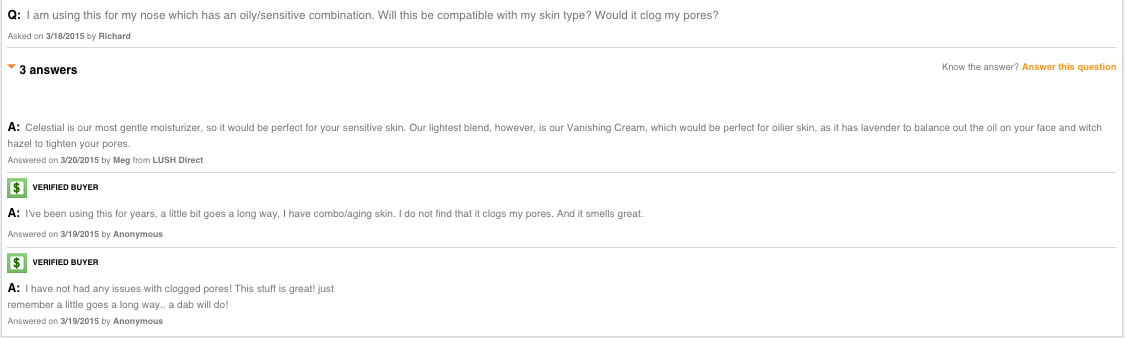
It’s no secret that Q&A software has a ton of benefits for customers and businesses. Q&A capabilities provide answers to consumers’ purchase-blocking questions and give them the little boost of confidence they may need to purchase a product. Skechers, one of our Q&A clients, said: “Because a customer who submits a question is already engaged, if we can give them the answer they want in a timely fashion, they usually buy the shoe.”
Brands and retailers adopting a Q&A solution have seen a large number of questions submitted by potential buyers. In fact, one of our IR100 clients saw more than 19,000 questions submitted in their first four months using the PowerReviews Q&A solution, Social Answers.
Receiving tons of questions from your customers shows that they’re engaged with your site and looking to make a purchase, but answering all of those questions can seem daunting to some internal teams. If you’re worried that the volume of questions will be too high for your internal and customer support teams to handle, there are ways to not only reduce the burden on your team, but also provide better answers to purchase-blocking questions from your potential buyers.
PowerReviews offers two additional answer sources: the On-Demand Answer Community and Ask a Product Owner. The On-Demand Answer Community leverages a group of researchers to answer product-specific customer questions and the Ask a Product Owner feature leverages your existing base of customers who have recently purchased your products to provide answers to questions asked by other shoppers. Some of our clients use only the On-Demand Answer Community and Product Owners to answer buyer questions.
The On-Demand Answer Community is an excellent resource to quickly answer questions, but I want to focus on Ask a Product Owner in this post. Ask a Product Owner not only ensures that your internal team won’t be overwhelmed with question volume, but provides other benefits as well.
Here are the 4 reasons to adopt an Ask a Product Owner feature if you are implementing a Q&A solution or you already have one on your site:
1. Lessen the burden on your internal team
Implementing a Q&A solution on your site will not overwhelm your team if you use multiple answer sources, especially Ask a Product Owner. Surprisingly enough, past customers love answering questions from future buyers. With past product owners’ willingness to answer many of the questions asked by potential buyers, your customer support and internal teams can focus on other tasks, while you collect more quality content for your product pages. Currently, one of our top retailers uses Ask a Product Owner to answer more than three quarters of the purchase-blocking questions asked on a daily basis.
2. Allow your customers to continuously participate
Ask a Product Owner isn’t just beneficial for your potential buyers and their conversion on your site. When potential buyers ask a question, your product owners are the first to be notified through an email to answer the inquiry and help shoppers make the right buying decision. Using the Ask a Product Owner feature also allows you to re-engage your customer base and turn your product owners into brand advocates and regular content contributors.
3. Faster answer times
Product owners tend to answer questions faster than internal teams. One of our IR100 clients saw faster answer times (median answer time of 9 hours) once they began using the Ask a Product Owner feature on their site.
4. Provide authentic and experience-related information
Internal and customer support teams are knowledgeable about products sold on their sites, but they can’t provide an experience-based answer like a product owner. An answer from a product owner adds authenticity, which provides a level of comfort for your future purchasers, especially if they are buying a high consideration item like a crib or an expensive snowboard.
When adopting a Q&A capability, be sure to use the multiple answer sources provided to ensure that your customers get faster and more authentic content without putting a burden on your team.
Do you have standards? If you’ve ever traveled to a foreign country, you’ve experienced a “standard” when you plugged anything requiring power into a wall socket. If there weren’t standards, you’d be traveling with two pieces of luggage….one for your clothes…and one for your 50 wall adapters!
With the Internet, there are MANY agreed upon standards you’ve probably heard of: HTML, JavaScript, USB…and maybe a few you haven’t…IEEE 802.11, SMTP, and Schema.org.
What Is Schema Markup?
Schema.org is an agreed upon standard/specification for structuring data on websites. Google, Bing and Yahoo started the initiative back in June 2011, and has been working for years to improve the breadth and adoption of the standard.
In the last 12 months, Google has started to expand the technical options companies have for delivering the markup on their website, which is in turn driving adoption. From calendar information to people to reviews…web content can benefit from being structured in a way that provides search engines the ability to offer up more relevant, content rich results in their search experience.
Why Should We Care?
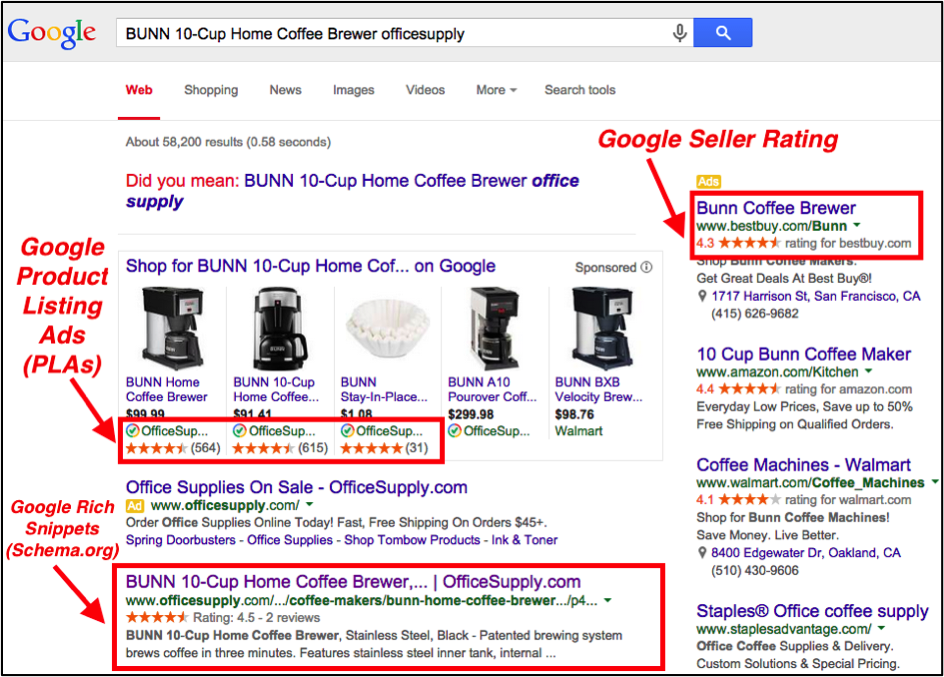
For reviews and SEO, search engines like Google take structured information they’ve crawled to another level by modifying the search engine results page (SERP) to include the star rating (also known as rich snippets) of the product/item in organic search.
This has shown to increase click-through rates up to 30%, and with an average site getting up to 60% of their traffic from organic search, every little bit helps.
How Do We Get It?
The good news is that if you’re a PowerReviews client and have Inline SEO enabled, you’re 95% of the way there. We can enable the feature for your account(s) so that the next time your periodic content delivery bundle is generated (usually nightly), Schema.org flows with it.
Then it’s as simple as unpacking the file like you normally do and publishing on your website. If you’re a current customer, contact the Client Success team and request this feature on your account.
That Easy
PowerReviews is continually adding capabilities to its products to help brands and retailers drive traffic, increase sales, and create actionable insights. We also work to make it easy for our customers to adopt new features that will help them meet their business goals. Schema.org is a great and easy way for clients to drive more organic traffic with just a little effort and no additional cost.
Announcing key client wins, PowerReviews carries out mission to deliver brands and retailers more product reviews and better insights alongside top-notch customer service.
JUNE 17, 2015 – CHICAGO – PowerReviews, a leading provider of ratings, reviews and question-and-answer technology to more than 1,000 brands and retailers, marks its 10th anniversary with continued momentum sparked by record growth and a continued commitment to bringing more reviews to shoppers online and in-store.
Since its relaunch in July 2014, PowerReviews has experienced explosive customer growth, signing more than 100 new enterprise customers, including some of world’s leading brands such as Avery, Crocs, The North Face, Tempur Sealy, Vans, Whirlpool and World Kitchen. Establishing PowerReviews as one of the largest providers of ratings and reviews technology, these companies join the ranks of PowerReviews’ current client base, which includes other influential brands and retailers such as Toys “R” US and Sports Authority.
“The most successful brands and retailers all have one thing in common – they recognize ratings and reviews as a vital component of their online strategies. Not only are ratings and reviews proven to drive traffic and increase sales, but they also allow brands and retailers to derive real value from actionable consumer insights about their products and services,” said Matt Moog, CEO of PowerReviews. “For today’s shoppers, ratings and reviews are an expectation; they drive more conversions than any other type of content, user-generated or professionally produced.”
Since PowerReviews’ founding 10 years ago, the retail landscape has evolved dramatically. The path to purchase is no longer linear as brands and retailers are engaging consumers across a variety of channels. In a recent study, PowerReviews analyzed the impact of mobile and wearable technology on consumer shopping behavior and found that consumers are interested in using new technologies to connect with brands and retailers. In fact, 82 percent of shoppers are interested in using wearable technology, such as smartwatches, to enhance the overall shopping experience.
Acknowledging the rise in mobile shopping and core importance of ratings and reviews, PowerReviews recently announced key updates to its software platform. These updates enable brands and retailers to more easily generate and display ratings and reviews, regardless of channel, providing mobile-optimized review forms and displays.
While consumer demands have shifted, PowerReviews’ mission has remained the same – to empower brands and retailers with the software and data to collect, display and syndicate content that drives traffic, increases sales and creates actionable insights. Built for innovation, scalability and flexibility, the PowerReviews platform includes three key technologies that help brands and retailers advance their digital strategies.
Unified Platform PowerReviews’ unified software platform is enabling greater innovation. Built on a true multi-tenant SaaS platform, the PowerReviews platform enables all customers to use the same version of software. And with just one platform to support, PowerReviews invests more resources to deliver new capabilities for all customers. The unified platform also enables customers to easily implement new features, meaning PowerReviews customers can adopt new innovations more quickly.
Unified Product Catalog With a single structured catalog for review and Q&A data, PowerReviews customers can more easily mine data for insights and syndicate review content faster than with competitors. The Unified Product Catalog, along with PowerReviews’ sophisticated product matching technology, empowers customers to syndicate content in one or two days, while other providers can take up to eight weeks.
Open Syndication Network The PowerReviews Open Syndication Network syndicates content from 1,800 brands to 2,500 retailers, reaching 700 million in-market shoppers each month. With the PowerReviews Open Syndication Network, PowerReviews customers can get more reviews in front of more consumers, faster than with other providers.
About PowerReviews PowerReviews is the choice of 1,000 global brands and retailers to collect and display ratings and reviews on 5,000 websites. An essential resource for consumers as they search and shop online and in-store, ratings and reviews drive relevant traffic, increase sales, and create actionable insights to improve products and services. PowerReviews’ mobile-friendly rating and review and Q&A software is fast to implement and simple to customize, making it easy for brands and retailers to generate more authentic content that is seen by more consumers. The PowerReviews Open Syndication Network is the largest in the industry, reaching more than 1 billion in-market shoppers every month, giving retailers and brands the power to reach shoppers wherever they are. For more information, visit www.powerreviews.com.
For additional information: Meghan Spork
Walker Sands Communications
312-241-1474
Meghan.spork@walkersands.com