The following is a guest post from Lesli Esposito, Partner and Co-Chair of the Antitrust Group at DLA Piper.
How the Administration Views Consumer Protection and Reviews
User-generated content — including reviews, images and videos — has become an expected part of the path to purchase. PowerReviews research found that 86% of consumers consider reviews an essential resource when making purchase decisions.
In addition to helping consumers make informed purchases, user-generated content can be a valuable tool for helping businesses drive traffic and sales — especially when this content is of a positive nature. And some businesses can be tempted to modify user-generated content in their favor in order to attract — and convert — more shoppers. However, the Federal Trade Commission, which oversees consumer protection, actively works to prevent companies from engaging in this harmful and fraudulent behavior.
Earlier this month, the PowerReviews team invited me to present their monthly webinar. During the webinar, I shared some recent developments in consumer protection when it comes to reviews, as well as practical do’s and don’ts to help ensure businesses don’t break their customers’ trust — or the law.
Recent Developments: Consumer Review Fairness Act
If you’re not familiar with the Consumer Review Fairness Act (CRFA), now’s the time to get acquainted. The CRFA is a new federal law that, according to the FTC’s website, “protects people’s ability to share their honest opinions about a business’ products, services, or conduct, in any forum, including social media.” The law does this by prohibiting certain things, including:
Contract provisions that bar or otherwise restrict a person’s ability to provide a review of the company’s products, services or conduct
Contract provisions that impose a penalty or fee if someone gives a review
Contract provisions that require a reviewer to give up their intellectual property rights in the content of their reviews
In other words, the law ensures that companies can’t prohibit consumers from writing reviews, or penalize them for doing so. And, it’s worth noting, that for the purposes of this law, a review is defined as comments regarding a product or customer service and includes online reviews, social media posts, photos and videos.
Though it’s generally a best practice to avoid deleting negative reviews, there actually are a few circumstances when you should remove reviews, including if the review:
Contains confidential or private information
Is libelous, harassing, abusive, obscene, vulgar or sexually explicit
Is “inappropriate” with regard to race, gender or ethnicity
Is unrelated to the company’s products or services
Is clearly false or misleading
The penalties for breaking this law include financial penalties, court orders, and consent orders (with reporting requirements), so it’s important for businesses to ensure they have measures in place to comply.
Practical Advice: The Do’s and Don’ts of Reviews
The good news is, complying with this new law isn’t hard to do. The key is to maintain transparency and authenticity.
I wrapped up the webinar by sharing some practical advice for brands and retailers. Read on to learn the do’s and don’ts I shared for being compliant — and transparent — when it comes to reviews.
8 Do’s for Reviews
In order to protect consumers — as well as the trust you’ve worked hard to earn — make sure your business does these eight things.
Remove provisions in contracts with consumers that restrict a customer’s right to give a review or penalize a customer for giving a review, including negative reviews
Remove provisions that require reviewers to give up their IP rights to the content of their reviews or claim copyright over someone’s review
Remove reviews that contain confidential or private information
Remove reviews that are libelous, harassing, obscene, inappropriate as to race, gender, ethnicity
Remove reviews that are unrelated to a product or customer service
Remove reviews that are clearly false or misleading
Disclose material connections with endorsers
Ensure all claims are substantiated
8 Don’ts for Reviews
There are also eight things brands and retailers should avoid when it comes to reviews. Make sure you don’t:
Restrict a customer’s ability to review a product or customer service
Penalize a customer for giving a review, including a negative review
Claim copyright over the contents of a customer’s review
Remove negative reviews
Post false reviews
Fail to disclose material connections in a clear and conspicuous manner
Blame social media constraints for failing to disclose
Lesli C. Esposito focuses on complex commercial litigation and government investigations, concentrating in the fields of antitrust and consumer protection. She represents a wide range of corporations, as well as individuals, as both plaintiffs and defendants.
Lesli has extensive experience litigating antitrust and consumer protection matters in both federal and state courts, as well as representing parties in class actions. She also has extensive experience representing clients in antitrust and consumer protection government investigations, including investigations conducted by the Department of Justice, Federal Trade Commission, Consumer Financial Protection Bureau, Department of Transportation, Federal Aviation Administration and state Attorneys General.
She represents clients in a variety of industries, among them pharmaceuticals, healthcare, consumer products, telemarketing, oil and gas, mortgage lending and legal services. Her matters have involved a wide range of claims, including but not limited to allegations of price fixing, abuse of monopoly power, conspiracy, false advertising, and tortious interference, as well as alleged violations of various FTC, FCC and FDA regulations, such as the Telephone Consumer Protection Act.
Rossio to drive product strategy and roadmap to help retailers and brands increase sales and create actionable insights across channels
CHICAGO – July 18, 2017 – PowerReviews, a leading provider of ratings, reviews and question and answer technology to more than 1,000 global brands and retailers, today announced that the company has hired Sara Rossio as senior vice president, Product Management. In this new position, Rossio, will focus on identifying and developing innovative products that deliver value to customers, enhance the open network, and unify and amplify the voice of the consumer.
“Sara has a proven record of delivering creative and differentiated solutions to solve critical customer problems. Her experience and leadership will accelerate our delivery of product innovations that help consumers make better purchasing decisions, across all channels, growing sales and actionable insights for our customers,” said Matt Moog, chief executive officer, PowerReviews. “We are thrilled to welcome her to our team.”
Rossio, a 2015 Crain’s Chicago Business “40 Under 40” recipient has more than 20 years of experience in product management and marketing. Before joining PowerReviews, Rossio served as vice president of Product for Gogo, where she led a team to develop the product strategy and roadmap for the leading inflight internet and entertainment provider. At PowerReviews, Rossio will drive the product strategy and roadmap to continue to expand our suite of products to encompass all types of consumer feedback and content, including images and videos, across all channels and throughout the consumer journey. She is also charged with optimizing and expanding the open network.
About PowerReviews PowerReviews works with more than 1,000 global brands and retailers to deliver cloud-based software that collects and displays ratings and reviews and questions and answers on websites. PowerReviews unifies and amplifies the voice of the consumer throughout their journey, across all channels to help consumers make better purchase decisions and to help businesses drive conversion and improve products and services. Ratings and reviews are essential for consumers as they search and shop online and in-store, driving traffic on more than 5,000 websites, creating actionable insights to improve products and services, increasing conversion, and growing online site-wide sales. The PowerReviews Open Network reaches more than 1 billion in-market shoppers every month, giving retailers and brands the power to reach shoppers wherever they are. For more information, visitwww.powerreviews.com.
Meet the Team is a recurring series on the PowerReviews blog, allowing you to get to know the people behind our success.
We recently sat down with Sara Rossio, our SVP, Product Management to chat about life at PowerReviews and what attracted her to a career in product management.
Tell us about your career path before joining PowerReviews? How did you get into product management? I started my product management career at Eaton Corporation, and have worked in Product Management for the last 15+ years. I was given the opportunity to run a sensor product line after I created a price sensitivity analysis that guided the pricing decisions for the product line. I fell in love with the job because of the diversity of what I got to do everyday. Since then I’ve worked for two other technology companies, to support product management, including NAVTEQ and Gogo.
What initially attracted you to this role at PowerReviews? I was excited to work for a technology company in a high growth stage that offered a value proposition that I am excited about.
What does a day in the life of an SVP of Product Management at PowerReviews look like? Everyday is a bit different. I traditionally spend the day meeting with people to understand what our customers value, how they feel about our products, and the status of development to ensure we deliver the most impactful product offerings.
What most excites you about product management? I love making customers happy, and delivering more than they expected.
You’ve only been here a few weeks, but what’s your favorite thing about PowerReviews so far? I am so impressed by all my interactions with everyone at PowerReviews. The team is passionate about making our customers happy and willing to openly share information.
What’s your favorite way to unwind after work? I love listening to music.
6 Ways to Increase the Reach of Your User-Generated Content
This blog post is the fourth in our series of key takeaways from the keynotes and breakout sessions from the 2017 PowerReviews Digital Commerce Summit.
OK, so you’re collecting user-generated content such as ratings and reviews, photos and videos. And you’re displaying all of this great content on your product pages. But how can you get this content in front of more shoppers in more places — beyond the product page?
Earlier this year, I led a session at the PowerReviews Digital Commerce Summit, exploring strategies for generating and displaying reviews online, in mobile apps and in-store to lift sales across all channels. Read on to learn six strategies I shared during the session that can help you get more mileage from your user-generated content.
1. Include UGC in Other Marketing Initiatives Consumers trust the opinions of others like them. So look for ways to integrate user-generated content — including reviews, photos and videos — into other print and digital marketing initiatives, such as email, social and display campaigns. For example, our friends at Duluth Trading Company tout the number of 5-star reviews they have for their Buck Naked underwear in a number of different marketing initiatives across channels.
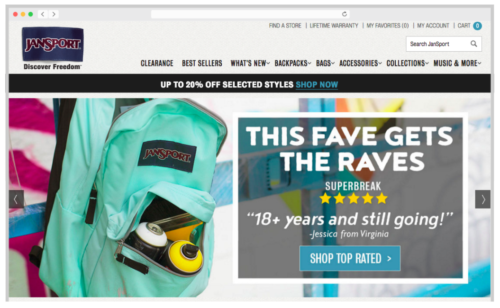
2. Highlight Ratings on Your Home Page Want to influence where a visitor goes once they hit your homepage? Include star ratings and reviews for a featured product on your homepage. For example, our friends at JanSport highlighted their best selling “Superbreak” backpack on their homepage (just in time for back to school shopping), along with the average star rating and a written review for the product.
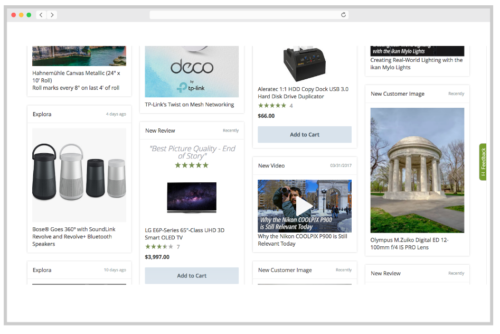
3. Highlight Visual Content on Category and Home Pages After you’ve collected visual content (such as photos and videos) and prominently displayed it on your product pages, use this content to enhance other parts of your website, too, including category pages and even your homepage.
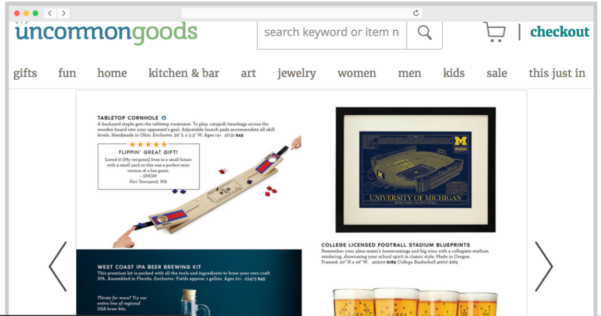
4. Include Ratings and Reviews in Catalogs Consider including star ratings and written reviews in printed and digital catalogs to capture attention for key products. For example, if you’re an online and catalog retailer (like our friends at UncommonGoods) preparing to send a Holiday 2017 catalog, include written reviews that mention your key items being great gift items.
5. Amplify the Voice of the Consumer In-Store Shoppers aren’t just turning to user-generated content while they’re shopping online. They also want access to this content when they’re shopping in a brick and mortar store. In fact, PowerReviews research found that around 70% of shoppers would like to access product ratings and reviews while shopping in-store.
Be sure to allow consumers to find user-generated content when they’re shopping in your physical store locations. There are a lot of different ways to do this that range from high- to low-tech.
On the high-tech end, build functionality in your mobile app that allows shoppers to scan a product while in a store and access reviews for that product. Or feature localized user-generated content in your fitting rooms like Fabletics does.
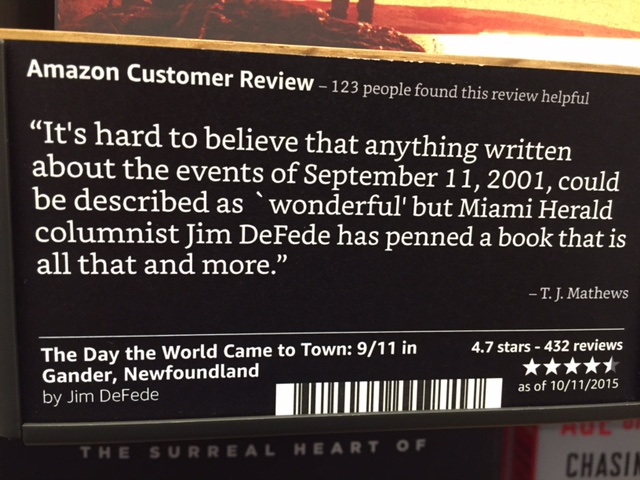
If you don’t have the technical resources available to do that, consider featuring star ratings and customer reviews on cardboard signs alongside your products — similar to what Amazon does in their bookstores.
Or incorporate consumer feedback into your in-store displays, touting the positive aspects of your product reviews — similar to what our friends at Benefit Cosmetics do.
6. Participate in the PowerReviews Open Network Review syndication is the distribution of user-generated content, including ratings and reviews, collected on brand sites to retail ecommerce sites. Brands that participate in the PowerReviews Open Network and syndicate their content benefit from increased reach — your reviews get in front of more consumers on more websites. Retailers that accept syndicated brand content benefit from increased review coverage and depth — you get the benefits of having reviews on your site without having to generate them yourself!
Company Adds Arend Henderson to Role of Senior Vice President of Analytics
CHICAGO – July 11, 2017 – PowerReviews, a leading provider of ratings, reviews and question and answer technology to more than 1,000 global brands and retailers, today announced that the company hired Arend Hendersonas senior vice president of Analytics. In this role, Henderson will focus on providing robust analytics to help companies make data driven decisions.
“The value of ratings and reviews goes well beyond their proven ability to increase website traffic and drive sales. The customer feedback that the reviews contain provides actionable insights to help brands and retailers improve products and the shopping experience to better meet expectations,” said Matt Moog, chief executive officer, PowerReviews. “Arend adds senior expertise to our existing analytics practice to help clients interpret data to better understand shopper behavior.”
Henderson has more than 20 years of experience leading executional analytics, consumer insights and strategic marketing initiatives. He joins PowerReviews from Conversant where he served as the vice president of Business Intelligence. In this new role he will be responsible for leading the analytics team, which develops behavioral insights and other optimization and measurement solutions for clients. The analytics team leverages analytics and data to make smarter product decisions that better meet shoppers’ needs.
About PowerReviews PowerReviews works with more than 1,000 global brands and retailers to deliver cloud-based software that collects and displays ratings and reviews and questions and answers on websites. PowerReviews unifies and amplifies the voice of the consumer throughout their journey, across all channels to help consumers make better purchase decisions and to help businesses drive conversion and improve products and services. Ratings and reviews are essential for consumers as they search and shop online and in-store, driving traffic on more than 5,000 websites, creating actionable insights to improve products and services, increasing conversion, and growing online site-wide sales. The PowerReviews Open Network reaches more than 1 billion in-market shoppers every month, giving retailers and brands the power to reach shoppers wherever they are. For more information, visitwww.powerreviews.com.
Is Your Ratings and Reviews Provider Working For You?
By now, we’ve all heard the stats about the role of reviews in the path to purchase. 95% of consumers consult reviews, and 86% consider them an essential resource when making purchase decisions. Clearly, you understand the value of reviews, since you’re actively collecting and displaying this content on your website.
But lately, you’ve noticed you’re not seeing the business impact you expected from the reviews you’ve generated. Or maybe you feel like you’ve outgrown your current solution because the features or support are no longer meeting your needs.
If this is the case, it may be time to consider switching to a new ratings and reviews partner that better suits your business goals and objectives. While it may seem like an overwhelming task to evaluate and implement a new provider, if you choose the right partner, the reward will definitely outweigh the risks.
When it’s Time to Switch
How do you know when it’s time to consider a new ratings and reviews provider? Here are five signs it might be time to make the switch.
1. Your review coverage and depth are less than stellar.
Review coverage is the number of products on your website that have reviews, while review depth is the number of reviews per product. Both of these factors play a significant role in how much traffic you get to your product detail pages — and how high your conversion rate is once shoppers land on these pages. If your review coverage and depth leave a lot to be desired, it may be time to switch providers.
OK, so you’ve started collecting and displaying reviews on your ecommerce site. But adding this content isn’t impacting your traffic and sales like you anticipated. Something’s not right, here. It may be time to switch.
3. Your provider isn’t innovating with new features and functionality.
Consumer shopping preferences are constantly changing thanks, in large part, to technology. Your ratings and reviews provider should be continuously evolving its offerings in order to help you meet your shoppers’ changing expectations.
For example, more and more shoppers want to find visual content — such as photos and videos — in addition to text reviews. In fact, a recent report found that 88% of consumers specifically look for visual content submitted by other consumers before making a purchase, and 65% are more likely to trust products that have user-submitted photos or videos in their reviews. Your ratings and reviews provider should offer features and functionality that allow you to provide your shoppers with this type of content.
4. New enhancements are hard to implement.
Maybe your ratings and reviews provider is consistently releasing new features and functionality. But these enhancements take a lot of your tech team’s time to implement…and you’re not even confident these features will move the needle in growing your business. I get it — we’re all crunched for time. You should easily be able to add product updates and innovations to your site with little effort on your part and understand the impact of making that update. If this isn’t the case, it might be time to make a switch.
5. Your partner isn’t helping you succeed.
Your ratings and reviews provider should pair you with a member of their client success team that will help ensure you’re getting the most from your investment. In addition to being available to answer any questions that may arise, she should schedule regular check-ins with you to discuss your results, as well as best practices that can help you improve review coverage and depth, traffic, conversion, and sales. If you don’t think of your ratings and reviews provider as a true partner that understands the ins and outs of your business, it may be time to look for a new provider.
Want to know what questions to ask and things to consider when choosing a new ratings and reviews provider? Download the Ultimate Ratings and Reviews Buyer’s Guide today!
Reflections on the Whole Foods Acquisition
It’s hard to believe that a mere 20 years ago, the only reason a consumer would visit Amazon.com was to buy books. And now — through a combination of innovations and acquisitions — shoppers are able to purchase just about anything they could ever want from Amazon — from electronics and toys to apparel and jewelry.
And now, Amazon has its sights set on grocery. A few years ago, Amazon launched Amazon Fresh, its grocery delivery service. And earlier this month, the ecommerce giant announced it would acquire Whole Foods for $13.7 billion, which has the potential to dramatically disrupt the way consumers shop for groceries.
The Next Frontier for Ecommerce According to the U.S. Department of Commerce, ecommerce accounted for 11.7% of total retail sales in 2016. That’s a 15.6% increase over 2015. While more and more transactions happen online, grocery has traditionally fallen behind — especially in the U.S.
Though the majority of groceries are still purchased in a store, there is definitely a growing trend of consumers who are shopping for food online. In fact, this trend will likely accelerate with the Whole Foods acquisition, and I’d argue that grocery will become the next frontier for ecommerce.
Now, that’s not to say that traditional grocery stores will be a thing of the past. Instead, consumers’ expectations will evolve, requiring grocery retailers to rethink the way they operate.
Brick and Mortar Isn’t Going Away It seems like we’re constantly bombarded with headlines about another retailer closing its brick and mortar locations. But there’s also plenty of evidence of another trend — online-only retailers such as Fabletics, Warby Parker, and yes, Amazon — opening physical store locations. In fact, when I recently attended an IRCE presentation by Gregg Throgmartin, President and General Manager for Fabletics, he argued that “It’s one of the best times to open a brick and mortar store.”
Obviously, ecommerce continues to grow, but physical stores provide the opportunity to experience products first hand — an experience consumers simply can’t get when they’re shopping online. A shopper can feel the fabric of a dress or try on a new lipstick shade before committing to a purchase. Or, in the case of Whole Foods, she can hand select her own produce.
But stores can no longer survive by simply being a place to conduct a transaction. Today, consumers go to a store expecting to be entertained and inspired.
Clearly, Amazon recognizes the consumer’s desire for great in-store experiences, which is why they chose to acquire a grocery chain that goes beyond the transaction. For example, at the Whole Foods store in the Lincoln Park neighborhood of Chicago, visitors can enjoy a glass of wine after work, meet a friend for lunch, or enjoy a children’s cooking class with the family. These unique experiences allow consumers to connect with the brand on a deeper level — and likely lead to future purchases. The consumer that attended a wine tasting opts to purchase a few bottles of the wine they tasted for a housewarming party. And the mom that attended the cooking class returns to Whole Foods to purchase the items needed to recreate the meal from the class.
It’s Time for Grocery Retailers to Marry the Online and In-Store Experience If you’re a grocery retailer, don’t be discouraged about the news of Amazon’s acquisition of Whole Foods. Instead, use this as an opportunity to rethink your in-store and online strategies and focus on creating a seamless shopping experience for shoppers across all channels.
Leverage Your Brick and Mortar Stores If you have brick and mortar grocery stores, think of ways you can leverage this asset to create memorable experiences for your shoppers that go beyond a transaction. For example, offer cooking classes that’ll entertain and inspire consumers. Or offer spaces and opportunities for shoppers to socialize. According to a Capgemini study, 60% of consumers want stores to provide a social experience with friends and family.
Offering rich experiences to your in-store shoppers will allow you to forge deep connections with them. And I’m willing to bet that those who visit your store for a cooking class or a wine tasting will stay to pick up some groceries, too.
In addition, look for opportunities to leverage your brick and mortar stores as a tool to help drive your online success. One way retailers are doing this is by offering in-store pick up of ecommerce sales. For example, 55% of all digital sales for Target are fulfilled in-store. Offering this service not only saves your customers time, it also has the potential to drive additional in-store sales.
Finally, think of ways you can bring the online shopping experience to your brick and mortar stores, something Amazon has done extremely well with their physical book stores. Start by making sure that all of the information available to your shoppers online is also available in store. For example, prominently featuring star ratings and reviews alongside your products to boost customer confidence.
Bolster Your Online Presence A growing number of consumers are browsing for and purchasing groceries across channels. According to a study by Nielsen and the Food Marketing Institute, 23% of American households are buying food online today. And 72% of shoppers expect to buy groceries online in the future.
Now’s the time to bolster your online presence. For starters, make sure your website provides a great user experience for your shoppers and includes plenty of information about your products and your stores so shoppers know exactly what to expect. PowerReviews research found that poor product information is the top irritation for consumers when browsing for products online.
In addition to your own product descriptions, be sure to prominently feature product ratings and reviews on your website so consumers can hear about the experiences of other consumers. As an added bonus, user-generated content — such as ratings and reviews — can ensure your product pages are showing up in search engine results.
But it’s not enough to simply collect reviews. Instead, be sure you’re regularly monitoring reviews and acting on the insights they provide in order to improve products and the customer experience.
I’ve said it before, and I’ll say it again. Retailers that survive — and thrive — are those that successfully marry the online and in-store shopping experience. Rather than being discouraged by the Amazon acquisition of Whole Foods, use this as an opportunity to rethink your online and in-store strategy.
IRCE Key Takeaways Part 1
This blog is the first in a series of key takeaways from the 2017 Internet Retailer Conference and Exposition (IRCE).
Earlier this month, I had the opportunity to attend the annual Internet Retailer Conference and Exhibition (IRCE). IRCE is one of my favorite events of the year — partially because the event is held right in PowerReviews’ hometown of Chicago — and partially because I’m always impressed with the great content and networking opportunities it provides for ecommerce pros.
Barbara Corcoran from Shark Tank kicked things off on the first day of the event. Barbara has a really interesting success story, borrowing $1,000 to start a real estate company when she was 23 years old, which she went on to grow into a $5 billion business. Based on her own success — as well as the experiences of businesses she’s invested in over the years — Barbara shared insights with the audience on how to take risks and be more successful. She also challenged folks to see mistakes and setbacks as opportunities to forge new paths to success. It was a really energizing way to kick off IRCE 2017.
Subsequent breakout sessions focused on a wide range of topics — from digital marketing and customer service — to omnichannel strategies and how to be successful on online marketplaces.
While attending sessions on Wednesday and Thursday, I noticed a few key themes emerge.
The value of brick and mortar retail and the importance of creating a truly omnichannel experience
How mobile is changing the way consumers shop
The role of video in the customer journey
In this blog, I’ll focus on the first theme — creating an omnichannel experience for your shoppers. Future posts will focus on the other themes.
Providing a Seamless Experience Across Channels I attended a session presented by Tony Fross, Vice President of Digital Strategy for Capgemini Consulting. Tony shared the results of a survey Capgemini conducted, which identified consumers’ frustrations with in-store shopping. The survey found that 32% of consumers would rather wash dishes or do laundry than go shopping in stores.
This is probably a discouraging stat for brands and retailers with physical store locations. But it doesn’t have to be. Tony went on to discuss how customer frustrations with the in-store experience are inherently linked to the conveniences of online retail. This is a big opportunity for retailers to bring key aspects of the online shopping experience, in-store.
Using Online to Enhance In-Store, and Vice Versa It seems like everyday, we’re bombarded with headlines about another retailer closing stores. But contrary to what many may think, there is still tremendous value in brick and mortar retail. In fact, according to Gregg Throgmartin, President and General Manager for Fabletics, “It’s one of the best times to open a brick and mortar store.” Fabletics — previously an online-only retailer, recently opened 18 retail stores in 13 months and has experienced tremendous success both online and in-store. In fact, Fabletics has found that customers who shop both channels are happier — with 32% higher NPS scores, 231% higher lifetime value, and 121% more purchases (and post IRCE, we have the Amazon acquisition of Whole Foods, in case you need further proof of the importance of the value of the in-store experience).
The secret is to successfully leverage digital and physical store assets to enhance each other — something Fabletics does well. For starters, the brand has built a fitting room experience that does a great job providing in-store shoppers with assets and information they’d typically only get online. For example, fitting rooms feature localized user-generated content. So if you’re in the fitting room of a Fabletics store in Chicago, you’ll see user-generated content that was submitted from other consumers in Chicago. This content can provide inspiration and ideas to in-store shoppers — which can lead to larger transactions.
In addition, personalized digital signage in fitting rooms allows for cross-channel purchases. If you try on a few items in-store but decide not to buy, these items will be saved in your cart so you can easily purchase online later without having to search for specific products and remember which sizes worked for you.
Fabletics also leverages in-store feedback to improve products and the customer experience across all channels. For example, in a store, associates can get feedback from shoppers about why they chose not to purchase a particular product. This can help inform online product descriptions or even changes to the product itself. Gregg mentioned that the in-store conversion rate of a particular pair of leggings was 81%. However, they found that the conversion rate for the XS size was only 74% and the conversion for the XXS size was 51%. Thanks to in-store feedback, they identified a size-grading issue with the XS and XXS leggings regarding fit in the calf area. As a result, the design team worked with production to address the fit issue and improve the conversion rate for these smaller sizes.
People-Powering Your Website There’s a ton of chatter about omnichannel retail. But the truth is, in most cases, consumers aren’t getting a seamless shopping experience across in-store and online channels. For example, if a shopper is in a department store receiving help from a sales associate, that connection is lost as soon as the consumer leaves the store.
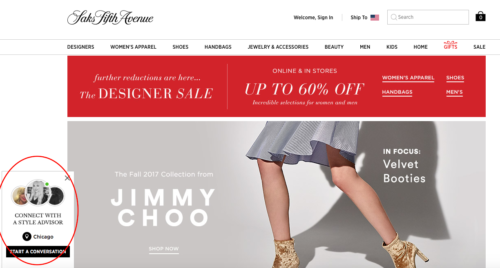
Saks Fifth Avenue is changing that. I attended a session led by Joe Milano, Senior Vice President, General Manager, Digital Retail for Saks Fifth Avenue and Oscar Sachs, CEO of Salesfloor. During the session, Joe discussed how Saks was generating a lot of traffic to its website, but its sales associates were best at making connections with shoppers and closing a deal. Saks saw an opportunity to “people power” its website, allowing customers to shop online directly with their favorite local Saks Style Advisor. Each Style Advisor can create their own personalized version of the Saks’ website with personalized product recommendations and live shopping experiences.
Shoppers who don’t have a preferred Style Advisor can connect with a local associate via live chat or a texting platform directly from the retailer’s website. By doing so, they can receive the personalized, 1:1 assistance they’d receive in a Saks store.
Brick and mortar is very much alive and well, and many consumers are still opting to shop in a physical store. The brands and retailers that will be survive — and thrive — are those that successfully connect the online and in-store experiences.
What was your favorite session from IRCE 2017? Please share in the comments below!
This blog post is the second in our series of key takeaways from the keynotes and breakout sessions from the 2017 PowerReviews Digital Commerce Summit.
Last month at the inaugural PowerReviews Digital Commerce Summit, Jessica Teji, Manager of Client Success, and I teamed up to present a session on product sampling. If you know me, you know that product sampling is a channel I’m passionate about, and I enjoyed having the opportunity to discuss how sampling can help brands increase reach.
When you think of product sampling, you probably think of small, one-time use products — like a travel size tube of toothpaste or makeup samples. But we challenged folks in the audience to think bigger. PowerReviews has executed successful campaigns for much larger products — including luggage and even mattresses!
We’ve found that product sampling is especially effective for the following three types of products.
1. New Products
It’s a simple fact that shoppers are much less likely to purchase products that don’t have reviews….and we’ve got the research to back it up. A recent PowerReviews study found that 45% of shoppers will turn to a search engine if there aren’t reviews (or aren’t enough reviews) for a product on a brand or retailer site.
How can you generate those critical first reviews for a brand new product? Through product sampling, obviously! Then, the reviews you generate through sampling will help convert more shoppers. At PowerReviews, we’ve found that when a product without reviews adds one or more reviews, the conversion rate for that product increases by an average of 65%.
As an added bonus, reviews for new products are likely full of insights that can help you improve future iterations of your products. For example, if you’re releasing a new piece of luggage and several of your samplers mention a faulty zipper in their reviews, you can work with your manufacturer to fix the zipper — and watch your star ratings soar.
Hint: If you’re launching a new product in time for the 2017 holiday season (but not necessarily a seasonal item), it’s not too late to launch a sampling program. Do it now, and you’ll generate plenty of reviews so when holiday shopping season is in full swing, consumers will find plenty of review content to build their confidence in this new product.
2. Seasonal Products
The window for purchasing seasonal products — such as holiday-themed merchandise — is generally quite short. For example, parents are probably only in the market for this holiday doll a couple months out of the year — at most.
That’s why it’s important to generate reviews for these seasonal products as quickly as possible. How can you generate these reviews? With a sampling campaign, of course. If you have a holiday product, consider a pre-season sampling program now. Then, your seasonal product will have plenty of reviews available when consumers start actively shopping for it.
3. Targeted Products
Use our dashboard to isolate key products on your website that have a low volume of reviews — or no reviews at all, and high traffic. Then, run a sampling campaign to generate reviews for these products so more of your traffic converts as they see a high number of reviews.
Learn More
Interested in learning more about how product sampling can help you generate valuable user-generated content? If you’re an existing PowerReviews customer, contact your Client Success Director. If you’re not a current PowerReviews customer, contact us today.