Meet the Team is a recurring series on the PowerReviews blog, allowing you to get to know the people behind our success.
We recently caught up with Arit Nsemo, Senior Client Success Director, EMEA at PowerReviews, to hear about her move to London and what it’s like working with some of the biggest brands and retailers around the world.
You’ve been a part of the PowerReviews team for almost three years. What were you doing before PowerReviews? Before I worked at PowerReviews, I was the Director of Client Services at a company called Cappex, which works to match high school students with colleges. I managed our client services team there and worked closely with our college and university clients. I have a strangely vast knowledge base about even the most obscure colleges, if anyone’s interested. Before that, I managed a daycare, worked in content writing and editing, and even had a brief stint in corporate banking at JPMorgan Chase.
You recently moved from Chicago to London, to work more closely with clients outside of the U.S. What made you decide to make the move? I’ve always wanted to live and work internationally, and I travel a lot as it is so it felt like a natural next step for me. I love working for PowerReviews, and the opportunity to continue my work for a great company, connect with our European clients and learn to adapt to conducting business in a foreign country were all very appealing for me.
What’s your favorite part about having a client-facing role? Building relationships and the pace of work. There is a lot that goes into ensuring that clients are successful with PowerReviews, and when you’re in a client-facing role it’s important that you stay on top of everything and think of things that your clients don’t. We want to be the experts and build trust with our clients so they’re able to lean on us and we’re able to be consultative. The more I work with our amazing customers, the more I learn about their businesses, the better our relationship becomes — and that’s super satisfying for me.
You work closely with some of the biggest brands and retailers in Europe and Australia. What’s that like? It’s a lot of fun. Seriously. Being new to living in Europe, it’s so lovely to get this kind of introduction to the culture through working with some of the biggest brands and retailers. I get an inside look at how their customers interact with them, and therefore I get a holistic view of a ton of different types of people.
What’s the best part about living in London? The weather! Just kidding. The best part of living in London has got to be proximity to all of Europe for fun weekend trips, and having the ability to easily visit clients across Europe. I also enjoy that London is such a global city. I’m a native Chicagoan, so big cities aren’t a stretch for me, but London’s diversity in culture is really unique. If I’m being honest, I’m also looking forward to skipping out on below zero temps in Chicago this winter.
The following is a guest post from our partners at Mavrck.
As a result of the proliferation of digital channels and connected devices, U.S. consumers now spend, on average, two hours per day on social networks and the equivalent of 12 hours per day consuming media online.
This rise in media consumption has also come at a cost, namely consumers’ increased ad fatigue, as well as a growing challenge for marketers to create relevant content. Nearly 33% of U.S. adults online say they currently use an ad blocker, and 48% report they actively avoid ads, according to a recent report from Forrester Research.
As consumer trust in institutions continues to dissolve, we’ve become a society whose purchase behavior is increasingly influenced by those we choose to connect with online. In 2016, 74% of people trusted social networks to guide their purchase decisions. With the growing need for content, it’s also not enough for marketers to rely on social listening and content curation alone. Investing in an influencer marketing and relations strategy is now essential for brands to compete for consumers’ attention.
When you hear the words ‘influencer marketing,’ I’m sure the Kardashians and other Hollywood celebs are some of the first to pop into your mind. However, celebrities aren’t the only type of influencers. The content that consumers trust and seek out today, is content that’s created by consumers. In the context of your brand, you have the opportunity to harness this interest and intent by leveraging the power of your most underutilized business asset: existing customers with social influence.
As more consumers seek out credible and authentic information online, here’s how to leverage the influence of your most influential customers to impact consumers in the moments that matter.
The Power of Micro-Influencers By now, you’re probably realizing the power of identifying your most influential customers. These micro-influencers are everyday customers who possess influence around relevant topics among their followers on social media. Let’s take a look at the ways micro-influencers can be most beneficial for your brand — creating, amplifying and submitting branded content, such as social posts and product reviews.
While there are many ways to generate a steady stream of ratings and reviews, leveraging your micro-influencers is one key way to keep this content coming. Due to the sheer number of micro-influencers, they are able to generate more content than macro- or mega-influencers. They also have such rich knowledge and insight, that to not leverage them for content creation is a significant missed opportunity. Since micro-influencers are loyal customers of your brand, their feedback is more authentic and credible than mega- or macro-influencers. Still not convinced?
The Latest From Us We want to help your brand reach its goals. We are excited to announce that PowerReviews and Mavrck have partnered to enable merchants to generate user-generated content on demand from their Mavrck influencers, advocates, referrers and loyalists, and syndicate that review content out to 5,000 sites and one billion monthly in-market shoppers across the PowerReviews Open Network. This combined solution has been proven to help merchants and marketers activate and drive more business value out of their influencers and advocates. Want to learn more? Contact us today.
About the Author
Liz Gottbrecht is Vice President of Marketing at Mavrck, an influencer marketing company. Prior to joining Mavrck, Liz was the Director of Marketing at Streetwise Media, a digital media and events company that operates news properties in Austin, Boston, DC and Chicago.
By now, you’ve likely heard the stats about how user-generated content — particularly ratings and reviews — drive traffic and sales. But in case you haven’t…on average, when a product adds one or more reviews, that product experiences a 108% lift in traffic, a 65% lift in conversion and a 92% lift in sales.
In addition to driving traffic and sales, reviews — both positive and negative — are also full of valuable insights that can help you improve your business. Read on to learn six ways you can start using the insights from customer reviews to improve your products and the overall customer experience.
1. Fix a Product Flaw A negative review or two may tip you off to something that is a legitimate – and correctable – gripe. For example, Hammacher Schlemmer, a PowerReviews customer, noticed that a watch they sold on their website had an average star rating of 2.7. After digging into the reviews for the watch, the company noticed that several customers mentioned the clasp on the watch wasn’t working. Hammacher Schlemmer took this information to their manufacturer to change the clasp, and the average star rating for the watch climbed to 4.7.
2. Add a New Feature If enough shoppers mention a relatively easy enhancement that could provide a benefit, consider adding it. For example, let’s say you’re a sportswear brand. You observe that several reviews suggest adding a zipper to the pocket of one of your running jackets, to ensure personal belongings don’t fall out while running. So, you work with the manufacturer to add a zipper to the product. Once you add this feature, you notice that many reviewers sing the praises of the new zipper and your overall star rating soars.
3. Enhance Your Product Descriptions Sometimes, a negative review is the result of a buyer not having a clear understanding of the product’s details. For example, you’re a luggage brand, and you notice for one particular suitcase, several reviews mention that they expected the handle of the suitcase to be leather, when it’s actually foam. You use this as an opportunity to add a statement similar to this in the product description:
“Foam handle for more comfortable carrying.”
Now, future shoppers have a more accurate picture of what to expect from your product, and they can use this information to find the products that best fit their needs.
4. Improve Instructions Imagine you’re a brand that sells home furnishings. You note that the reviews for a children’s dresser aren’t so great. Shoppers love the design, but several mention that it’s extremely confusing and time consuming to assemble. Use this as an opportunity to simplify the assembly instructions that are sent with this item.
5. Highlight an Unsung Feature Most likely, there are certain product features that you tout the most. But by examining your product reviews, you might identify other product features that you’ve overlooked — but are important to your customers. Consider adding these features in your product descriptions.
6. Build Customer Loyalty If you improve your product or another element of the customer experience based on feedback from reviews, let your customers know. People want to feel like their voices are heard. And acting on their feedback — then letting them know you’ve done so — will help you forge even deeper connections with your customers.
Start Identifying Actionable Insights Today Ready to start identifying insights that can help you improve your products and the customer experience? If you’re an existing PowerReviews customer, contact your Client Success Director to learn more about identifying actionable insights in your review content. If you’re not an existing customer, schedule a demo today to learn how you can drive traffic, sales and insights with ratings and reviews.
An Analysis of 7.8 Million Reviews in the PowerReviews Open Network
There was once a time (in the not so distant past) when the idea of asking for feedback from customers — then displaying that feedback for the world to see — was a pretty radical concept. But now, the importance of ratings and reviews is largely understood by brands and retailers as a key part of the consumer’s purchase journey. In fact, nearly all consumers consult customer reviews, and 86% consider them an essential resource when making a purchase decision.
Clearly, consumers find reviews helpful when identifying the products that best fit their needs. But not all reviews are created equal. While one review may be full of great insights, another may fall short. At PowerReviews, we allow consumers to give individual reviews “helpful” or “not helpful” votes to indicate how useful a given review was during the shopping experience.
So what makes one review more helpful than another? To shed light on this question, we analyzed 7.8 million reviews from the past year in the PowerReviews Open Network to determine the common features of reviews that have been voted by consumers as helpful. We explored the impact of various review characteristics — including review length, sentiment and recency — as well as the types of products that are most likely to have reviews with helpful votes.
During the most recent PowerReviews webinar, I shared the results of this analysis. Read on for a summary of three key findings that I shared during the webinar, as well as some recommendations for brands and retailers to start generating and displaying the content that’s most helpful to consumers.
Longer Reviews Aid Consumers
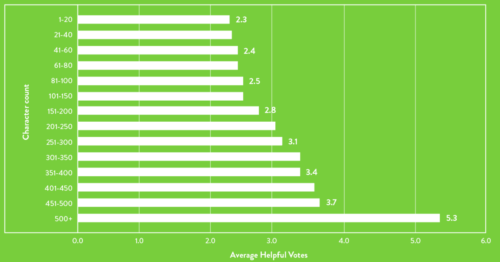
We found that review length is the characteristic most correlated with helpful votes. The longer the character count of a review, the greater its average number of helpful votes. While a review that’s under 20 characters has an average of 2.3 helpful votes, a review with 500 or more characters has an average of 5.3 helpful votes.
Longer Reviews are More Helpful
Recommendation for Brands and Retailers: Longer reviews provide greater detail, which make them more helpful to future shoppers. One way for brands and retailers to generate longer (and likely, more helpful) reviews is to tie in review generation to an existing rewards program and award points for longer reviews, regardless of the star rating. Then, once a consumer accrues a set number of points, they receive some type of award, such as a coupon or a code for free shipping.
One-Star Reviews Have the Most Helpful Votes
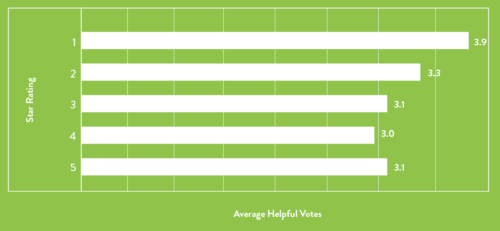
Our analysis also found that one-star reviews, on average, generate more “helpful” votes than any other star rating. Why? Because—in addition to adding a level of authenticity to your review content, negative reviews steer consumers towards products that best fit their needs.
Consumers want to hear the worst thing someone has to say about a product. In fact, 82% of consumers seek out negative reviews. Reading negative reviews helps a consumer determine if negative elements are relevant to their needs.
For example, let’s say you’re a brand that sells running shoes. One particular style of shoe has a one-star rating, with a review that notes that the shoe doesn’t work well for trail running. A future shopper finds this review helpful because she does all of her running on a treadmill. The previous consumer’s comment about trail running is irrelevant to her.
Average Helpful Votes By Star Rating
Recommendation for Brands and Retailers: Though you certainly don’t want to aim for negative reviews, this content is a helpful tool that allows consumers to identify the products that best fit their needs. In addition, negative reviews provide a level of authenticity to your content. Previous research found that nearly half (44%) of Generation Z shoppers wouldn’t trust a product’s reviews if there were no negative reviews present. And finally, negative reviews allow you to identify insights to improve future iterations of your products, as well as the overall customer experience.
Visual Content Boosts Helpfulness
A growing number of consumers are seeking out reviews that include user-submitted visual content, such as photos and videos. In fact, recent research on the role of visual content found that 88% of consumers look for visual content—such as photos and videos—submitted by other consumers prior to making a purchase. And a product experiences a 69% conversion rate lift, on average, when that product adds at least one user-generated image.
Since consumers are actively seeking out this content, it makes sense that reviews with helpful votes include more photos and videos than those without. Reviews with helpful votes have 16% more videos and 13.8% more photos than those without visual content.
Recommendation for Brands and Retailers: More and more consumers depend on user-generated visual content to inform their purchases. Ensure you’re making it easy for your shoppers to submit photos and videos as part of their reviews. This visual content makes product reviews even more helpful to future shoppers.
Later this month, myself, along with other members of the PowerReviews team, will be headed to Los Angeles, California for Shop.org 2017, a three-day ecommerce conference hosted each year by the National Retail Federation.
This year’s agenda is packed with sessions on all things digital, from creating omnichannel experiences, to using data to drive personalization, to making your company fit for the future with new technologies. Attendees will have the opportunity to hear from industry leaders, including Walmart, Kohl’s and Wayfair, among many others. Plus, there will be plenty of time for ecommerce pros to network with their industry peers. It’s going to be a fantastic time, and I’m looking forward to it.
If you’re going to be at Shop.org, don’t miss these two opportunities to connect with the PowerReviews team:
Hear about the Transparency Economy I’m not a neuroscientist, but I’m playing one at Shop.org. On Wednesday, September 27 at 9:00am, I’m presenting a tech talk session on the Transparency Economy. Today, consumers have access to more information than ever before. They expect it, but even more importantly, their brains require it to make better decisions in all aspects of their lives.
During the session, I’ll explore how the human brain makes decisions, and its connection to how transparency through authentic feedback from other consumers (both positive and negative) drives the Transparency Economy.
Meet with the PowerReviews Team Our team will be at booth #732 in the expo hall, so be sure to stop by to find out what’s new at PowerReviews, win prizes and discuss the opportunities and challenges your business is facing and how PowerReviews can help.
We’ll be in the expo hall during the following shifts:
Tuesday, September 26 from 9am-5:30pm
Wednesday, September 27 from 9am-3pm
If you’re not currently a PowerReviews client and would like to schedule a time to meet with a member of our team, reach out to us and we’ll get something scheduled. If you are a current PowerReviews client and want to schedule time to connect with the Client Success team while you’re at Shop.org, feel free to reach out to your Client Success Director and they can make that happen.
I hope to see you September 25-27 in LA!
There’s no longer any doubt that reviews are a helpful tool for consumers. 95% of consumers consult customer reviews and 86% consider them an essential resource when making a purchase decision.
But here’s the thing — when it comes to helpfulness, not all reviews are created equal. While one review may be full of detailed insights to help a customer make a smart purchase decision, another may provide no insight at all.
Let’s say you’re an expectant mother shopping for a rocking chair for your baby’s nursery. There are two reviews for one model you’re considering. The first review is full of details and even includes a photo of the chair in a nursery, to give you a better idea of what it looks like “in the wild.”
“I live in a small condo in Chicago and searched forever for a rocking chair that would work for my son’s small nursery. This one was exactly what I was looking for. It’s high quality and sturdy and has a high back to accommodate my tall husband. As an added bonus, the chair is very stylish so once we no longer need it in the nursery, we’ll move it out to the living room.”
This review helped you determine that you want to add this rocking chair to your shortlist, so you give it a “helpful” vote.
The next review is also five stars, but provides short, vague feedback, with no visual content.
“Great chair.”
Since this review didn’t provide very much insight, you give it an “unhelpful” vote.
What Makes a Review Helpful
So what makes one review more helpful than another? Recently, we analyzed 7.8 million reviews from the past year in the PowerReviews Open Network to identify common characteristics of reviews that have been voted by consumers as helpful. Here are four of our key findings:
1. Longer is Better: The longer the character count of a review, the greater its average number of helpful votes. This makes sense, since longer reviews likely provide more details, as illustrated in my example above.
2. Visual Media Matters: Reviews with helpful votes have a 16% higher volume of videos and a 13.8% higher volume of photos than those without. This comes as no surprise, since previous PowerReviews research found that 88% of consumers look for visual content (think photos and videos) submitted by other consumers prior to making a purchase.
3. Product Price Makes a Difference:Reviews with helpful votes tend to be on higher priced items, most likely because shoppers are spending more time consuming reviews for expensive products and taking the time to indicate a review’s helpfulness.
4. One-Star Reviews Pull in the Most Helpful Votes: One-star reviews, on average, generate more “helpful” votes than any other star rating. In addition to adding a layer of authenticity to your review content, negative reviews steer consumers away from a product that doesn’t meet their needs, and steer them toward products that do.
Six Tips for Collecting and Displaying the Review Content Most Helpful to Your Shoppers
Reviews are a key tool for helping consumers make smart purchase decisions. But, as our analysis found, not all reviews are created equal. Here are six recommendations for generating and displaying more of the review content that’s most helpful to your consumers.
1. Identify Your Most Helpful Reviewers Analyze your review content to identify contributors of helpful content. For example, look at the number of reviews your consumers have written, as well as the components of those reviews — including helpful votes, visual content and length.
2. Reward Reviewers for Optimal Content Once you’ve identified your helpful reviewers, ask them to contribute additional content. Consider tying review generation to your existing loyalty program and awarding points to reviewers whose content meets certain criteria. For example, give points to reviewers that write reviews that are a certain number of characters long or include a photo or a video. Then, when the consumer accrues a certain number of points, he can redeem the points for a reward such as free shipping or a percentage off a future purchase.
3. Focus on High Priced Items We know from previous research with Northwestern University that reviews are more impactful for items that are higher priced in their category — for example, an organic cereal that is more expensive than a non-organic variety. And our most recent analysis found that reviews with helpful votes tend to be on higher priced items, likely because consumers are spending more time reading reviews for items that cost more.
Identify higher priced items in your product catalog, and prioritize generating reviews for these products. There are many ways to do this, but the most impactful way is to send a post purchase email to shoppers, asking them to contribute reviews for products they’ve recently purchased. In fact, we’ve found that more than 60% of reviews are written as the result of a post purchase email.
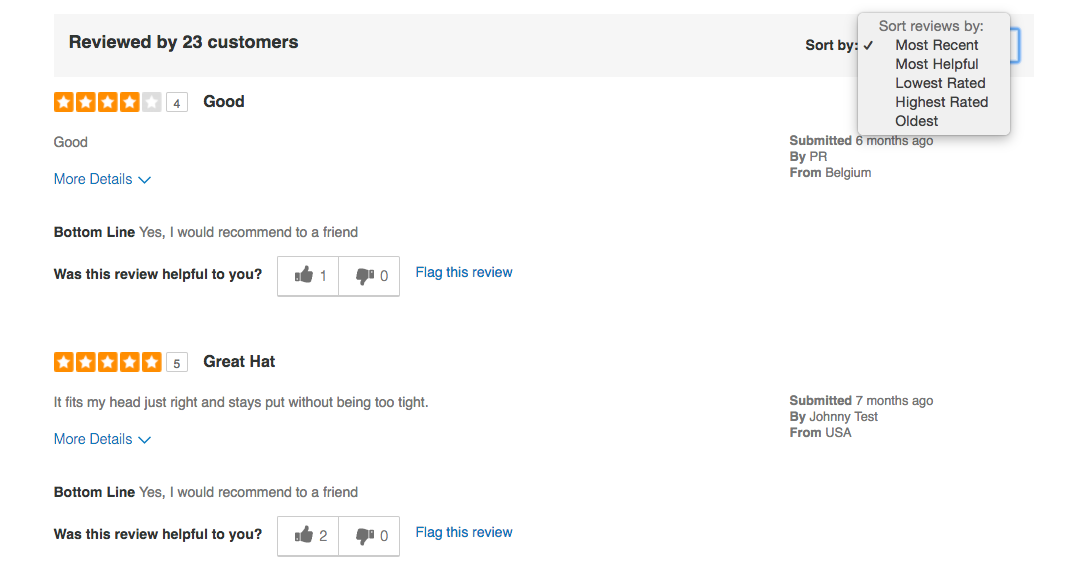
4. Allow Consumers to Sort By Review Helpfulness Most likely, your website allows visitors to sort reviews for a given product by a number of different factors, such as star rating (highest rated vs lowest rating) and recency (most recent vs oldest). Be sure you’re also allowing consumers to sort reviews by helpfulness. This allows shoppers to easily identify the content that has been most helpful to others like them.
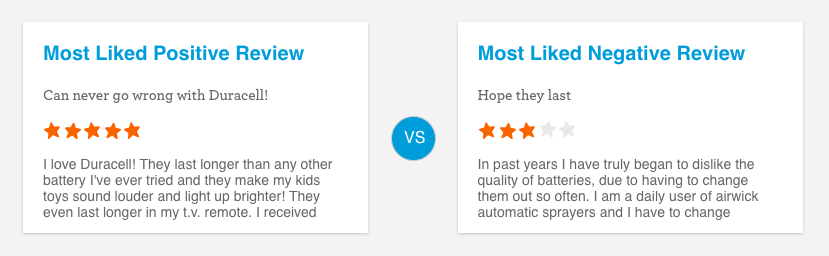
5. Prominently Feature Helpful Reviews Once you’ve generated plenty of reviews, make it easy for shoppers to find the most helpful review content for each of your products. Ask your ratings and reviews provider if they offer a review “faceoff” that provides consumers with an at-a-glance summary of the most helpful positive and negative reviews. This faceoff will help your shoppers more quickly determine if a product is right for their needs.
6. Embrace Negative Reviews Our analysis also found that one-star reviews, on average, generate more “helpful” votes than any other star rating. And though you certainly don’t want to aim for negative reviews, this content is a helpful tool that allows consumers to identify products that best fit their needs. In fact, 82% of consumers seek out negative reviews. And 44% of Centennial shoppers (age 13-18) don’t trust a product’s reviews if there’s no negative feedback present.
In addition to helping shoppers make smart purchase decisions, allowing negative reviews to be posted on your website provides a level of authenticity to your content, which helps you build trust with your shoppers. Plus, negative reviews allow you to identify insights to improve future iterations of your products in order to better serve your customers.
Want to find out what else we learned about helpful reviews? Download our latest report: Anatomy of a Helpful Review.
What’s the best way to encourage your customers to review your products?
With an automated post purchase email simply asking your shoppers to write reviews for recently purchased products. The following guide covers everything you need to know about post purchase emails — from the importance of sending these emails to getting your own Collect Email program live with PowerReviews.
Read the post in its entirety or use these jump links to find the content you need.
Post purchase emails are typically automated communications sent to your recent customers a set number of days after a purchase. These emails ask about their experience with your product or service. The idea is to solicit — then display feedback that will help you get more customers and to make your products even better.
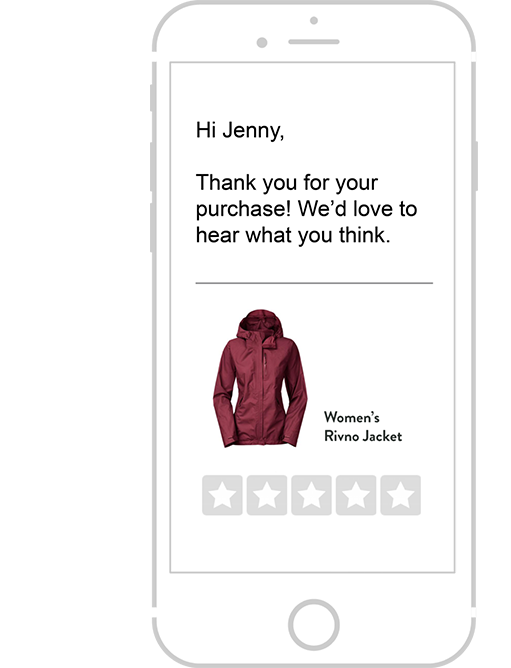
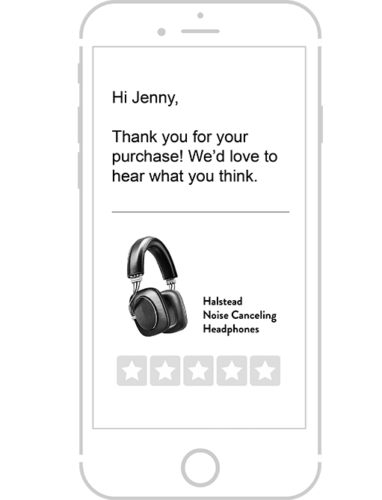
The image below is an example of a Collect Email, asking a customer named Jenny to rate the product she recently purchased. Feel like you’re ready to dive in and create your own program? See how PowerReviews helps increase your review content.
Why Send Post Purchase Emails?
Post purchase emails are the most effective way to generate more products reviews, which are proven to increase traffic, sales and insights. In addition, post purchase emails help you increase the lifetime value of your customers.
Increasing Customer Lifetime Value
Post purchase emails help you build relationships with past shoppers. By letting consumers know that you care about their feedback, they’ll be more inclined to turn to your brand when they’re in need of a product you sell. And by driving former customers back to your website you also benefit from another potential purchase.
Generating More Product Reviews
One of the best ways to get more reviews is to ask for them. Encourage customers to review the products they’ve purchased in an easy, streamlined, mobile-friendly post purchase email.
Why Product Reviews Are Important
Product reviews are important for many reasons. For one, Google indexes product reviews, which means the more reviews you have, the higher your products will place in Google search results. This leads to more traffic on your site. In fact, we’ve found that when a product without reviews adds at least one review, that product experiences a 108% lift in traffic, on average.
Reviews also increase conversion by helping your customers make more confident purchases. When a product without reviews adds one or more reviews, that product experiences an average conversion increase of 65%. In addition, our research with Northwestern University found that reviews are especially important for high consideration items.
Another reason reviews are helpful is that brands can use the authentic customer feedback in reviews — both positive and negative — to improve their products and their customer’s experience.
Hammacher Schlemmer, a PowerReviews customer, noticed that a watch they sold on their website had an average star rating of 2.7. After digging into the reviews for the watch, the company noticed that several customers mentioned the clasp on the watch wasn’t working. Hammacher Schlemmer took this information to their manufacturer to change the clasp, and the average star rating for the watch climbed to 4.7.
Want yet another reason why reviews are important? Your customers want to read them. 86% of consumers indicate that reviews are an essential resource in the purchase journey. And 70% of mobile shoppers reported being more likely to purchase a product if the mobile site or app they’re purchasing from has reviews.
Best Practices for Post Purchase Email Content
Many elements contribute to the performance of your emails — including design, timing, mobile friendliness and incentives. But one of the biggest factors is the content — the words you use to ask shoppers for a review. Here are some tips to create Collect email content that will drive big results.
Keep Things Short and Simple
Research from Microsoft found that the average attention span of a human is 8 seconds — one second shorter than that of a goldfish. Since humans are easily distracted, it’s crucial to keep the text of your emails short, simple and to the point. The purpose of this email is to solicit reviews, so make sure to include a direct call to action to write a review. Avoid elements that will pull customers away from writing a review, such as banners, links to other parts of your website, or other sales or marketing calls to action.
Personalize When Possible
Shoppers have come to expect personalized experiences throughout their shopping journey. Always use the customer’s name in the body of the email, and consider including it in the subject line, too. Research from Experian found that personalized subject lines garnered a 26% higher open rate.
In addition, thank the customer for purchasing a specific product. And include a photo of the product so the customer knows what product they should review.
Avoid Truncated Subject Lines
The subject line will play a big role in whether or not the customer opens your post purchase email. So make sure it’s compelling. Also, keep in mind that more than 50% of emails are opened on a mobile device. So keep your subject lines under 55 characters to avoid being truncated on mobile devices. Use mobile responsive ratings and reviews software when possible.
Measure, Test and Optimize
Don’t adopt a “set it and forget it” mentality when it comes to your post purchase emails. Instead, build your post purchase email program, continuously measure results, and look for ways to improve.
Consider testing different elements of the email, including:
Subject lines
Headlines
Promotions
The look and feel of the email
If you’re seeing a higher conversion rate, great! But keep tracking progress so you know if that number ever starts to dip.
Best Practices for Post Purchase Email Design
Now we’ll focus on some design do’s and don’ts that can help you improve the performance of your post purchase emails.
Do: Keep it Simple
Keep the design of your post purchase emails clean and simple, with the important elements in the upper portion of the email whenever possible. That way, shoppers will quickly understand the call to action, even if they don’t scroll through the entire email.
In addition, avoid banners, links and other promotions that will distract shoppers from writing a review.
Don’t: Use a Small Font
Using small fonts can cause your customers to squint and struggle, and potentially miss the value of your follow up message. Because more than half of people are reading their email on a mobile device, it’s important to use a readable font size. A 16 or 18 point font size will make your email easy to read — regardless of the device your shoppers use.
Do: Use a Single Column Format
Your multi-column email format might look beautiful on a desktop browser, but there’s a good chance it’ll get awkwardly broken up on a mobile device, resulting in something that’s difficult to read and engage with. Use a single column layout so the email scales down nicely on mobile devices and your customers aren’t forced to pinch, zoom, and scroll to see the entire message.
Don’t: Bury the “Write a Review” Action
The easier you make it for your customers, the more likely they are to write a review. Make the “Write a Review” action stand out by including an image of the product you want the customer to review, along with a button that takes him to the Write a Review form. And remember — people are using their finger (not a mouse) on their mobile devices. So avoid tiny links and opt for larger buttons instead.
The Best Time to Send Post Purchase Emails
A key factor that can make or break the success of your post purchase emails is timing.
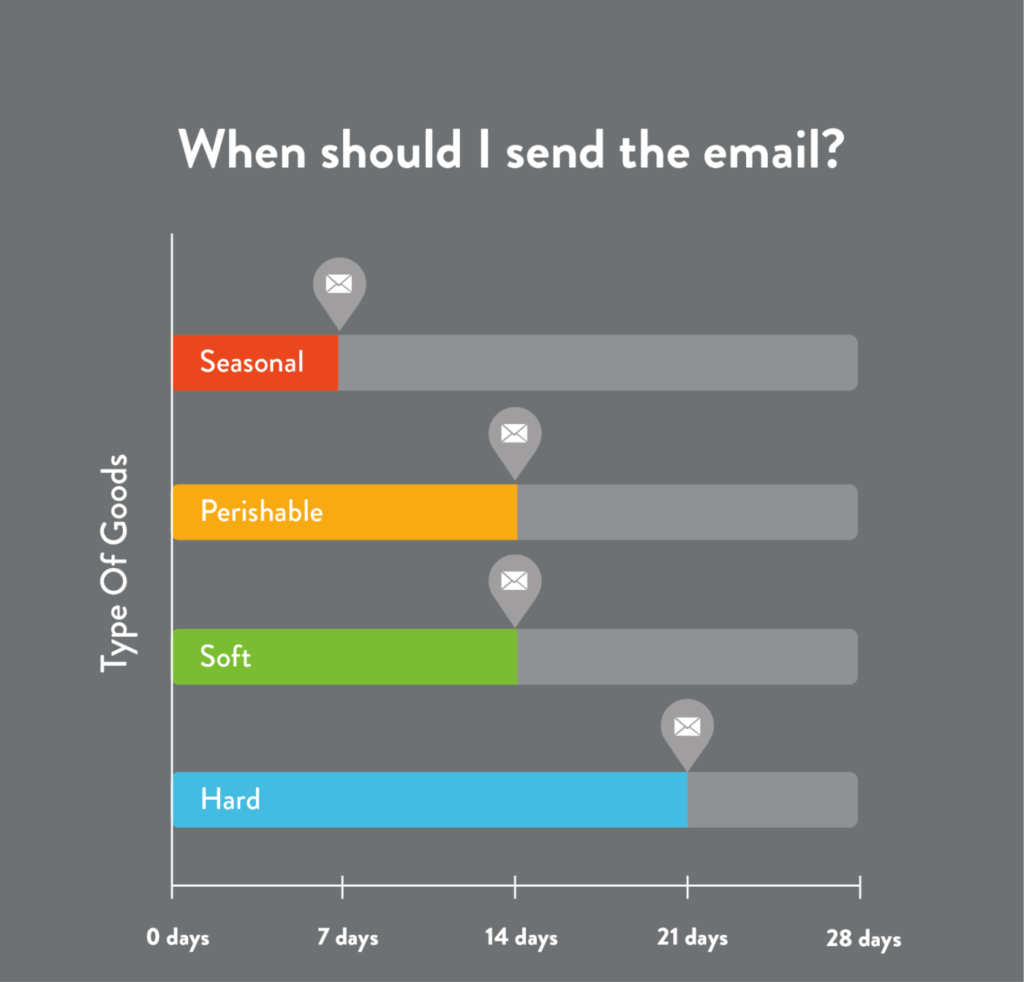
So, when’s the best time to send a post purchase email? In general, Wednesdays and Saturdays have the highest conversion rate for reviews. But how long should you wait to send a post purchase email? The short answer is, “it depends.” The ideal timing depends on the type of product the consumer purchased.
Hard Goods – 21 Days
Hard goods are items that are durable and don’t wear out quickly. Here are some examples of hard goods.
Refrigerators
Washing machines
Computers
Wait 21 days before sending a post purchase email for hard goods. Why so long? Let’s say a customer purchases a new washing machine. If you send a post purchase email too quickly after the purchase, the customer has probably only used the machine a few times. But if you wait 21 days, he’ll have enough time to get a good feel for the washing machine so he can write a well-informed, thorough review.
Soft Goods – 14 Days
Soft goods are items that are immediately consumed or have a lifespan of three years or less. Here are some examples of soft goods.
Clothing
Cosmetics
As with hard goods, you’ll want to give customers the opportunity to try out the product before writing a review. But don’t wait too long, since the lifespan of soft goods is much shorter than hard goods and the purchase won’t be top of mind for long.
Perishable Goods – 14 Days
Though you want to give customers the opportunity to experience the product, if you wait too long, the product will be out of sight and out of mind. Some examples of perishable goods include:
Cut flowers
Fresh fruits and vegetables
Start Sending Your Post Purchase Emails with PowerReviews
1. If you’re not already a user, request a demo to chat with the team and figure out whether our solution is a good fit.
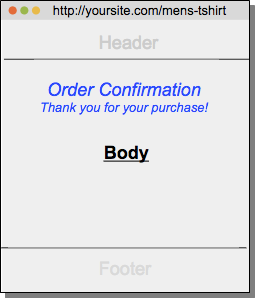
2. Install our Checkout Beacon on your confirmation page. This beacon sends PowerReviews your customer order data so our software can automatically send your Collect Emails to your customers. If you have your own email service provider that’s no problem, we can work with you on getting it automated on your side.
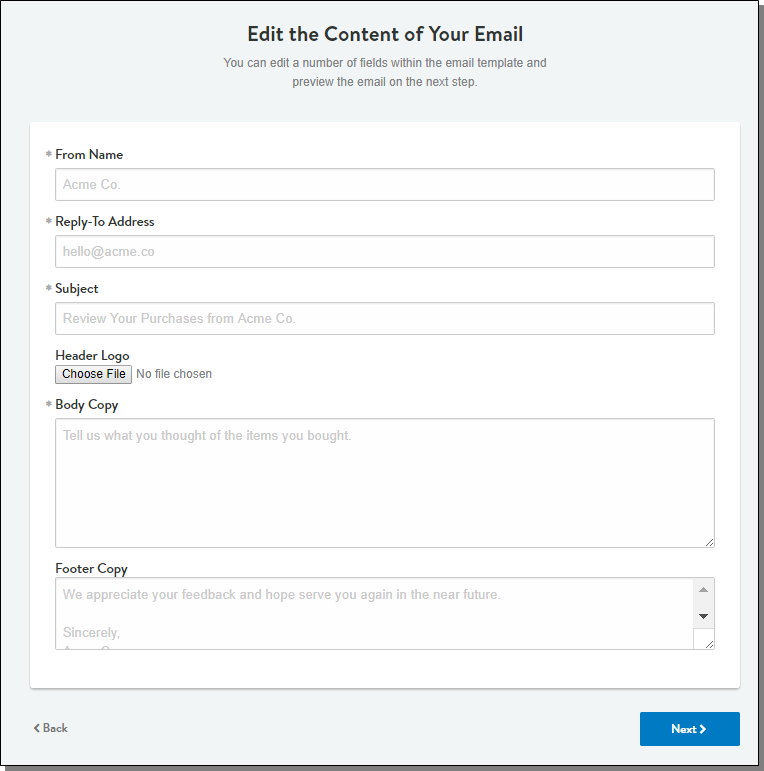
3. Edit the content of your email to match your brand. You can tweak the from-name, reply-to address, subject line, header logo, body and footer copy.
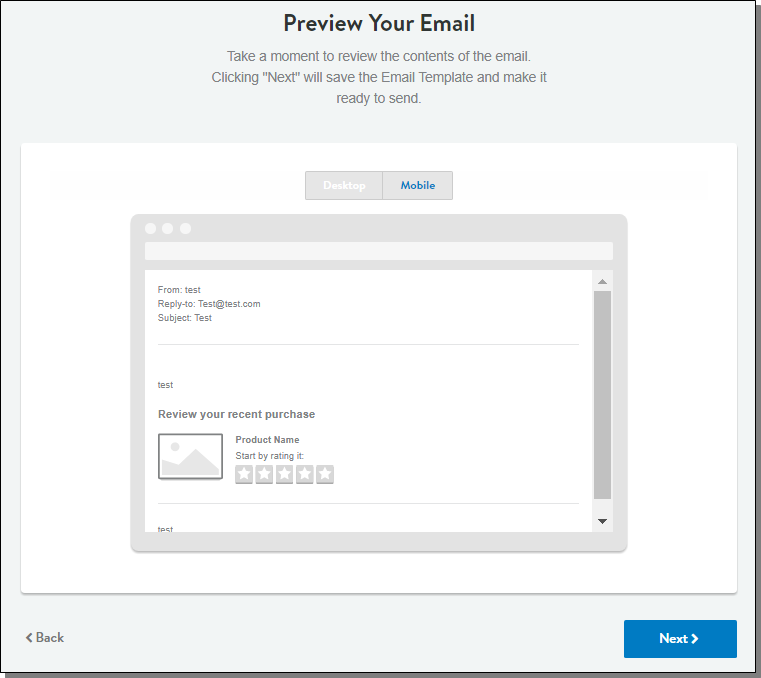
4. Preview your new email to make sure that it’s capturing the proper data and looks good across multiple devices.
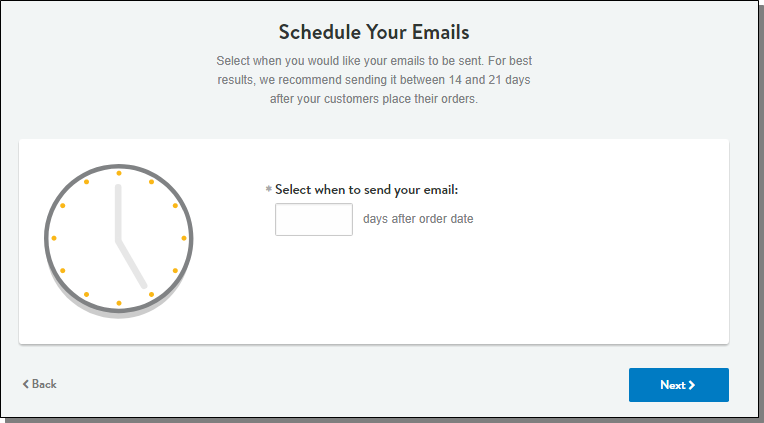
5. Once your email looks the way you want it to, you’ll need to schedule it. In the wizard, enter the number of days after the order date when you want your emails to be sent to your customers.
Prep Your Product Pages for Black Friday and Cyber Monday Traffic
Gift givers are increasingly turning to user-generated content such as ratings and reviews to inform their holiday purchases. How can you ensure you have plenty of this content available for your key products so you can boost traffic and conversion this holiday season?
Read on to learn five things you should do now so you have plenty of reviews for plenty of your products by the time Black Friday and Cyber Monday roll around.
1. Send Collect Emails If you’re an existing PowerReviews customer, you’ve heard this tip time and again…but it’s worth mentioning again. Make sure you’re sending an email to your shoppers asking them to write reviews for recent purchases. Your post-purchase emails should be mobile-friendly, include a short subject line, and a clear call to action. We’ve found that more than 60% of reviews are written as the result of a Collect email.
[bctt tweet=”More than 60% of reviews are written as the result of a Collect email.” username=”powerofreviews”]
2. Launch a Product Sampling Campaign for New Products If you’re like many brands and retailers, you’re likely introducing new products in time for Black Friday and Cyber Monday shopping. Be sure you’re launching these products with plenty of reviews in place in order to build confidence for your shoppers — if you don’t, you risk losing shoppers to a site that provides the content they crave. PowerReviews research on the path to purchase found that 45% of shoppers will turn to a search engine if there aren’t reviews (or aren’t enough reviews) for a product on a brand or retailer site.
How can you generate reviews for products you haven’t yet launched? With a product sampling program. Work with your ratings and reviews provider to send samples to your own list of consumers or an on-demand community of reviewers. Then, collect reviews from those who received a free sample. Vornado, a leader in airflow products, found that 97% of consumers who received a sample as part of their most recent product sampling campaign with PowerReviews went on to write a product review. Read more about how Vornado uses product sampling to generate and syndicate reviews.
3. Streamline the Process for Collecting Reviews for Multiple Items You’re shopping for a pair of shoes, and you end up with socks, too. You put a dress shirt in your shopping cart, and at the last minute, you add a tie. Sound familiar? You’re not alone. We’ve found that about 60% of orders coming through the PowerReviews network include more than one item.
[bctt tweet=”60% of orders coming through the PowerReviews network include more than one item.” username=”powerofreviews”]
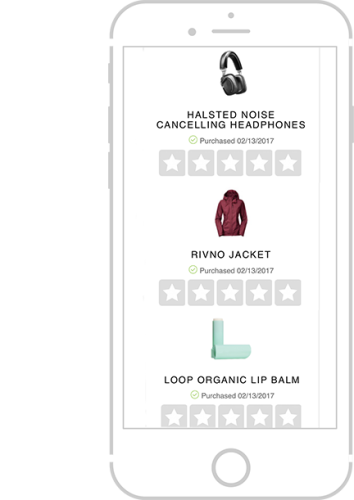
So, make it easy for shoppers to write multiple reviews in one sitting. PowerReviews offers a product feature called Review Your Purchases that allows consumers to quickly review all purchases within a single, mobile-friendly page, rather than requiring them to navigate to a different page to write each review. We’ve found that our clients who use Review Your Purchases have increased review volume by 92% year over year, compared to just using a standard, single product review form.
4. Collect Reviews from In-Store Shoppers The National Retail Federation predicts that online retail will grow 8-12% in 2017 — three times the growth rate of total retail sales. And while ecommerce continues to grow, the fact remains that today, the majority of retail transactions still happen within the four walls of a brick and mortar store.
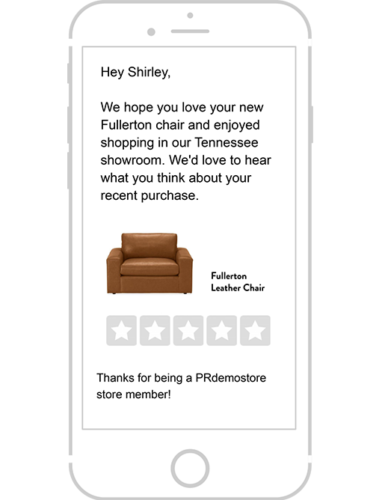
If you’re not currently collecting reviews from your in-store shoppers, you’re missing out on an opportunity to generate a ton of content. How can you start collecting reviews from in-store shoppers? Leverage your existing rewards or loyalty program to send emails to consumers who shop in your stores, asking them to submit reviews. Consider rewarding these shoppers with loyalty points for contributing content, and once they accrue a certain amount of points, send them a coupon for a percentage off a future purchase.
If you don’t have a rewards or loyalty program, print a call to action on all of your store receipts, asking shoppers to write reviews for the products they purchase.
5. Ask Your Staff Members to Write Reviews Chances are, some of your biggest brand advocates are the folks who work in your corporate office and your stores. For example, if you’re a retailer that sells snowboards, I’m willing to bet there are a good number of your employees who own one of your snowboards.
So, ask your staff members to write reviews for products they own. In order to maintain transparency — and the trust you’ve work hard to earn, be sure to add a badge to all reviews that were written by a member of your team.
4 Ways to Stay Ahead and Be Prepared to Navigate in New Directions
The retail landscape is constantly evolving, thanks to many factors including technology advancements, new (and different) competition, global market shifts, and the ever-changing expectations of shoppers. Marketers need to constantly be on the lookout for ways to lead the front edge ideas of tomorrow.
Earlier this month, Kim Feil, CEO of bizHive, spoke during the PowerReviews monthly webinar about the importance of going back to the marketing strategy drawing board in order to remain competitive in an ever-changing world. During the webinar, she shared these four ideas for staying ahead and being prepared to navigate in new directions.
Encourage competition between cross-functional teams Make sure your cross-functional partners see and embrace the changes ahead. Assign cross-functional teams to compete with each other, and give them the task of playing the role of a competitor or an industry you want to understand better. Bring everyone back together and let them argue about how those competitors or an industry change could potentially put you out of business, and how you’d shift your strategy to prevent that from happening.
Dedicate team time to debate impacts of external trends and identify contingency plans Think about the possible positive and negative impacts external trends will have on global industries and brainstorm ways your company can capitalize on possible business deals. In other words, ask yourself what these changes mean for your company and how you can pivot in order to come out on top. For example, if a particular technology is commercialized by a company, what can your company do to be stronger and better?
Shop your category with Millennials Millennials have a lot of money and influence. They don’t care about how things were 18 years ago — they just want to know what’s available to them today. They constantly want more, and your company needs to be prepared to give them that. Shop your products with a Millennial, and you’ll get some really eye opening insights.
Identify potential support partners and resources to be part of your strategies Ask yourself where can you create joint ventures and acquisitions (such as the case of Amazon and Whole Foods). Identify where you need to build, to buy and to ally.