It’s hard to believe, but the holiday season is almost upon us. You’ve been busy optimizing your website for increased traffic, ensuring inventory is well stocked and increasing staff to prepare your stores and websites for the holiday season. But make sure you’re not overlooking one thing that’s key for holiday prep — filling your product pages with ratings and review content.
In 2016, 75% of holiday shoppers said they considered product reviews to be important when choosing to make holiday purchases, according to the National Retail Federation. Gift givers heavily rely on reviews during the holidays, because they’re buying things they’re not familiar with. For example, a man is visiting his girlfriend’s family for the first time, and is buying a gift for her parents. Reviews give gift givers like him the confidence they need to know they’re giving gifts that’ll be well received. And don’t forget that shoppers are treating themselves, too — the NRF reports that more than 70% of consumers bought gifts for themselves last holiday season. These consumers also want to find review content for the products they’re purchasing for themselves.
How do you provide gift givers with the ratings and review information they’re looking for? Here are four tips for appealing to consumers that are shopping for both themselves and others this holiday season — and beyond.
1. Generate Reviews
There are two kinds of holiday shoppers — those who begin shopping before Thanksgiving and those who prefer to wait until December, according to research by CPC Strategy. Both sets of consumers rely on reviews to inform their purchases. And since 35% of shoppers start the purchase journey on a search engine, it’s key to start collecting reviews now — before the busiest shopping days — to ensure your site includes all the information your shoppers are looking for and is optimized for search.
One of the most effective ways to generate reviews is to send post purchase emails. Post purchase emails are automated communications sent to your recent customers a set number of days after a purchase, asking about their experience with your product or service. 60% of reviews in the PowerReviews network come from post purchase emails, on average. Make sure these emails are optimized for mobile, since 50% of emails are opened on a mobile device.
And don’t overlook your in-store customers. Today, a majority of transactions happen in a store. To generate feedback from this segment of customers, either tap into an existing rewards program or ask shoppers to share their email addresses at the register. Then, send a post purchase email asking them to provide feedback on their recent purchases. Consider offering an incentive, such as a coupon for a future purchase.
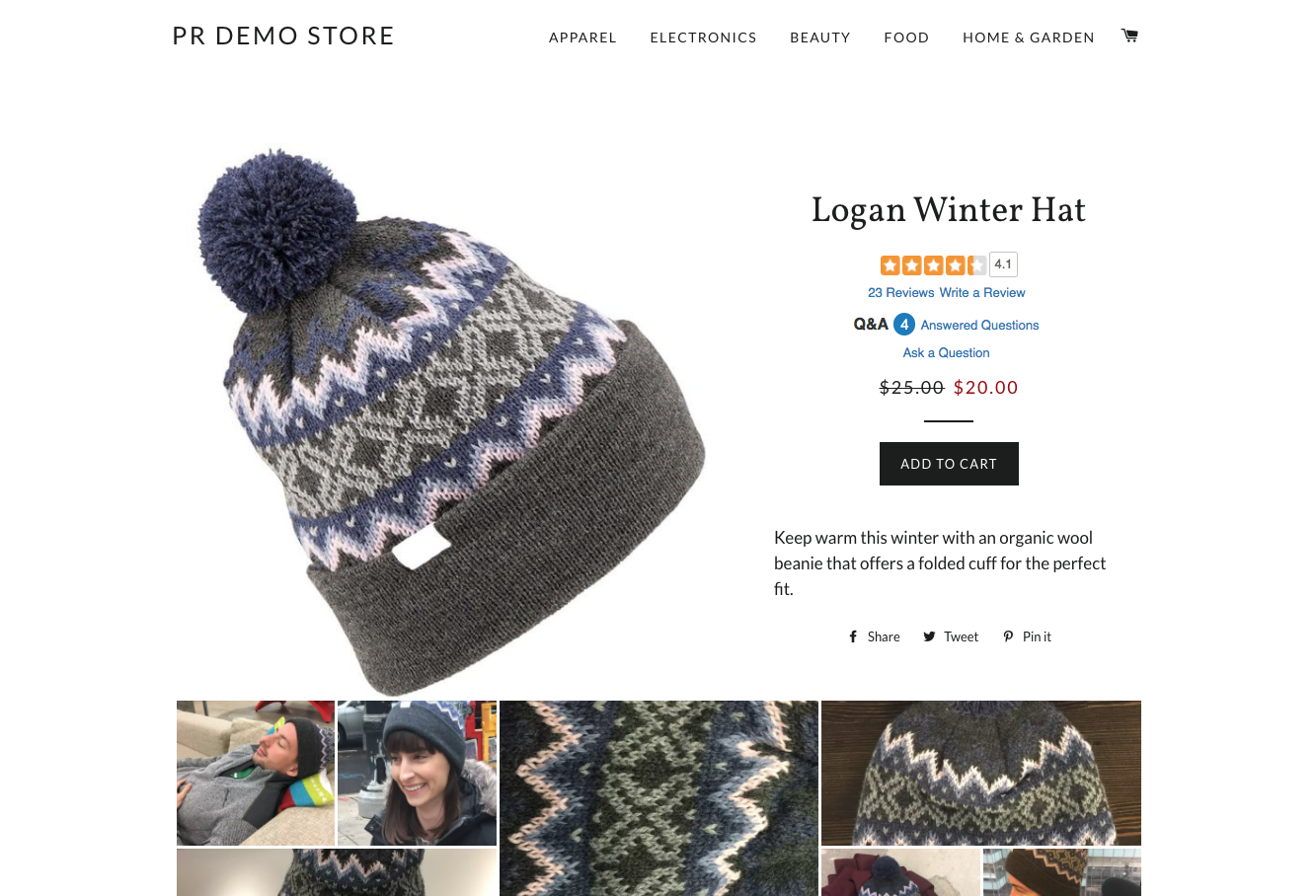
Shoppers want all the information they can get their hands on prior to making a purchase. And product information is no longer limited to written descriptions and text-based reviews. In fact, 72% of consumers say they regularly or always seek out visual content prior to purchase. Visual content shows shoppers what a product looks like “in real life” and also gives consumers inspiration for holiday gifts.
So make it easy for shoppers to submit visual content — such as photos and videos — with their reviews. Then, display this visual content directly on your site. For example, display this content in an image gallery to increase visibility, engagement and conversion.
3. Prominently Display User-Generated Content
A growing number of consumers are making purchases on their mobile devices. And 54% of consumers use their mobile device to look for product ratings and reviews while shopping in-store. So make sure reviews are easy to find on your website, via all devices. In addition to displaying review content on your product pages, think of ways you can incorporate this powerful content into other areas of your website, including category pages and even your homepage.
And don’t overlook the opportunity to display user-generated content in-store. Business advisory firm AlixPartners reports that 71% of consumers plan to do half or more of their holiday shopping in stores. It makes sense then, to prominently display consumer reviews and star ratings next to top holiday products in brick-and-mortar locations, similar to what our friends at Benefit Cosmetics do.
4. Syndicate Content
Sometimes a consumer purchases a product directly from a brand site. But other times they purchase a product through a retailer site. Syndicating your review content to your retailer partners allows you to reach both types of shoppers. And retailers that accept syndicated content have the opportunity to grow their review content — without having to generate it themselves. On average, retailers get 58% of their review content from syndication.
Wrapping Up
Consumers are increasingly turning to user-generated content — including ratings and reviews, images and videos — to inform their purchases, whether they’re buying for themselves or others. Start collecting and displaying reviews now so shoppers can find the information they’re looking for this holiday season and into the new year.
The following is a guest post from our partners at Workarea.
This holiday season will bring an influx of traffic, and for most online retailers a good chunk of this traffic will be new. Whether you use segmentation to serve targeted content, personalization engines or a combination of both, we know more relevant experiences can boost conversion rates and revenue. But how can you deliver personalized merchandising to new visitors without browsing history?
A common merchandising mistake
Many ecommerce sites roll the dice on what customers want, and showcase featured products, brands and categories in prime home page merchandising slots.
With a catalog of 35,000 products, iHerb has a .00003% chance Sierra Bees lip balm is the best option for prime home page real estate.
While there’s a case for featuring hot deals and heavily discounted products, the chances of nailing relevance or appeal for every visitor (or even most visitors) can be slim. This tactic can work great for brands with small catalogs and tight product lines or homogeneous customers, but the larger and more diverse your offering and customer base, the riskier this is.
What’s more, these single-shot offers don’t help you glean the useful information that helps you personalize the site experience immediately and in future visits. Instead of suggestive selling, think guided selling. Make sure your home page includes callouts for content and categories that match the customer segments you target through personalization, email marketing and other strategies.
Common segmentation attributes include:
Geolocation
Gender
Age
Interests
Ownership (vehicle, device, pet, etc.)
B2C or B2B status
Of course, your business may have its own, based on your product offering and target customer.
Here are 4 tips to convert new visitors through smart holiday merchandising and guided selling. (Bonus tip: you can use these strategies year-round!)
1. Get customers to self-segment
If you’re already using an email capture pop-up, ask for one more piece of information from your customers. Not only does this give you a head-start on segmenting your email list, you can pass this data back to your commerce system to serve targeted content and offers based on this context, within the user’s session (depending on your ecommerce platform’s capabilities). You can also potentially pass this back to your retargeting platform (again, depending on your solution).
Billabong allows customers to opt into gender-segmented offers.
World Kitchen asks for birthdate. The inclusion of birth year helps segment by age, which may be useful in promotional, merchandising and remarketing campaigns.
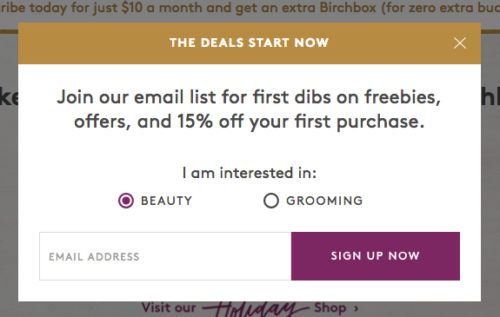
Birchbox asks customers to self-segment by interest.
Email opt-in fields also give you more reliable segmentation information. Click-through and buying behavior during the holidays is a poor indicator of what your customer will respond to year-round, when buying context shifts from gifting to buying for one’s self.
This can also be done through home page content. Rather than leave the customer to browse the site and filter category lists by hair type, Ouidad puts shop-by-hair-type front-and-center. This provides relevant product results quicker than traditional browsing, and allows Ouidad to segment customers and serve relevant content earlier in the purchase journey.
Ouidad makes self-segmentation its main home page goal.
2. Use Geolocation
Geolocation tools can tailor your experience in a variety of ways. At the country level, show the right catalog with the right pricing and shipping options, free shipping offers and other messaging. For example, the U.S. and Canada’s Thanksgivings fall within different months. December 26 is Boxing Day in Canada and the U.K.
Segmenting by state lets you target the right products and imagery by climate, cultural and lifestyle factors. For example, no snow blowers for Arizonians and plenty of umbrellas for the Pacific Northwest.
Different states also have different tax rules, and you may be able to offer faster shipping options in regions near your fulfillment centers. One Workarea customer leverages same-day shipping for time-sensitive Halloween costumes in the regions it can with great success, showing this offer only to the customers it applies to.
3. Offer guided selling tools
“Gift finders” are common holiday merchandising features. Essentially they offer a way to apply multiple attribute filters up-front, versus navigating through the traditional catalog structure and weeding through many more results.
When done right, they anticipate the attributes customers should be thinking about. Like a helpful in-store salesperson, they ask the right questions to give the best results.
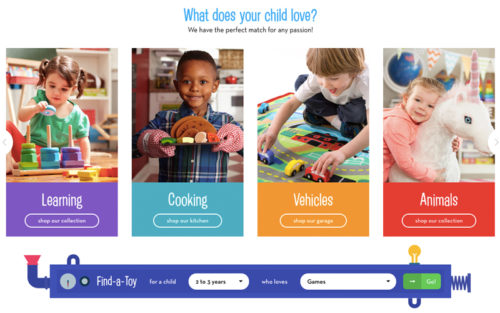
Melissa and Doug allows buyers to filter by age and interest for a tighter set of relevant results.
Year-round, package your product finder as an interactive quiz. Multi-attribute quizzes work better when customers are shopping for themselves.
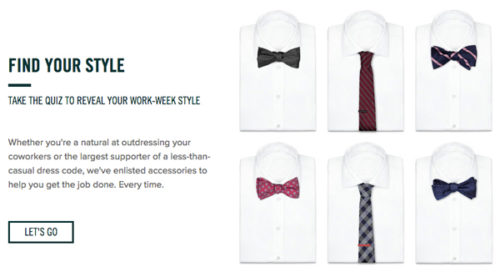
TieBar’s style quiz reveals your top work-week picks.
4. Feature top-rated products
New customers who haven’t arrived with a specific purchase in mind will bypass navigation and search, and browse your recommendations. While featuring trending products on your home page is better than random picks, nothing’s more persuasive than the social proof of top-rated products.
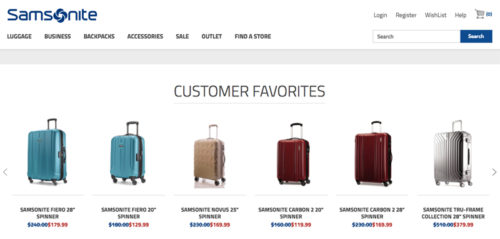
Samsonite’s home page features a Customer Favorites carousel, linking through to a special landing page.
Samsonite includes a Customer Favorites carousel on its home page.
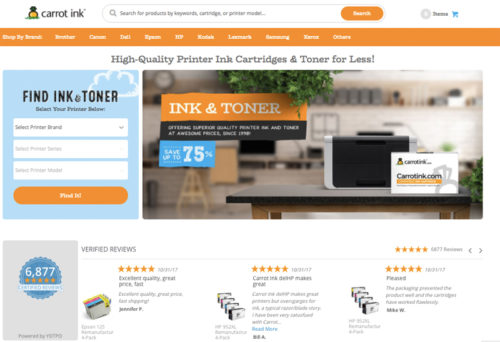
In addition to a product finder, Carrot Ink’s home page features an animated carousel highlighting its top rated products (this also reinforces that Carrot Ink has thousands of happy customers).
Carrot Ink showcases top-reviewed products in an auto-scrolling carousel.
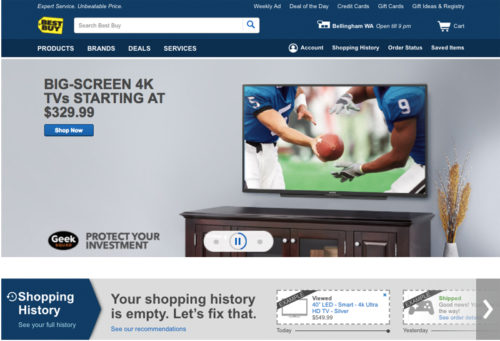
For visitors without browsing history, Best Buy provides a bold call-out.
Best Buy calls out “Your shopping history is empty. Let’s fix that.”
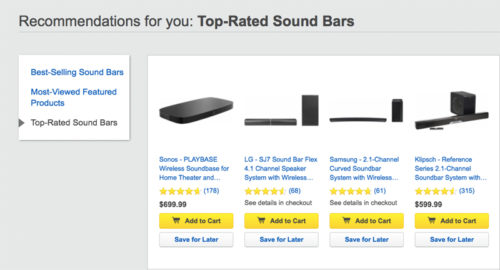
Clicking through leads to a recommendations widget that includes best-selling, most-viewed and top-rated products.
Top-rated features can help kickstart customers’ click through and give you content for further personalization.
The goal with new visitors is to get them to click and provide your system with data to run dynamic content or personalized recommendations over time.
Remember holiday shopping context
Holiday visitors can be cookied, retargeted through display, remarketed to through email and social and greeted with personalized experiences upon their returns in 2018. However, what’s most relevant to them may be radically different when buying context shifts to personal shopping.
Depending on the personalization tools and tactics you’re using, you may be able to adjust for this behavior and context to various degrees.
Your safest bet is to keep collecting visitor context through bold, self-segmented content, calls to action and merchandising all year long, and baking it into your overall strategy.
Linda Bustos is the director of merchant strategy for Workarea, the modern SaaS commerce platform purpose-built for medium to large businesses to achieve their full potential online.
Meet the Team is a recurring series on the PowerReviews blog, allowing you to get to know the people behind our success.
We recently sat down with Francis Okonkwo, Sr. Front-End Engineer, to chat about what it’s like to be on the PowerReviews engineering team and why he doesn’t eat food that requires the use of more than one hand.
What did you do before working with PowerReviews? I worked for a small trading firm for about five years, on a really small team of about three developers. After that, I worked for Bank of America doing front-end work.
What does a day in the life of a Sr. Front End Engineer at PowerReviews look like? No two days are exactly the same, since our days vary based on how close we are to our sprints or if we’re we’re releasing a new product. If it’s at the start of a sprint, there’s a lot of heads-down work, focusing on getting features completed. On those days, I’ll get to the office, go to my desk, get my headphones on and try to do as much work as possible. When I want to take a break, I’ll go talk with the Client Success Directors to get their feedback on the new features we roll out.
When did you first know you wanted to be a software engineer? There really wasn’t one moment, but I’m creative and have always been comfortable with computers. I used to draw a lot of comics, and front-end engineering does bring some of those designing skills — working with colors and shadows and things like that.
I grew up in Nigeria so I was done with high school at 16. And in between finishing high school and moving to the U.S., my mom made me take this course on how to make websites, and I really liked it. Then while studying electrical engineering in college, I took a computer science class that I ended up really enjoying. So I changed my major to computer science and ended up getting my Master’s Degree in that.
What’s your favorite part about working on the technology team? First of all, the people are great. I did interview quite a lot before taking this position, because I wanted to get my next role right. And I like the energy here, and I really like my team and my manager.
But also, the impact you can make as an individual engineer here is really impressive. You have engineers taking ownership of really core functionalities or offerings. The work I’ve done at PowerReviews in the year that I’ve been here has easily been the most challenging work, as well as the most rewarding.
Do you have any quirks? I don’t like eating foods that require more than one hand because I like to keep one hand clean when I eat. I just feel vulnerable when both of my hands are dirty — I can’t answer the phone, I can’t stop my kids from doing something they’re not supposed to. So I do my best to keep one hand clean, no matter what I eat.
What’s one thing that people in the office might not know about you? My brother was born on my third birthday, so we have the same birthday even though we’re three years apart.
Brick and Mortar Still Rules
It’s no secret that ecommerce continues to grow at a rapid pace. According to data from the U.S. Department of Commerce, ecommerce accounted for nearly 12% of total retail sales in 2016. But while a growing number of transactions happen online, grocery is an area that has traditionally lagged behind — especially in the U.S.
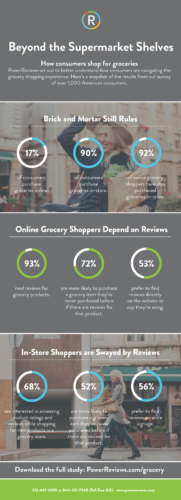
Today, the majority of consumers are still visiting a brick and mortar store to purchase groceries — at least part of the time. PowerReviews recently surveyed more than 1,000 U.S. consumers to learn more about their grocery habits and found that 90% have made an in-store grocery purchase within the last three months. And even shoppers who opt to purchase groceries online are still visiting physical store locations — 92% of online grocery shoppers have also made an in-store grocery purchase within the last three months.
[bctt tweet=”90% of consumers have made an in-store grocery purchase within the last three months.” username=”powerofreviews”]
But online grocery will continue to grow, driven by the growing number of shopping options available to consumers. And consumers’ desire for information is resulting in a change to their in-store shopping habits, too. Read on to find out what we learned about how today’s consumers are using technology and information to navigate the grocery store aisles.
Consumers Use Their Phones as a Grocery Shopping Tool
A majority of consumers continue to purchase their groceries in a brick-and-mortar store. However, these in-store shoppers certainly aren’t steering clear of technology altogether. In fact, our most recent research found that the majority of grocery shoppers (59%) are using their phones as a shopping tool while browsing the grocery store aisles.
[bctt tweet=”59% of grocery shoppers use their phones as an in-store shopping tool.” username=”powerofreviews”]
How exactly are in-store grocery shoppers using their phones while shopping? The most popular activities are finding or redeeming coupons (32%) and reviewing shopping lists (30%). Grocery shoppers are also using their phones in-store to find product information prior to purchase, including recipes (20%), ratings and reviews (17%) and competitor prices (16%).
In-Store Grocery Shoppers Want Reviews for Products that are New (or New to Them)
A consumer may not ordinarily seek out reviews for a grocery item that she purchases each week—such as cereal. But if she’s considering a cereal she’s never purchased before, there’s a certain amount of risk involved. Reviews can help mitigate this risk.
It makes sense, then, that the majority (68%) of in-store grocery shoppers are interested in accessing product ratings and reviews while shopping for new products in a grocery store. Be sure to incorporate review generation into product launches — consumers want to find this content.
[bctt tweet=”68% of in-store grocery shoppers are interested in finding reviews for new products.” username=”powerofreviews”]
Reviews Sway In-Store Grocery Shoppers
We know that 72% of online grocery shoppers are more likely to purchase a grocery item they’ve never purchased before if there are customer reviews for that product. And our latest research found that reviews also have the power to sway in-store shoppers: more than half (52%) of in-store shoppers are more likely to purchase a grocery item they’ve never purchased before if there are reviews for that product. Again, this points to the importance of generating plenty of reviews, especially for new products.
Shoppers Want Reviews on Store Signage
Our survey found that while in-store grocery shoppers are using their phones for various shopping related tasks, 41% admit they don’t use their phone to help them shop. It makes sense, then, that more than half (56%) of in-store grocery shoppers prefer to find reviews on store signage.
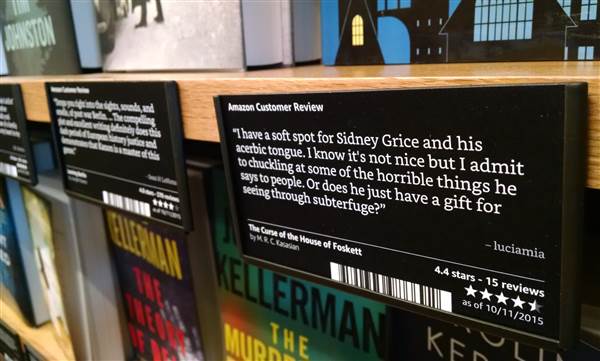
Shopper marketing professionals, take note: now’s the time to start providing your shoppers with review content in-store. Featuring this content in your stores can be as simple as displaying star ratings and customer reviews on cardboard signs alongside your products, similar to what Amazon does in their bookstore locations.
In-Store Shoppers Also Seek Reviews Online
As mentioned previously, a majority of grocery shoppers are using their phones as a grocery shopping tool. So, understandably, in addition to the 56% of shoppers who want to find reviews on store signage, 25% prefer to find reviews on the store’s mobile app, and the remaining 19% want to find reviews using the store’s website via a mobile phone.
Be sure you’re appealing to your mobile-savvy, in-store shoppers by ensuring you have plenty of reviews on your website and mobile app, too. As an added bonus, this content helps ensure your product pages are showing up in search engine results, too.
Wrapping Things Up
The way consumers shop for groceries is evolving, driven by the growing number of shopping options and the desire to easily access product information, regardless of the shopping channel. Leading grocery brands and retailers are adapting their strategies to more effectively meet the expectations of today’s grocery shoppers. If you’re a grocery brand or retailer, now’s the time to rethink your strategy to better connect with shoppers across channels.
Best Practices for Product Sampling
By now, most businesses understand that ratings and reviews are a powerful tool to increase traffic, conversion and insights. One effective way to quickly collect more of this powerful content is product sampling.
Product sampling campaigns are a quick and simple way for brands and retailers to increase product review content for both new and existing products. They allow brands and retailers to collect a large amount of review content in a short amount of time and are practical for products of any size — even products as large as luggage and mattresses.
At PowerReviews, we’ve found that brands and retailers using product sampling campaigns see an 85% review completion rate, on average, with some clients seeing completion rates as high as 97%. Read on to learn six tips that can help you get the most from your product sampling campaign.
1. Know what you’re trying to accomplish
Maybe you’re looking to generate a high volume of reviews for one particular product, or perhaps you’re hoping to generate reviews across multiple items in your product catalog. Either way, it’s important to understand your end goal in order to run a successful product sampling campaign.
Some brands and retailers opt to send out a low volume of samples for a wide range of products in order to achieve high coverage — the number of products that have reviews. This is important because on average, when PowerReviews customers go from displaying 0 reviews to at least 1 review for a given product, they see a 108% lift in traffic, a 65% lift in conversion and a 92% lift in sales.
Some businesses set out to generate a high volume of reviews for one particular product. This strategy can be used to generate a high volume of content prior to product launches. The resulting reviews give customers the confidence to convert and provide insights to help brands and retailers identify and fix any product flaws before the launch.
2. Know your target audience
Make sure the people who receive your samples are part of your ideal audience. This will ensure you’re sending to more engaged recipients, and in turn, you’ll see higher review collection rates. Here are a couple ways to do this:
Send surveys
Always send surveys to your potential sampling recipients with targeted questions about your products. For example, if you’re running a sampling program for a toy train, you might ask if the recipient has any children between the ages of five and 10. And make sure you send new surveys for each campaign. This ensures you’re sending your samples to people who are engaged and active, leading to higher collection rates.
Cultivate your database
It’s beneficial to work with a sampling provider that has a database of customers with many different backgrounds. For example, the PowerReviews sampling database has been cultivated over the last 10 years to ensure that all potential demographics can be targeted by our customers. As a result, PowerReviews can target specific client personas for different campaigns. For each campaign, we screen our database with qualifying questions and then only distribute the samples to the respondents who meet our client’s specific criteria. We also pull live data points and verify contact information for every campaign.
3. Understand which products lend themselves to the most successful campaigns
At PowerReviews, we’ve found that product sampling campaigns are especially effective for these three types of products:
Product launches
Shoppers are much less likely to purchase a product that doesn’t have reviews. In fact, a recent PowerReviews study found that 45% of shoppers will turn to a search engine if there aren’t reviews (or aren’t enough reviews) for a product on a brand or retailer site. Prior to launching new products, execute a sampling campaign to ensure you have plenty of reviews available.
Seasonal promotions
For products with a short shelf life, such as holiday-themed items, it’s key to generate reviews quickly. A pre-season sampling program will make sure your seasonal product has plenty of reviews available when consumers start actively shopping for it.
Targeted products
Most likely, there are other products in your catalog that are in need of additional review content. One good example is products that have high traffic but low conversion. Run a sampling campaign for that targeted product to generate reviews — and in turn, give customers that are coming to your product pages the confidence to convert.
4. Time your sampling campaign right
A common misconception is that you need to wait for a product to be live on your site before running a sampling campaign– but that’s not the case. Instead, run these campaigns before the product is live in order to launch with plenty of reviews.
On average, sampling campaigns last 6-8 weeks, and we start seeing reviews generated at the end of the third week. At PowerReviews, we recommend that brands and retailers complete a sampling campaign prior to the product being live on your site or on a retailer’s site. This gives you time to collect all reviews, syndicate them and fix any product issues mentioned in reviews.
5. Send post purchase emails after consumers receive their samples
Send Collect Emails to the recipients once they’ve gotten their samples, encouraging them to write a review for your product. And make it easy for them to write a review — don’t make them log into a portal to write content about your products. Instead, make sure that the collect email you send has a direct link to the write a review form.
With PowerReviews, we send an initial email telling the participants the product has been shipped (with a tracking number when available). We also include the write a review form in this email. Then, we send a series of follow-up emails to maximize collection rates.
PowerReviews clients can customize when post purchase emails are sent. For example, a toy retailer might want to collect reviews within the first week after sending a children’s toy, but a mattress company would want to wait a couple months to give the recipient time to experience the new mattress.
6. Badge reviews appropriately
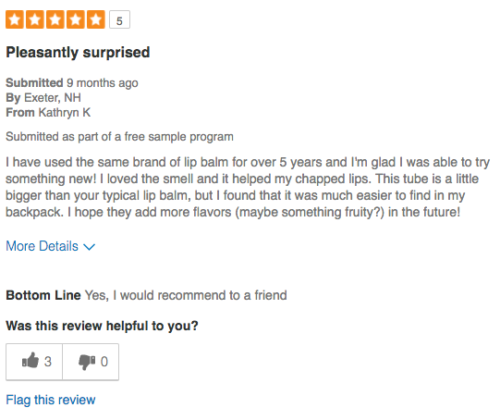
When it comes to product sampling, transparency is key. In order to preserve trust and transparency, be sure to indicate which reviews were written as a result of the sampling campaign.
Product Sampling Experts
To see what a company that’s running successful product sampling campaigns looks like, see what’s new with our friends at Vornado. The company’s first sampling campaign resulted in an 83% completion rate, and their most recent sampling campaign had a 97% completion rate. Plus, the reviews collected from sampling campaigns are 44% longer than those collected organically. This is important since recent PowerReviews research found that the longer a review, the more likely it is to garner helpful votes.
Filling your product pages with fresh, rich content helps drive more traffic to your site and helps your customers learn more about the products they’re perusing. One way to ensure your product pages are updated frequently with fresh content that’s relevant to your consumers is by implementing question and answer (Q&A) software on your website.
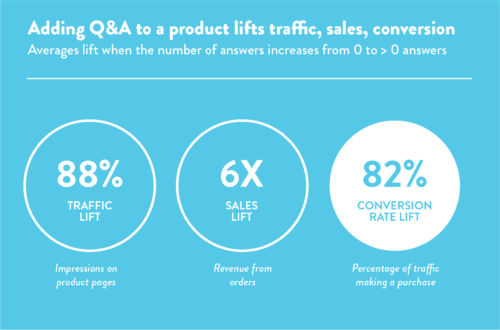
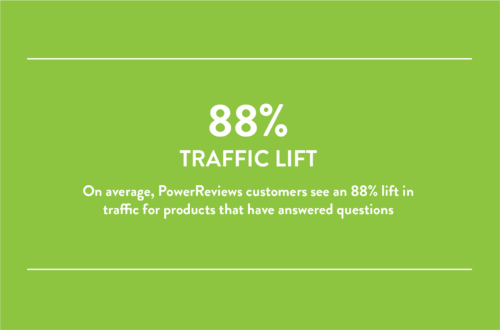
Q&A software allows your prospective customers to, you guessed it, ask questions about the products they’re interested in. In turn, quickly answering your customers’ purchase-blocking questions increases conversion and drives traffic to your product pages. On average, when a product goes from displaying 0 answers to at least one answer, brands and retailers see an 88% lift in traffic, and an 82% lift in conversion for that product.
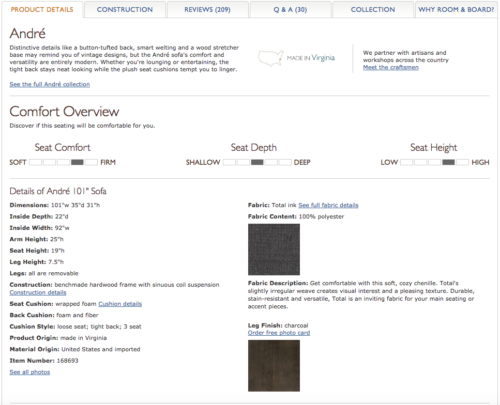
Giving shoppers access to this information at the point of purchase can — and will — impact whether or not they convert. In fact, the leading furniture retailer Room & Board noted that the conversion rate for consumers who either read reviews or questions and answers was 95% higher than the site average.
This complete guide to question and answer technology will explore everything you need to know about Q&A software. Learn how to leverage this software to increase conversion, generate more insights and bring more traffic to your product pages. If you’re looking for answers to specific questions, use the jump links below to navigate to that section, or simply read on.
Why is Q&A Software Important
Who Should Answer Customer Questions
Question and Answer Best Practices
How Do You Get Q&A Software On Your Site
Why is Q&A Software Important?
When consumers are shopping, they’re likely to have questions about the items they’re considering. This is why the content generated from Q&A is extremely valuable– 55% of U.S. online adults are likely to abandon their online purchase if they cannot find a quick answer to their question, according to Forrester. Question and answer technology allows your shoppers to find answers to the questions that stand in the way of them making a purchase.
Increasing Conversion by Answering Purchase-Blocking Questions
Q&A increases conversion by enabling you to provide fast answers to questions from online shoppers. No matter how detailed the product description, some shoppers may still have additional questions they need answered before they’re comfortable enough to convert. Giving them the option to ask questions is vital, as 45% of Centennials said they wouldn’t buy a product if they couldn’t ask a question about it.
The way our friends at Skechers describe it is simple. “Because a customer who submits a question is already engaged, if we can give them the answer they want in a timely fashion they usually buy the shoe.”
Increase Organic Traffic to Product Pages
It’s important to optimize your product pages for search, since 35% of shoppers start their purchase journey on Google or another search engine. The good news is, search engines prize fresh, relevant content. Having Q&A software on your website allows for a steady stream of fresh, relevant content, which helps improve your placement on search engines which, in turn, increases your site traffic. As previously mentioned, PowerReviews customers see, on average, an 88% lift in traffic when products go from displaying 0 answers to at least 1 answer.
Generate Better Insights for Products
Businesses with Q&A software can analyze the questions that are frequently asked by visitors to determine if there’s a need to enhance product descriptions. Let’s say you’re a furniture retailer and notice consumers frequently post questions about products in your bedroom category. You can take this opportunity to add more detailed product descriptions on your site, to reduce the amount of questions being submitted.
2. Who Should Answer Customer Questions?
OK, so you know answering customers’ questions increases your conversion rate. But you’re worried about burdening your team with all those questions. Good news — customer questions can be answered by a number of different people. In fact, using multiple answer sources will help alleviate some of the burden on your customer service representatives. Leverage internal subject matter experts and previous buyers, or gain access to the PowerReviews on-demand answer community.
Internal Subject Matter Experts
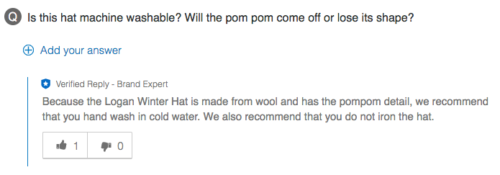
Subject matter experts are your brand education and customer service teams. They’re best suited to respond to questions from consumers since they deal with similar questions on a daily basis. Set them up with access to your Q&A dashboard and they can start answering customer questions. If you’re a PowerReviews customer, these answers will be badged as ‘customer care,’ to verify their authenticity.
Product Owners
Who knows your product better than someone who’s already purchased and used it? Asking a product owner helps speed up response time and allows consumers to hear from others like them. Plus, nearly two thirds of Centennials (consumers between the ages of 13-18) prefer having their questions answered by previous customers rather than a retailer.
When a potential buyer asks a question, your product owners are notified through an email and invited to answer the inquiry in order to help the shoppers make the right buying decision. In addition to speeding up the response time, allowing your product owners to answer questions gives you the opportunity to re-engage your customer base and turn your product owners into brand advocates and regular content contributors.
PowerReviews On-Demand Answer Community
PowerReviews customers can send unanswered questions to a vetted group of online researchers. If a product owner doesn’t answer a customer’s question fast enough, it will then be sent to the on-demand answer community where the answers then filter through our moderation process.
3. Q&A Best Practices
Now that you understand the impact of question and answer technology and you’ve implemented a Q&A solution on your website, read on for five tips for making the most of this solution.
Take It Slow
If you’re not sure about the volume of questions your team will be equipped to handle, take it slow. Launch Q&A on a few product pages, or on a specific category, to get a sense for the volume and types of questions you’ll be receiving. At PowerReviews, we recommend launching on your most popular products so you get a good baseline expectation and can adjust bandwidth accordingly.
Intelligently Route Questions
Questions asked on your site can go to different question queues based on the type of question. You can keep it simple and route all questions to a general queue, or you can route specific questions to different kinds of people. For example, maybe you want questions about shipping to go to a subject matter expert, but you want any questions having to do with a product and its use to go to a product owner.
You can also route questions in the case of answers not being generated in a given period of time. For example, a customer asks a question and first it’s sent to your product owners, if after 48 hours it’s not answered, it’ll be routed to your internal subject matter experts. If after 48 hours it’s not answered by them, it will be routed to the PowerReviews on-demand answer community.
Pre-Seed Questions
Your customer service team is likely already logging product questions as they receive and answer them. Take note of commonly asked questions and use this information to seed questions and answers into your Q&A platform so you can proactively answer frequently asked questions.
Leverage Q&A Search With Q&A Search, customers have the ability to filter through previously asked questions, to see if similar questions have already been submitted by other shoppers. This function helps to minimize repeat questions and get answers to customers even quicker.
Quickly Answer Questions
As stated above, 55% of U.S. online adults are likely to abandon their online purchase if they cannot find a quick answer to their question, according to Forrester. This is why quickly answering your shoppers’ questions is a key way to increase conversion. The PowerReviews recommendation is to answer questions in 24 hours or less for the best customer experience.
4. How to get Q&A Software On Your Site
Q&A increases both traffic to product pages and conversion rates, and generates actionable insights to improve your products and the customer experience. Here’s how to start collecting Q&A content on your site today.
Choosing a Q&A Software Provider
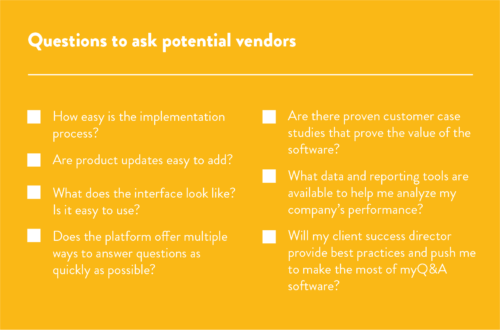
Choosing the best Q&A software provider for your business doesn’t have to be a tedious process. Here are some questions you’ll want to ask that will help you choose from the providers you’re considering.
How easy is the implementation process?
Are product updates easy to add?
What does the interface look like? Is it easy to use?
Does the platform offer multiple ways to answer questions as quickly as possible?
Are there proven customer case studies that prove the value of the software?
What data and reporting tools are available to help me analyze my company’s performance?
Will my client success director provide best practices and push me to make the most of my Q&A software?
Implementing Product Q&A Software
If you’re a current PowerReviews customer and already have ratings and reviews on your site, you can add Q&A to your site with minimal effort — simply contact your Client Success Director to get started. If you are not yet using PowerReviews, reach out today to learn how you can start collecting questions from your customers.
How Grocery Retailers can Better Connect with Today’s Shoppers Across Channels
Once upon a time, when a family ran out of milk, bread and eggs, the parents had no choice but to load up the kids into the family car and drive to the local grocery store to restock. Fast forward to today, when consumers have a growing number of online grocery store options.
Though the majority of grocery purchases today happen within the four walls of a brick-and-mortar store, online grocery shopping is a trend that’s expected to grow. In fact, an analyst at Cowen predicts that online grocery sales will increase from $71 billion this year to $177 billion in 2022.
Clearly, the way consumers shop for groceries is evolving—and will continue to do so as more online grocery shopping options emerge. PowerReviews recently surveyed more than 1,000 American consumers to better understand how they’re navigating the grocery shopping process. Check out the infographic below for a snapshot of the study’s key findings. Then read on for six recommendations for grocery retailers to meet the needs of today’s consumers in order to compete—and win—in an increasingly competitive space.
Six Recommendations for Grocery Retailers
Feature Ratings and Reviews on In-Store Signage Grocery shoppers want access to reviews while they’re shopping in brick-and-mortar stores. And they don’t want to look hard to find them. In fact, more than half of in-store grocery shoppers prefer to find ratings and reviews on store signage.
If you have physical store locations, start displaying your review content in-store to help your shoppers make smart purchase decisions. Displaying review content doesn’t have to be a big investment. Simply feature star ratings and customer reviews on signs alongside your products — similar to what Amazon does at their bookstores. Doing this has the power to drive additional sales, since more than half of in-store shoppers are more likely to purchase a grocery item they’ve never purchased before if there are reviews for that product.
Include Ratings and Reviews on Your Website and Mobile Apps In addition to seeking review content on store signage, both online and in-store grocery shoppers want to find this content on retail websites and mobile apps. If you haven’t already, develop a strategy to collect plenty of reviews for plenty of your products. Then, make this content easy to access on your website and your mobile app. Consumers are actively looking for this content for a wide range of grocery products, from non-perishable items to fresh foods.
Leverage Sampling to Generate Reviews Product sampling is certainly not a new concept for grocery brands and retailers. But while sampling campaigns have traditionally been a tactic to get shoppers to try — then buy — your products, product sampling is also an effective way to generate ratings and reviews.
More than half of in-store shoppers and nearly a quarter of online shoppers are more likely to purchase a grocery item they’ve never purchased before if they can find review content for those products. So work with your ratings and reviews provider to send samples of new products — or products in need of additional review coverage. Then, ask those that received a sample to write a review.
When it comes to product sampling, transparency is key. Work with your ratings and reviews provider to make sure reviews that are generated as a result of a sampling campaign are appropriately badged.
Create Experiences in Your Stores If you have brick and mortar stores, identify ways you can leverage these assets to create memorable experiences for your shoppers that go beyond a simple transaction. For example, if you have a store that’s in an area with lots of families, offer a family cooking class. Then, at the end of class, provide them with recipes and a list of ingredients to recreate the meal at home.
Offering rich experiences for your in-store shoppers will allow you to forge deep connections with them. And chances are, a family that visits your store for a cooking class will likely stay to pick up some groceries, too.
Leverage Brick and Mortar Stores to Drive Online Success Look for opportunities to leverage your brick-and-mortar stores as a tool to drive your online success. One way grocery retailers are doing this is by offering click and collect services, which allow consumers to place an order online and pick it up in a store. For example, 55% of all digital sales for Target are fulfilled in-store.
Consumers appreciate the convenience of click and collect services — our research found that 38% of online grocery shoppers use this type of service. Offering this service saves your customers time, and it has the potential to drive additional in-store sales.
Bolster Your Online Presence
A growing number of consumers are shopping for groceries online. And even those who are visiting brick-and-mortar grocery stores are using their phone as a shopping tool. That’s why it’s important to have a strong online presence so consumers can find your product pages — and easily convert on them.
Make sure your website provides a great experience for your shoppers and includes plenty of information about your products and your stores. Go beyond your own product descriptions to prominently feature product ratings and reviews on your website and mobile apps. In addition to providing your shoppers with the information they’re looking for, featuring user-generated content on your website can also ensure your product pages are showing up in search engine results. At PowerReviews, we’ve found that when a product goes from having no reviews to having at least one review, the product page experiences a 108% lift in traffic, on average.
Though online grocery will continue to grow, that doesn’t mean traditional grocery stores will be a thing of the past. Instead, consumers’ expectations will continue to evolve, requiring grocery retailers to rethink the way they operate. Leading grocery retailers are already adapting their strategies in order to meet the changing needs of today’s consumers. And if you haven’t started to think about it yet, now’s the time.
Five Ways to Get Your User-Generated Content in Front of More Shoppers in More Places During Holiday 2017
It may only be October 3, but brands and retailers have already been busy for months developing strategies to reach and convert more shoppers this holiday season. And for good reason. Holiday 2017 is expected to be a busy time — eMarketer predicts that total retail will grow 2% this holiday season over holiday 2016, with 15.8% growth in ecommerce.
Shoppers are increasingly turning to user-generated content — such as ratings and reviews, photos and videos — to help them make informed purchase decisions. This is especially true during the holidays when consumers are shopping for products they’re not quite as familiar with. For example, there’s Aunt Callie — a recent college grad searching for a gift for her two year old nephew. Or Kevin, a 35 year old suburban dad picking out perfume for his grandmother. Collecting and displaying UGC allows you to break through the noise to reach your shoppers — and it helps your shoppers make better purchase decisions for everyone on their holiday shopping list.
By now, you’ve likely been collecting UGC for awhile. The next step is to display this content in unique ways to capture the attention of shoppers in more places. Read on to learn five ways to get your user-generated content in front of more shoppers this holiday season.
1. Start with Your Own Website
We’ve found that 45% of shoppers will turn to a search engine if there aren’t reviews (or aren’t enough reviews) for a product on a brand or retailer site. An additional 25% will head to Amazon to find this content. And here’s the thing — if a shopper has to look elsewhere to find this content, they probably won’t come back to your site.
So after you’ve started generating reviews, make sure you’re prominently displaying this content on your product pages. Avoid hiding your review content behind tabs or requiring your visitors to aimlessly click around to find what they’re looking for. And since a growing number of consumers are browsing and buying via a mobile device (eMarketer predicts that mobile-based purchases will increase by more than 50% this year), make sure your review content is easy to find and read, regardless of the device a shopper is using to consume it.
Then, think beyond the product page to identify ways to enhance other areas of your website with UGC, including category pages and even your homepage. For example, feature star ratings for your featured items or entice visitors to click through to a landing page that features top rated holiday gifts.
2. Enhance Holiday Advertising Campaigns
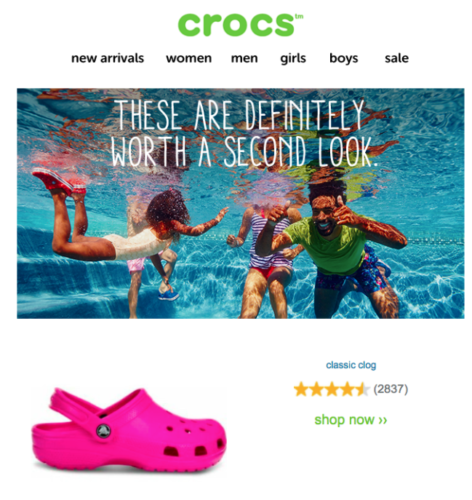
Social media, display, email and other targeted digital marketing campaigns can be a great way to reach more consumers this holiday season. To make yours stand out, add star ratings and review snippets to the advertisements.
For example, let’s say you’re a toy retailer promoting a new toddler learning toy that you’ve released in time for the holidays. You create a Facebook advertising campaign targeted at parents of toddlers. Then, you serve this audience an ad for this new toy that includes its average star rating, as well as text from a review written by a parent like them.
3. Add Star Ratings to Cart Abandonment Emails
If your shoppers are anything like me, they have no fewer than a million tabs open when they’re shopping for a gift. It’s easy to get distracted and leave the site without completing a transaction.
One effective way to bring shoppers back to your site to make a purchase is by sending cart abandonment emails. Adding star ratings and reviews for the items the consumer has in her cart can make these emails even more compelling. Bonus points if you include text from a review that mentions a product being a great gift.
4. Add Reviews to Holiday Signage
Ecommerce growth is expected to outpace that of overall retail this holiday season. But that doesn’t mean that consumers are completely steering clear of brick-and-mortar retail. In fact, physical stores still play a large role in the holiday shopping experience for many consumers. According to data from the National Retail Federation, 47% of shoppers say they browse physical stores to find gift ideas.
[bctt tweet=”47% of shoppers say they browse physical stores to find holiday gift ideas. ” username=”powerofreviews”]
If you have physical store locations, catch your shoppers’ attention by including star ratings and review snippets on your in-store signage. Doing this doesn’t have to be a big investment. Take a page out of Amazon’s book and display star ratings and customer reviews on signs alongside your products. And be sure to include this powerful content in your window displays to attract additional foot traffic.
5. Syndicate Your Content
Sometimes, a consumer will purchase an item directly from a brand’s ecommerce site. But in other cases, a consumer will make the purchase on the website of a retailer that carries the product. Review syndication — which is the distribution of user-generated content collected on brand sites to retail ecommerce sites — allows you to reach both types of consumers.
If you’re a brand who syndicates reviews, you’ll benefit from increased reach — your reviews get in front of more consumers on more websites. On the other hand, if you’re a retailer that accepts syndicated brand content, you get the benefits of having reviews on your site without having to generate them yourself. On average, retailers receive 58% of their review content from syndication.
[bctt tweet=”Retailers receive an average of 58% of their review content from syndication.” username=”powerofreviews”]
Consumers today have more shopping options than ever before. This holiday season, capture the attention of more shoppers by featuring UGC in more places. Best of luck!
There was a time, in the not so distant past, when the only option for purchasing groceries was to head to the local grocery store. Fast forward to today, and consumers have a growing number of online grocery shopping options.
Yet despite the growing number of choices, our recent survey of more than 1,000 U.S. consumers found that less than a quarter (17%) are purchasing groceries online today. However, as expected, we also found that consumers residing in larger cities are significantly more likely to purchase groceries online than their rural counterparts. Nearly a quarter (23%) of consumers living in a city with a population of 500,000 or more have made an online grocery purchase in the last 90 days, compared to 10% of consumers who reside in a town with a population of less than 50,000.
While these numbers may seem small, the number of consumers who choose to shop for groceries online will only continue to grow. Read on to find out what we learned about why consumers are opting to shop for groceries online and what information they’re using to make informed purchase decisions. By better understanding the grocery shopping habits of today’s consumers, you’ll be better equipped to develop strategies to effectively reach, convert and retain these shoppers across channels.
Consumers Shop Online to Save Time and Access Information Consumers lead busy lives and are always on the lookout for ways to maximize their time. So, as anticipated, saving time is the most popular reason consumers purchase groceries online, with 72% indicating it’s a key reason they choose to do so.
[bctt tweet=”72% of online grocery shoppers shop online to save time.” username=”powerofreviews”]
Shoppers also appreciate the access to information that online grocery shopping provides. 36% indicate that online shopping makes it easier to compare products and prices online, and 27% like that they can easily access information about products, including reviews.
Other top reasons for shopping for groceries online include avoiding impulse purchases that often happen in-store (30%) and avoiding the hassle of getting to a grocery store (23%).
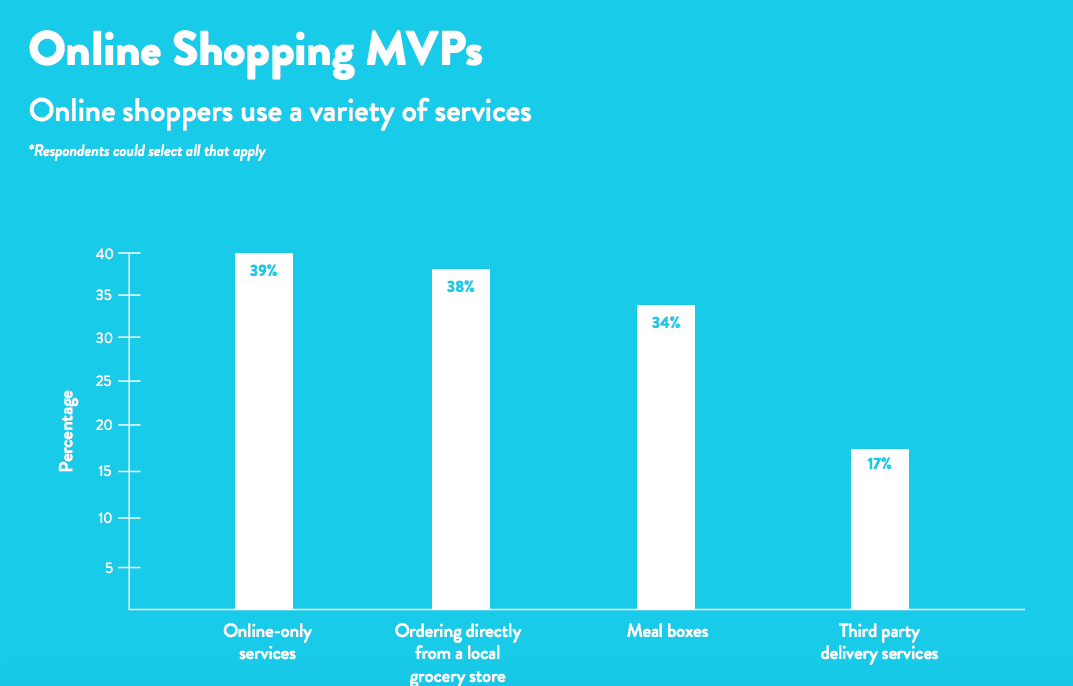
Shoppers Use a Variety of Online Grocery Services Depending on geographic area, there are a variety of online grocery shopping options available to consumers. Our research found that online-only services (think Peapod, AmazonFresh or Jet.com) are the most popular option — 39% of online grocery shoppers say they’ve used this type of service in the last 90 days. Following closely behind is ordering directly from a local grocery store for pickup or delivery (commonly referred to as click-and-collect), with 38% of online grocery shoppers using this service.
Meal boxes — such as HelloFresh and BlueApron — are another popular option, with 34% of online grocery shoppers using these services in the past 90 days. Surprisingly, only 17% of online grocery shoppers have used a third party service — such as Instacart — that pairs consumers with a personal shopper who purchases groceries from a local grocery store, then delivers them to the consumer’s home. This is likely because these services are often only available in densely populated metropolitan areas.
Shoppers Purchase a Variety of Grocery Items Online Grocery shopping is a sensory experience—much more so than other product categories. Consumers who shop in a store have the opportunity to touch, smell and even taste items to assess their quality and freshness. It’s much more difficult to judge the quality of fresh food items—such as meat and produce—when shopping online.
So it comes as no surprise that shelf-stable goods are the most popular grocery items to purchase online. 58% of online grocery shoppers purchase non-perishable packaged foods (such as cereal, canned soups and snack foods), 49% purchase personal care items (such as soap, shampoo and body wash) and 45% purchase home care items (such as detergent and cleaners).
But, as the survey results reveal, online grocery shoppers aren’t completely steering clear of fresh food purchases online. Nearly half (47%) of them shop online for fresh food, such as meat, produce and dairy. Other popular grocery items shoppers are purchasing online include frozen foods (32%), soft drinks (33%) and alcoholic beverages (12%).
Online Grocery Shoppers Read Reviews Ratings and reviews have become a key part of the path to purchase, regardless of what a consumer is shopping for. And our survey found that online grocery is no exception. If reviews are available on an online grocery service’s website, 93% of shoppers will read them at least occasionally. And most online grocery shoppers read them much more often. 19% of online grocery shoppers always read reviews for grocery items, and an additional 34% read them regularly.
Reviews Influence Online Grocery Shoppers Thanks to our previous research with Northwestern University, we know that reviews are especially impactful for new or unknown brands and products. It makes sense, then, that 72% of online grocery shoppers indicate that they are more likely to purchase a grocery item they’ve never purchased before if there are customer reviews for that product.
Online grocery shoppers are turning to reviews—and this content is influencing their purchases. Grocery retailers: make sure you have plenty of reviews available for plenty of your products, especially those that are new to market.
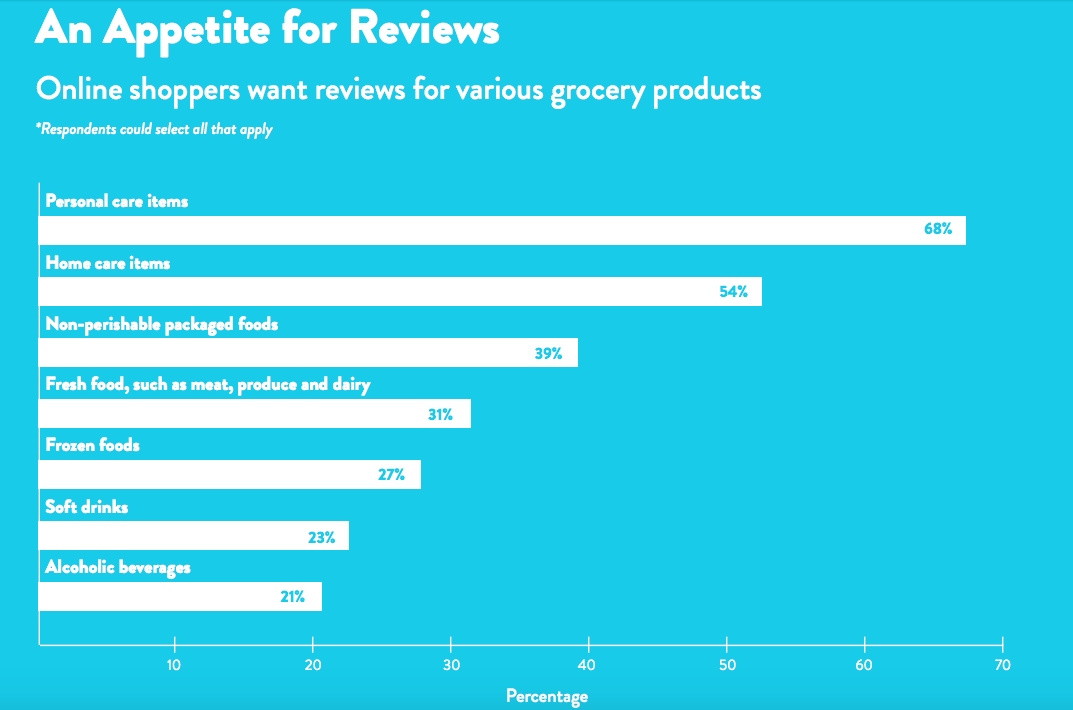
Shoppers Want Reviews for a Variety of Grocery Products Clearly, consumers are turning to reviews when they’re shopping online for groceries. But are they looking for reviews for specific types of grocery products more than others?
We found out that the top categories online shoppers want to access product reviews for are personal care items (68%), home care items (54%), non-perishable packaged foods (39%) and fresh food, such as meat, produce and dairy (31%). Other top categories include frozen foods (27%), soft drinks (23%) and alcoholic beverages (21%). Since consumers want reviews for a variety of products, it’s important to maximize your review coverage, which is the number of products in your catalog that have reviews.
Online Shoppers Want Reviews Directly on the Ecommerce Website or App Online grocery shoppers want to find reviews—and they don’t want to look hard to find them. Here’s the breakdown of where online shoppers prefer to find review content for grocery products.
53% want to find reviews directly on the website or app they’re using to purchase their groceries
38% want to find reviews on Amazon
9% want to find reviews on a third party review site
It’s key for grocery retailers to provide all of the information shoppers are looking for in one place. Retailers that don’t prominently feature product reviews directly on their website or mobile app risk losing shoppers to Amazon or another service that does.
Wrapping Things Up Today, less than a quarter of consumers are purchasing their groceries online. But this number will only continue to grow as options increase and consumers expect the convenience of online shopping. If you’re a grocery brand or retailer, now’s the time to develop a strategy to effectively reach shoppers across channels.