Today, according to Forrester Research, only 15% of apparel is purchased online. But as more and more consumers crave the convenience of browsing and shopping for just about everything online, the number of people shopping for apparel online is expected to grow. Amazon’s expansion into the online retail space will likely accelerate this growth.
According to a Morgan Stanley report, Amazon currently has a 7% market share of the apparel industry, but by 2020 that number is predicted to climb to 19%. During our recent monthly webinar, I shared five recommendations for apparel brands and retailers looking to leverage reviews in order to provide a differentiated experience to today’s information-hungry shoppers and avoid losing market share to Amazon. Read on for two of those recommendations.
Allow Consumers to Submit Photos & Video
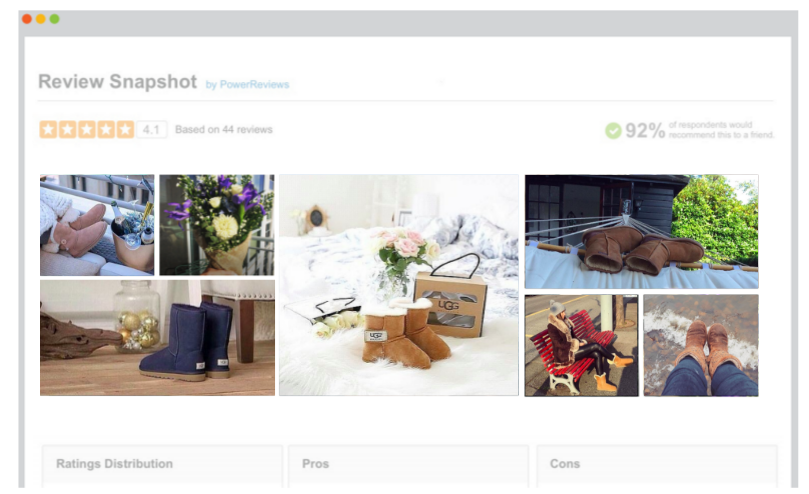
According to a survey from Body Labs, 23% of all clothing gets returned, and 64% of consumers say “incorrect fit” is the major reason for the return. In addition to collecting text reviews, encourage your shoppers to submit photos and videos of the products they’ve recently purchased.
Seeing images and videos of a product on a real person will allow future shoppers to understand how an apparel item fits on different body types, so they know what to expect when the item arrives. In addition, user-submitted photos and videos can also spark ideas for different ways to accessorize a piece of clothing, leading to more multi-item transactions.
If you don’t provide shoppers access to user-submitted photos and videos, they’re less likely to convert. A recent PowerReviews study found that 40% of Centennials (age 13-18) won’t purchase a product if there are no photos of people using the product. And if they do convert, there’s a good chance they’ll return the item once it arrives on their doorstep.
Generate Content Quickly
Apparel merchandise often moves on and off the shelves quickly, due to seasons changing or styles going in and out of fashion. For example, in most parts of the country, heavy winter jackets are only sold a few months of the year.
Since reviews play a powerful role in driving traffic and conversion, it’s key for apparel brands and retailers to generate quality reviews as quickly as possible. PowerReviews data has found that around 60% of reviews are written as a result of a post purchase email, which asks customers to review items they’ve recently purchased.
So be sure to send a mobile-friendly post purchase email to all consumers who make a purchase. In addition, while longer reviews provide valuable insights for shoppers and businesses alike, there’s great value in shorter reviews too, especially for products with a short shelf live.
Simply asking a shopper “Why Did You Buy?” immediately after purchase will provide you with additional content to drive traffic, sales, and insights.
Missed Our Apparel Webinar?
Did you miss our recent webinar on the importance of reviews for apparel brands and retailers? Hear all the tips I shared by watching the on-demand session.
In case you missed it, Google has changed the minimum number of Seller Ratings needed in order for a star rating to appear in your Google AdWords Campaign. Read on to learn more about the change, how it affects you, and how you can capitalize on this opportunity.
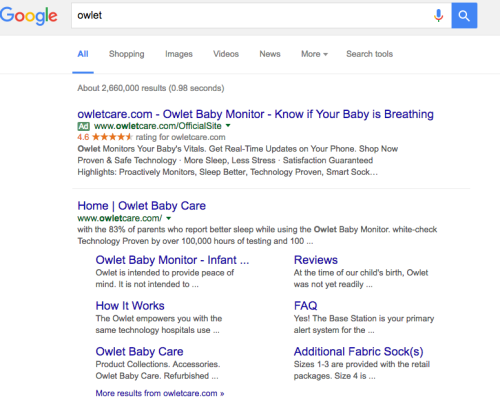
What Are Seller Ratings? Seller Ratings are a way to collect feedback from consumers about their overall shopping experience with a brand or a retailer. Google partners, such as PowerReviews, then share these ratings to Google, allowing star ratings to appear in your Google AdWords campaigns like the example below.
What Has Changed? Previously, Google required that a brand or retailer have at least 30 Seller Ratings from the past 12 months and an average star rating of 3.5 or higher in order for the star rating to appear in Google AdWords campaigns. Now, businesses must have 150 Seller Ratings from the past 12 months, with an average star rating of 3.5 or higher, in order for the star rating to appear in AdWord campaigns.
What Do You Need to Do? If you have 150 Seller Ratings from the past 12 months with an average star rating of 3.5 or higher, you won’t notice any changes. If you have fewer reviews, however, you’ll notice that the star ratings will disappear from your AdWords campaigns within the next couple weeks until you’ve collected the required 150 Seller Ratings. But don’t be discouraged! Instead, think of this change as an opportunity to engage with your customers to collect even more Seller Ratings.
At PowerReviews, we’ve found that the following best practices help brands and retailers collect the required 150 Seller Ratings needed in order for stars to appear in AdWords campaigns.
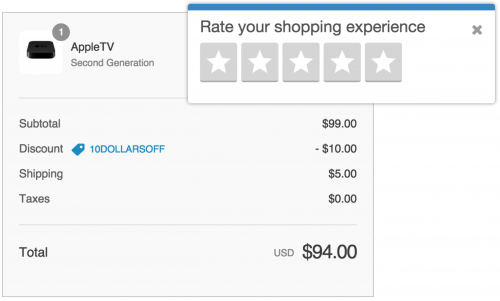
Ask for Feedback at the Right Time: There are three main components to a comprehensive Seller Rating — shopping experience, shipping, and service. Capture your shoppers’ attention and ask them questions when they’re in the context of each of these three components. For example, ask for feedback about the buying experience right after a purchase has been made, while the experience is still fresh in the mind of your consumer. Ask about shipping after the product has arrived, via a post purchase email. And ask for feedback about service after every experience over the phone or online.
Keep the Collection Process Simple: If you make the process of leaving Seller Ratings too complicated, your shoppers will likely abandon it all together. Rather than asking for lots of data, boil down each Seller Rating component to a simple star rating and open, qualitative feedback.
More Information About Seller Ratings Already a customer? If you’re an existing PowerReviews customer looking for ways to generate and leverage Seller Ratings, contact your Client Success Director or Community Manager.
Not yet a customer? If you’re not a current PowerReviews customer but are interested in learning more about how Seller Ratings can help you build consumer trust and increase conversion, contact us today.
But if you’re a small brand or retailer, how do you know when it’s time to invest in a ratings and reviews solution? Read on for four signs that you’re ready to add ratings and reviews to your site.
You’ve successfully built and launched your ecommerce site and now you’re looking for ways to grow your top-of-the-funnel traffic. Organic search is a great channel to invest in. According to our research, more than a third (35%) of shoppers are starting the purchase journey on a search engine, which points to the importance of having a strong presence on Google and other search engines.
[bctt tweet=”35% of shoppers start the purchase journey on a search engine.” username=”powerofreviews”]
Search engines love fresh and relevant content. One way to maintain a steady stream of fresh and relevant content is to host ratings and reviews on your site, where search engines can crawl the content and consumers can find it. This is a great way to help ensure your product pages are displaying in search engine results.
Plus, if your site is structured according to Schema.org standards (a single standard for structuring content on websites) and you have ratings and reviews, star ratings can appear with your product pages in the search results. These “rich snippets” catch the eye of shoppers, making them more likely to click through to your site.
Your Conversion Rate Needs a Boost
Your site traffic is growing, but your conversion rate is less than stellar. In other words, shoppers are finding your site, but they’re not converting. What gives?
Today’s consumers want as much information as they can about a product before they decide to purchase. And while your product descriptions and professional photos are a great place to start, consumers also want opinions from others like them, who have purchased and experienced a given product firsthand. That’s why it’s key to have ratings and reviews on your website, so shoppers can find this information without ever leaving your site.
What’s the risk if you don’t have reviews on your site? Shoppers will go elsewhere to find what they’re looking for and likely won’t return to your site. Nearly half (45%) of shoppers say they’ll turn to a search engine if there aren’t reviews (or aren’t enough reviews) for a product on a brand or retailer site. 25% say they will head to Amazon. And 20% will leave for another brand or retailer site.
You Need to Build A Strong Brand Presence on Retail Sites
If you sell your products through various retail channels, it’s important to build a strong brand presence there as well. Reviews gives you the opportunity to increase conversion wherever your products are sold.
You can do this by collecting and displaying reviews on your own site and then syndicating those reviews to your retail partners. This provides shoppers with the information they need to make smart purchase decisions regardless of the channel they’re using to shop.
You’re Looking for Ways to Improve Your Products and Website
In addition to driving traffic and conversion, product reviews can help you gather actionable insights about your products. For example, you can learn what features customers love and potential issues that can be fixed in the next iteration of the product.
Hammacher Schlemmer, a PowerReviews customer, noticed that a watch they sold on their website had an average star rating of 2.7. After digging into the reviews for the watch, the company noticed that several customers mentioned the clasp on the watch wasn’t working. Hammacher Schlemmer took this information to their manufacturer to change the clasp, and the average star rating for the watch climbed to 4.7.
Reviews can also be a great source of insights into ways to improve the content on your website. Room & Board, another PowerReviews customer, analyzed review content for their rug collection and noticed that several customers identified price as a negative. Armed with this information, Room & Board enhanced their product descriptions so customers could understand more about the quality of the rugs and why they were priced at the point they were.
Ready to start driving traffic, conversions, retail presence, and product insights with ratings and reviews? Find out which PowerReviews plan is best for you.
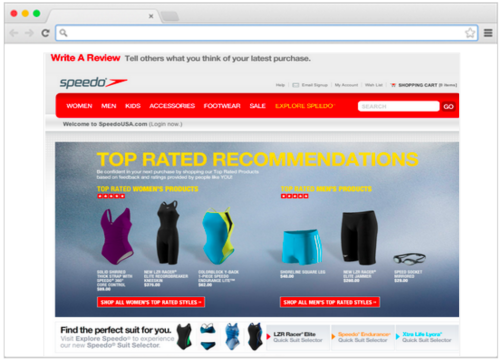
1. Display reviews throughout your site. Displaying reviews on your product pages is a great start, but don’t stop there. Look for opportunities to feature reviews on other parts of your website, too. For example, when Mother’s Day is approaching, feature your top rated gifts for mom on your homepage. Or, build landing pages that feature top rated products in a specific category, such as top rating men’s products or top rating women’s products.
2. Include reviews in digital marketing initiatives. Think about ways you can integrate reviews into your digital marketing initiatives, including email, display, and social media advertising. For example, let’s say you’re a baby products brand, running a Facebook targeted at expecting parents for a crib. Include the item’s star rating in the ad. Or, put together an email campaign for your customers that includes a roundup of that month’s top rated cribs.
3. Enhance traditional print advertising with reviews. If you run traditional print advertising, consider ways you can enhance your campaigns with ratings and reviews. For example, Duluth Trading Company, a PowerReviews customer, promotes the fact that their Buck Naked Underwear product has more than 12,000 5-star reviews by including this stat in various advertising campaigns.
4. Add reviews to in-store signage. PowerReviews research found that 70% of consumers are interested in accessing product ratings and reviews while shopping in-store. Take a page from Amazon’s book and include the star rating and written review for products you sell in your brick and mortar stores.
5. Syndicate your reviews to retailer sites. Brands can syndicate reviews to retailers to get their content in front of more consumers. And retailers can receive syndicated content from brands to improve their review coverage, without having to collect the content themselves.
One PowerReviews customer, a leading shoe brand, has collected over 65,000 reviews using PowerReviews. We’ve helped them syndicate their reviews to more than 5,000 product pages, and that content has been seen nearly a half million times in the last 3 months across our network. That plays a huge impact in driving sales throughout their retail channels.
It’s no secret that user-generated content, such as ratings and reviews and Q&A, have a big impact on website traffic and conversion. At PowerReviews, we’ve found that collecting and displaying ratings and reviews can increase online site-wide sales for brands and retailers up to 17%.
In most cases, a review is generated as a result of a relevant and actionable review request in the form of a post purchase email. This request asks a customer to write a review for a recently purchased product days after they’ve received it and had time to use it. However, in many retail sectors, merchandise moves on and off the shelves quickly. For these products, it’s key to generate user-generated content more quickly than a post purchase email allows — in hours or days rather than weeks. After all, if a customer waits a few weeks to write a review for a seasonal item like a swimsuit, that item may no longer be available or in-season.
With that in mind, PowerReviews developed a new product offering called Why Did You Buy. Why Did You Buy makes it easier for shoppers to provide feedback immediately after purchase, providing brands and retailers with additional content to drive traffic, sales, and insights.
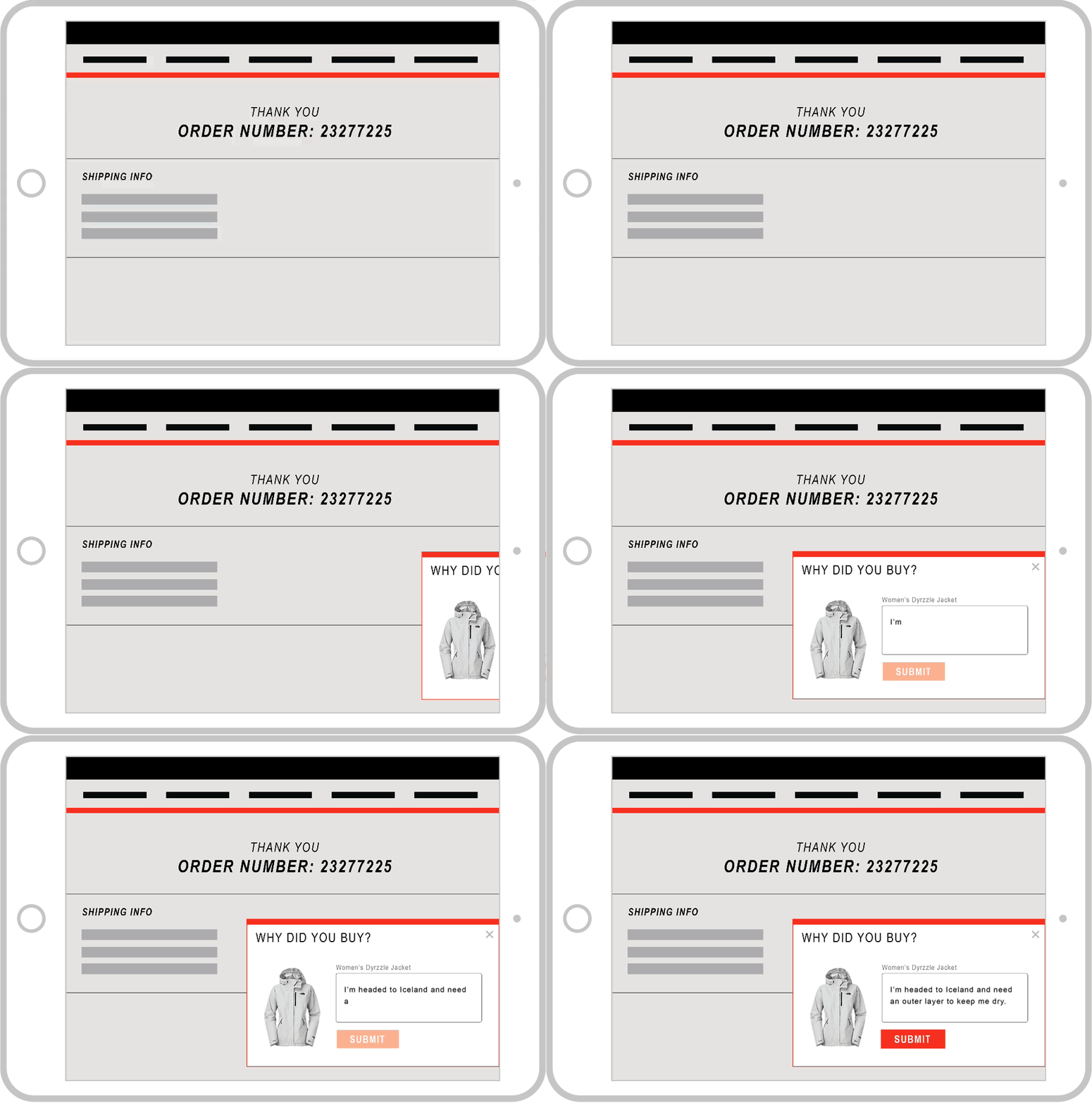
How it Works Imagine a customer purchases an item, such as a jacket, from your eCommerce site. Once the transaction is complete, the customer is taken to a thank you page. On that thank you page, the shopper is asked to provide feedback via a short, simple and mobile-friendly form by answering the simple question: Why Did You Buy?
All of the content submitted through Why Did You Buy then passes through our advanced fraud technology and our team of human moderators to ensure the content is authentic and fraud-free.
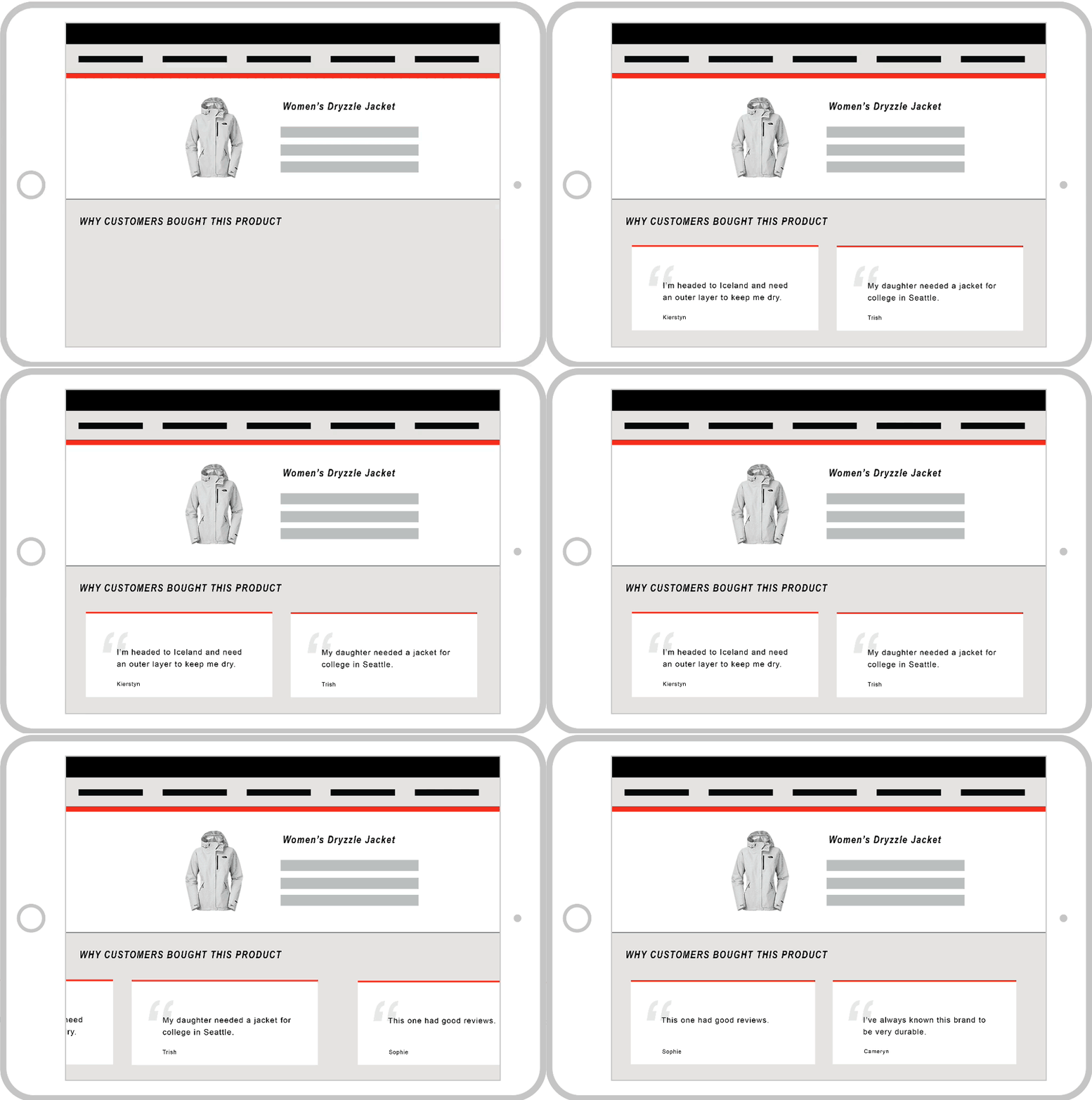
After moderation, content is displayed on product pages to help future shoppers understand the purchase intent of fellow consumers, which can give them the confidence they need to make well informed purchase decisions. For example, if a consumer is shopping for a jacket for an upcoming hiking trip and notices that other shoppers note that they purchased a particular jacket for a similar trip, she can confidently add the jacket to her shopping cart.
The content generated with Why Did You Buy boosts consumer engagement, which leads to greater conversion. In addition, this content provides businesses with insights to understand use cases and improve products.
What You Can Expect PowerReviews customers have seen some impressive results by adopting Why Did You Buy. During the program pilot, a leading activewear and outdoor sports gear brand achieved product coverage that was 65% higher than using a traditional review display alone. In addition, PowerReviews customers display four times more total content on their sites than they would without Why Did You Buy.
Start Collecting More Content, Faster Already a customer? Why Did You Buy can easily be added to PowerReviews’ Ratings and Reviews or Q&A solutions. If you’re an existing PowerReviews customer interested in generating more, high quality content faster with little effort on your part, contact your Client Success Director or Community Manager to learn more about Why Did You Buy.
Not yet a customer? If you’re not a PowerReviews customer but interested in learning more, contact us for a free demo.
Whether it’s in-store or online, apparel companies are always changing and adding inventory to offer consumers (every day, every week, every month, or at the very least, every season). While it’s great for consumers to have access to new products, the short shelf lives of fashion items poses a challenge for companies that want to quickly collect and display valuable user-generated content (UGC) from their consumers to help improve their conversion rates.
Consumers have come to expect UGC during their shopping journey. In fact, 86% of consumers say reviews are an essential resource when shopping. But with new items constantly getting added to shelves and sites, it’s difficult to collect high volumes of relevant content from consumers.
For traditional reviews (star rating, tags, and comments), it’s a best practice to send a write-a-review request to a consumer who bought a soft good 14 days after a purchase to give him time to receive the product and use it. At some clothing retailers, however, certain apparel items will only be offered for 2 weeks before it’s a new season or the items go on the sales rack.
Apparel companies know reviews and UGC are essential to consumers, but how can they collect more content and increase product coverage when inventory is constantly changing?
Check out the 4 reasons every apparel company should be using PowerReviews’ new Why Did You Buy offering on their websites.
1. You’ll collect and display content faster. According to recent research with Northwestern University, new products benefit most from UGC. With new items constantly getting added on apparel brand and retailer sites, it’s important to capture content on the newest products, as quickly as possible. Why Did You Buy does not use a post purchase email to ask consumers to write a review. Instead, when a consumer is on the purchase page, they’re prompted to leave a short sentence about why they chose to buy a product. Because the content is collected at the point of purchase, you’ll be able to display the content quickly for your future consumers to see.
2. You’ll collect more content. Why Did You Buy is designed to not only help you collect and display content faster, but also to enable higher content collection rates. Why Did You Buy complements your current review collection efforts by collecting additional content from your consumers immediately after purchase. Because the form is easy to use, you’ll be able to collect more unique pieces of content, helping you increase product coverage across your site.
3. You’ll reduce return rates. A quarter of consumers say they return products because they are not what they expect (2015). Why Did You Buy allows you to capture specific information from purchasers about why they chose to buy your product. This content helps consumers make better informed decisions and increases their confidence when they’re on your site looking to buy a product.
4. You’ll collect content from purchasers who bought your product as a gift. When you collect traditional reviews from your consumers, sometimes it doesn’t make sense for a gift buyer to write a review because they aren’t the end user. However, with Why Did You Buy, you can still collect relevant content from gift givers.
Interested in learning more about how Why Did You Buy can work for your business? Contact us for a demo. Or, if you’re an existing PowerReviews client, reach out to your Client Success Director to learn more.
In an ideal world, shoppers would navigate directly to your site anytime they were in the market for a product you sell. But the reality is, today’s consumers have nearly limitless options when it comes to researching and purchasing products. And in a vast majority of cases, they’re not starting their search directly on a brand or retailer site.
In fact, a recent PowerReviews study found that more than a third (35%) of shoppers choose to start the purchase journey on a search engine, compared to 21% that start directly on a brand or retailer site.
Why Your SEO Strategy Matters
This data sends a clear message to brands and retailers — if you want shoppers to find your product pages, it’s key to develop a strong search engine optimization (SEO) strategy. Many factors come into play when it comes to determining where your pages rank in search engine results.
Your company probably has someone on the team who focuses on many of these things, including freshness, keyword density, and inbound links, just to name a few. But one of the best ways to improve your SEO is to leverage the content that your users are already creating — including ratings and reviews and Q&A.
Read on to learn how brands and retailers can use reviews for SEO and how this content improves search engine presence, which will lead to more traffic and increased conversion.
Reviews Improve Ranking
Search engines prize fresh and relevant content. And a steady stream of ratings and reviews and Q&A can help keep your site’s content relevant and fresh with keyword-rich, permanent assets on your product pages. Then, search engines can crawl it which enables shoppers to find it.
Reviews Improve Click-Through
In 2011, major search engines including Google, Yahoo and Bing came together to create Schema.org, a single standard for structuring content on websites. Brands and retailers that adhere to Schema.org standards can benefit from an improved presence on search engines.
If a brand or retailer uses Schema.org standards, search engines can pull information from product pages and use it to enhance search results with what are called “rich snippets.”
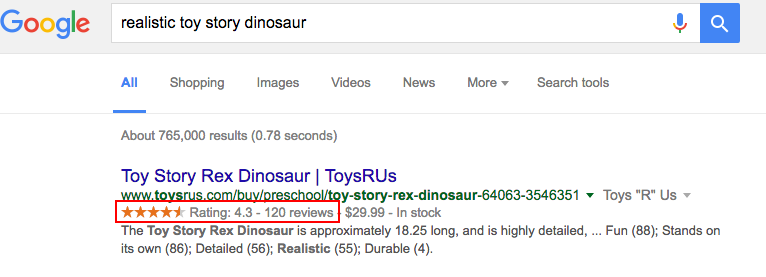
The most common type of rich snippets are star ratings and review counts. If your site is structured according to Schema.org standards and you have ratings and reviews, star ratings can appear when your product pages appear in search results. These rich snippets catch the attention of shoppers and significantly improve click-through rates.
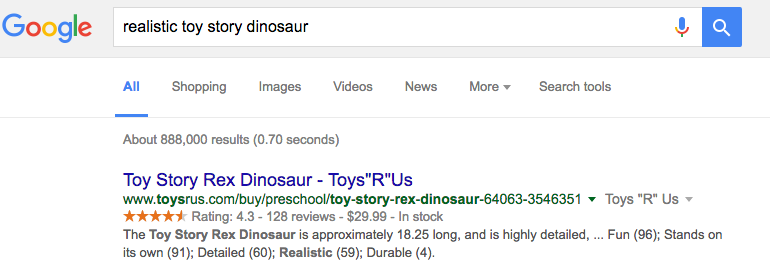
For example, let’s say you’re looking for a gift for your nephew, whose favorite movie is Toy Story. You navigate to Google and search for “realistic toy story dinosaur.” One of the top results is from Toys ‘R’ Us and includes a star rating and the number of reviews for the product. If you take a closer look, you can even see the pros, cons, and best uses listed below the star rating. You see that the toy has a great star rating, encouraging you to click through to the product page.
Are Your Reviews Structured Correctly?
We’ve found that more than 80% of brands and retailers are optimizing their content for crawlers. But around 30% are structuring it incorrectly.
But ensuring your site (including your reviews) is structured according to Schema.org standards doesn’t have to be overwhelming. In fact, if you’re an existing PowerReviews client and have our in-line SEO feature enabled, we do the heavy lifting for you.
Our in-line SEO feature essentially gives web crawlers the values they need to understand what your ratings and reviews content says.
If you’re a current PowerReviews customer, contact your Client Success Director or Community Manager to request in-line SEO be added to your account. And if you’re not currently a PowerReviews customer, contact us to learn more about how ratings and reviews can help improve your SEO.
Ratings and reviews are an important tool for driving more traffic and sales for apparel brands and retailers. In fact, we’ve found that once an apparel product in the PowerReviews network starts generating reviews, that product will experience an average 49.36% increase in traffic and an average 14.48% increase in conversion rate.
How can apparel brands and retailers better leverage reviews in order to increase traffic, conversion, and insights? Read on for five tips.
Capture the Voice of the Consumer Allowing apparel shoppers to hear from other consumers gives them the confidence they need to make smart purchases. Be sure you’re sending post purchase emails to shoppers asking them to write reviews for items they’ve recently purchased, since PowerReviews data has found that about 60% of reviews originate from these emails.
In addition, remember that many apparel orders include more than one item. According to an article from Internet Retailer, the average consumer purchases 4 apparel items per order. Make it easy for shoppers to review all products they’ve purchased within a single page, rather than requiring them to navigate to individual pages to write reviews for each product.
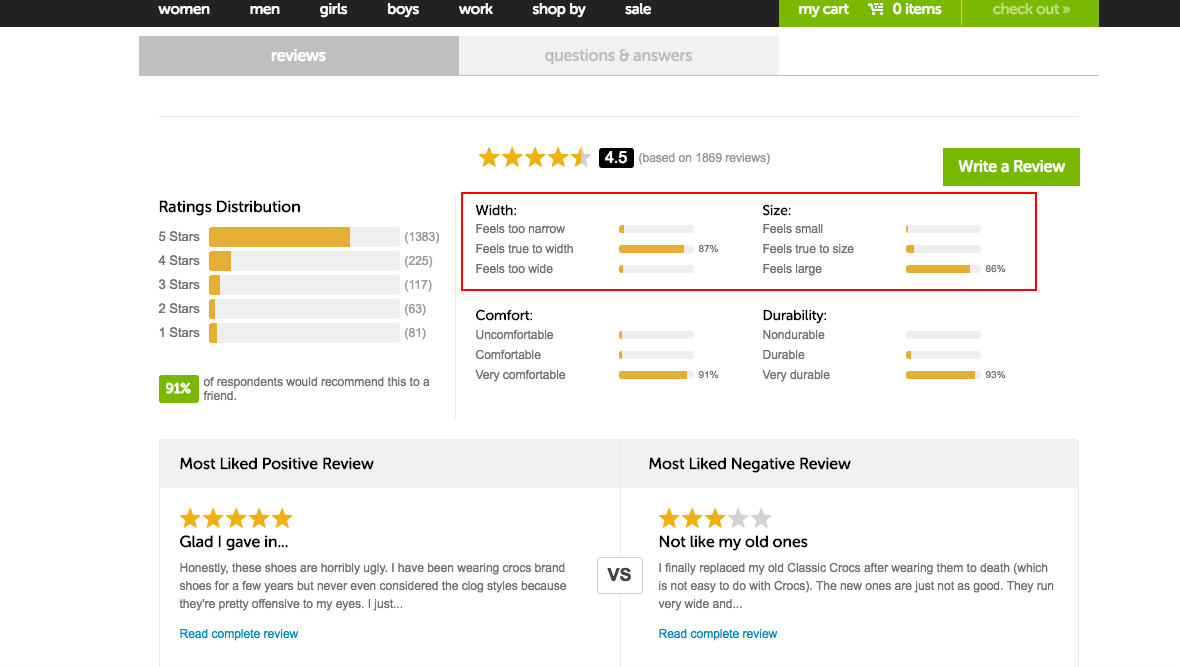
Highlight Size and Fit Feedback According to a survey from Body Labs, 64% of consumers say incorrect fit is the primary reason they return clothing. Avoid unnecessary returns by providing your shoppers with comprehensive information about the size and fit of your products, including the input of other shoppers. Ask your ratings and reviews provider if they offer an easy way to capture size and fit information from your consumers and display it on the product page to increase buyer confidence and help consumers make the right purchase decision.
Allow Consumers to Submit Photos and Videos Apparel is a visual category, and items look different on different people. If you’re not already, start asking your shoppers to submit photos and videos as part of their reviews. That way, future shoppers can see what your products look like on various body types and get ideas for different ways to accessorize.
Optimize for Mobile Shoppers are turning to reviews — whether they’re shopping online from a laptop computer or pulling out their phone prior to make a purchase in store. PowerReviews research found that 70% of consumers want to access products ratings and reviews while in-store. So be sure shoppers can easily access product information — including reviews — regardless of the device they’re using.
In addition, make sure the entire process for writing a review, from the post purchase email to the write-a-review form, is easy to complete on a mobile device. If a shopper gets hung up on any part of the process, they’re likely to abandon it completely. evo, a leading online retailer of outdoor gear and fashion apparel, switched to a mobile-friendly post purchase email template and experienced a 203% increase in reviews written on mobile year over year.
Generate Reviews Quickly Since apparel items move on and off the shelves quickly, it’s key for apparel brands and retailers to generate reviews as quickly as possible. After all, if a shopper waits too long to write a review, the product may not be available anymore. Consider collecting information at the time of checkout by asking the customer a simple question: “Why did you buy this item?” This makes it easier for your customers to provide feedback while they’re still in your ecosystem and provides you with additional content to help drive traffic, sales, and insights.
Reviews play a key role in increasing conversion rates for brands and retailers. So it comes as no surprise that one of the most common questions we hear from our customers is, “How can we collect more reviews?”
The best way to increase the number of reviews is to make the process of writing reviews as easy as possible for shoppers. It starts with sending shoppers a post purchase email, asking them to review items they’ve recently purchased. Make sure it’s mobile friendly, since more than 50% of consumers are reading emails on a mobile device.
But it can be challenging to get shoppers to write reviews for multiple items. That’s why PowerReviews developed a new product feature called Review Your Purchases, which streamlines the process for writing multiple reviews for products within the same transaction. This allows brands and retailers to generate more high quality content which can help drive traffic, conversion, and insights.
Why Review Your Purchases? More than 60% of the consumer orders coming through the PowerReviews network include more than one product. And for some categories, orders contain quite a few items. For example, the average apparel order includes 4 items.
But until now, if a consumer wanted to write reviews for multiple items in an order, they’d have to navigate to multiple pages to write each review. At PowerReviews, we saw this as a big missed opportunity for brands and retailers to collect more reviews and increase overall site coverage. That’s why we developed Review Your Purchases, which allows shoppers to quickly and easily review multiple products from one order (or throughout their purchase history) from a single screen.
How it Works Let’s say a customer purchases a camera, a 10 inch tablet, and a 10 pack of ballpoint pens, all in a single order. After the customer gets his items in the mail, he receives a post purchase email asking him to review all three of the products he purchased. He clicks through and is able to easily review all three products from a single page that looks like this:
As the shopper continues to purchase products from you over time, he can access a landing page that includes every product he’s ever purchased from you. And he can easily review any product he’s purchased right from that landing page.
Review Your Purchases makes the review collection process easier for your customers, so you can increase product coverage and generate a high volume of quality content that’ll help improve the performance of your ecommerce site.
What You Can Expect PowerReviews customers have seen some impressive results by adopting Review Your Purchases. During the program pilot, a major retailer experienced:
93% increase in reviews quarter over quarter
36% increase in product coverage
400% increase in review completion rates
And after they started using Review Your Purchases, a large sports retailer experienced:
75% increase in reviews collected year over year
252% increase in review completion rates quarter over quarter
Start Collecting More Reviews Already a customer? If you’re an existing PowerReviews customer interested in generating more, high quality content with little effort on your part, contact your Client Success Director or Community Manager to learn more about Review Your Purchases.
Not yet a customer? If you’re not a PowerReviews customer but interested in learning more, contact us for a free demo.